You are chatting with a friend, reading a social media comment, or helping a child with homework when you suddenly come across the word antonym. At first, it might seem like another complicated English term, but it is actually one of the easiest language concepts to understand. Once you know what it means, you’ll notice antonyms everywhere in books, conversations, and even online posts.
Learning the meaning of an antonym can improve your vocabulary, make your writing stronger, and help you understand English more clearly. In this guide, you’ll discover what an antonym means, where people use it, real examples, common alternatives, and answers to frequently asked questions.
What Does Antonym Meaning in Text?
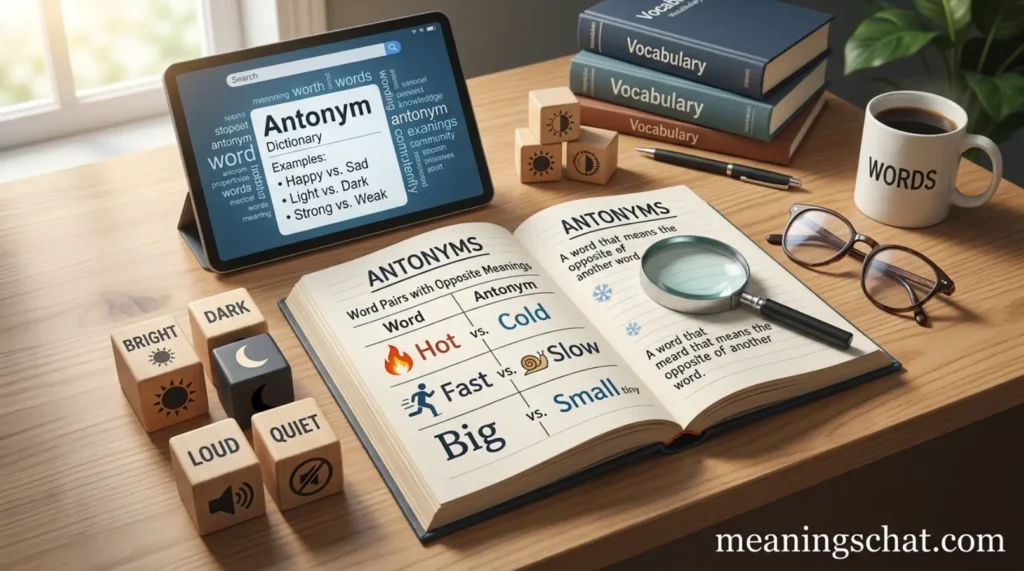
An antonym is a word that has the opposite meaning of another word.
For example:
- Hot → Cold
- Happy → Sad
- Fast → Slow
- Big → Small
- Open → Closed
Simply put, if two words express completely opposite ideas, they are antonyms.
People often use the word “antonym” while learning English, reading books, solving quizzes, or discussing grammar. Unlike internet slang or texting abbreviations, “antonym” is a standard English grammar term used in both casual and formal settings.
Simple Definition
Antonym means a word with the opposite meaning of another word.
Can Antonym Have More Than One Meaning?
The word antonym itself has only one meaning. However, many words have multiple antonyms depending on the context.
For example:
Word: Light
Possible antonyms:
- Dark (brightness)
- Heavy (weight)
This is why understanding the sentence is important before choosing the correct antonym.
Where Is Antonym Used?
Unlike texting abbreviations, antonym appears in many different places because it is a grammar concept.
School and Education
Teachers often ask students to write antonyms during English lessons.
Example:
“Write the antonym of ‘strong.'”
Dictionaries
Most dictionaries include antonyms to help readers understand words better.
Homework and Exams
English tests frequently ask students to match words with their antonyms.
Example:
Choose the antonym of “increase.”
Writing
Writers use antonyms to create contrast and make sentences more interesting.
Example:
“The room was once noisy but now completely quiet.”
Everyday Conversations
People also use the word while discussing vocabulary.
Example:
“Do you know the antonym of generous?”
Online Learning
Many educational websites, YouTube lessons, and language-learning apps teach antonyms to help learners improve vocabulary.
Examples of Antonym in Conversation
Here are some natural conversations showing how people use the word.
Example 1
Ali: What’s the antonym of “early”?
Sara: It’s “late.”
Example 2
Teacher: Can anyone tell me the antonym of “kind”?
Student: “Cruel.”
Example 3
Friend: I always confuse synonyms and antonyms.
You: Synonyms have similar meanings. Antonyms have opposite meanings.
Example 4
Parent: What’s the opposite of “empty”?
Child: “Full.”
Example 5
Student: I need help with my English assignment.
Friend: Which antonyms are you looking for?
Example 6
Teacher: Find the antonym of “accept.”
Student: “Reject.”
Example 7
Friend: My vocabulary keeps growing because I learn new antonyms every day.
When to Use and When Not To Use Antonym
Knowing when to use the word “antonym” is just as important as knowing its meaning.
When You Should Use It
Use “antonym” when:
- Talking about English grammar
- Learning vocabulary
- Teaching students
- Solving crossword puzzles
- Writing educational content
- Studying for language exams
- Reading dictionaries
When You Should Not Use It
Avoid using the word if people are unfamiliar with grammar terms and simply want the opposite word.
Instead of saying:
“What is the antonym?”
You can simply ask:
“What is the opposite word?”
This sounds easier for young learners or beginners.
Is It Formal or Casual?
The word “antonym” works in both formal and casual situations.
Formal:
“The antonym of success is failure.”
Casual:
“What’s the antonym of tiny?”
Because it is a standard English word, it is perfectly acceptable in classrooms, workplaces, books, and conversations.
Common Types of Antonyms
English has several kinds of antonyms.
Gradable Antonyms
These describe opposite ends of a scale.
Examples:
- Hot and Cold
- Young and Old
- Tall and Short
- Rich and Poor
Complementary Antonyms
Only one of the two can be true.
Examples:
- Alive and Dead
- True and False
- Present and Absent
- On and Off
Relational Antonyms
These words describe opposite relationships.
Examples:
- Buy and Sell
- Parent and Child
- Teacher and Student
- Employer and Employee
Understanding these categories helps improve vocabulary and reading comprehension.
Why Are Antonyms Important?
Antonyms help people understand language more effectively.
Benefits include:
- Improve vocabulary
- Make writing more interesting
- Strengthen reading skills
- Help explain word meanings quickly
- Improve communication
- Prepare for English exams
- Increase confidence while speaking English
Many language learners study antonyms every day because they make new vocabulary easier to remember.
Difference Between Antonyms and Synonyms
People often confuse these two grammar terms.
| Antonyms | Synonyms |
|---|---|
| Opposite meanings | Similar meanings |
| Happy → Sad | Happy → Joyful |
| Fast → Slow | Fast → Quick |
| Begin → End | Begin → Start |
| Win → Lose | Win → Triumph (context) |
A simple trick is:
Synonyms are similar. Antonyms are opposite.
Popular Examples of Antonyms
Here are some common opposite word pairs.
| Word | Antonym |
|---|---|
| Happy | Sad |
| Big | Small |
| Strong | Weak |
| Rich | Poor |
| Begin | Finish |
| Love | Hate |
| Open | Close |
| Early | Late |
| Empty | Full |
| Young | Old |
| Honest | Dishonest |
| Light | Dark |
| Victory | Defeat |
| Accept | Reject |
| Laugh | Cry |
Learning these pairs makes English much easier.
Similar Grammar Terms or Alternatives
Although “antonym” is unique, these related language terms are often learned alongside it.
Synonym
Words with similar meanings.
Example:
Happy → Cheerful
Homonym
Words that sound alike or have the same spelling but different meanings.
Example:
Bat (animal)
Bat (sports equipment)
Homophone
Words that sound the same but have different spellings.
Example:
Sea
See
Prefix
Letters added before a word to change its meaning.
Example:
Happy
Unhappy
Vocabulary
The collection of words someone knows and uses.
Building vocabulary becomes easier when you study antonyms and synonyms together.
Tips for Learning Antonyms Faster
Here are a few simple ways to remember antonyms.
- Learn words in opposite pairs.
- Read English books regularly.
- Use flashcards.
- Practice quizzes.
- Write your own example sentences.
- Play vocabulary games.
- Read one new word every day.
These habits can improve your English naturally.
Common Mistakes People Make
Many learners make these mistakes.
Confusing Synonyms and Antonyms
Remember:
Synonyms = Similar
Antonyms = Opposite
Choosing the Wrong Opposite
Some words have different antonyms depending on context.
Example:
Light
Brightness → Dark
Weight → Heavy
Memorizing Without Context
Always learn antonyms by reading complete sentences instead of isolated words.
FAQs
What does antonym mean from a girl?
The meaning does not change based on who says it. It simply refers to a word with the opposite meaning of another word.
Is antonym slang?
No. Antonym is a formal English grammar term, not internet slang or a texting abbreviation.
Can I use antonym in professional chats?
Yes. It is appropriate in educational, academic, and professional discussions about language.
Does antonym have any flirty meaning?
No. Antonym has no romantic or flirty meaning. It is only used when discussing vocabulary and grammar.
Is antonym still popular in 2025?
Yes. Students, teachers, writers, and English learners continue to use the word regularly because it remains an essential part of learning English.
Conclusion
Understanding antonym meaning is an important step toward building a stronger English vocabulary. An antonym is simply a word with the opposite meaning of another word, making it easier to understand language, improve writing, and communicate clearly. You’ll find antonyms in classrooms, books, dictionaries, online learning platforms, and everyday conversations. By practicing opposite word pairs regularly, you can remember new vocabulary more easily and use English with greater confidence.

William Jones is a dedicated writer at Meaningschat who specializes in explaining text slang, abbreviations, and online language trends. He enjoys creating simple, engaging, and reader-friendly content that helps people understand modern digital communication with ease. His writing style is clear, conversational, and informative, making complex internet terms easy for everyone to follow. In his free time, William loves exploring social media trends, reading about digital culture, and discovering how online language continues to evolve.