
You are scrolling through a document, reading a legal paper, or chatting with someone online when you suddenly notice the word annex. At first, it might seem like internet slang or a texting abbreviation, leaving you wondering if you’re missing a hidden meaning. Many people search for annex meaning after seeing it in emails, official documents, or social media discussions.
The good news is that annex is not actually a modern text slang term. Instead, it is a standard English word with several meanings depending on the situation. It commonly appears in business, law, education, government, and even geography. Understanding its different uses will help you avoid confusion and use the word correctly.
What Does Annex Mean in Text?
The annex meaning depends on the context in which it appears. Unlike abbreviations such as LOL or BRB, annex is a complete English word.
Here are its most common meanings:
1. An Attachment to a Document
This is the most common meaning.
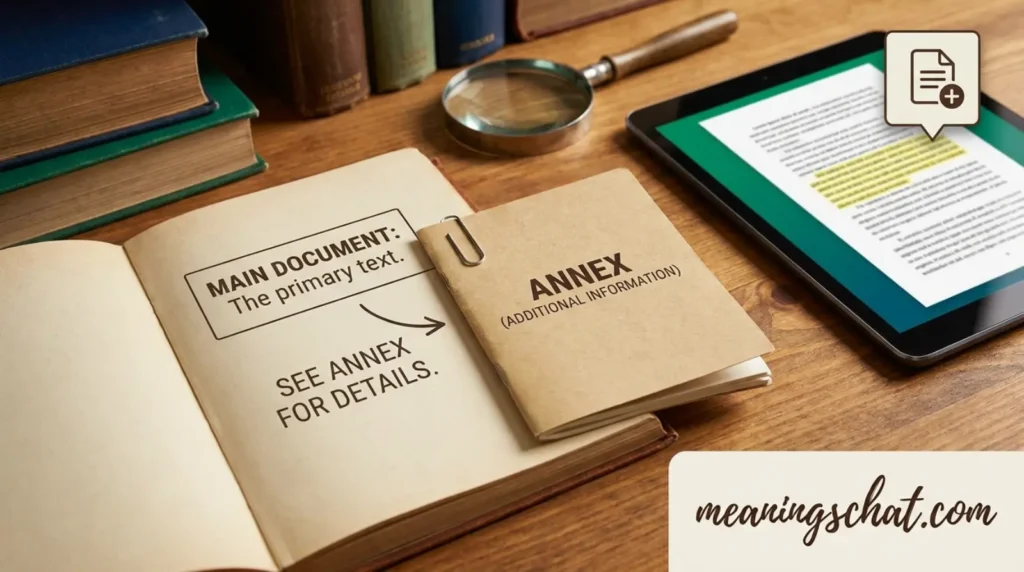
An annex is additional information attached to the end of a report, contract, agreement, or research paper. It contains supporting details that are useful but not necessary in the main document.
Example:
“Please see Annex A for the full survey results.”
In this case, Annex A includes extra information that supports the report.
2. A Separate Building
An annex can also mean a building connected to or located near the main building.
Example:
“The conference will be held in the hotel annex.”
The annex is simply another part of the property.
3. To Take Control of Land
As a verb, annex means to officially take control of land or territory.
Example:
“The country attempted to annex the neighboring region.”
This meaning often appears in history and political news.
Is Annex a Text Slang?
No.
People do not use annex as a texting abbreviation like:
- LOL
- OMG
- BRB
- TTYL
If someone writes annex in a message, they usually mean an attached document or extra information.
Where Is Annex Used?
The word annex appears in many different situations.
Business Emails
Professionals often attach contracts, reports, and supporting files called annexes.
Example:
“Please review Annex B before signing.”
Legal Documents
Lawyers regularly use annexes to organize evidence or supporting information.
Academic Writing
Students and researchers include annexes for questionnaires, interview transcripts, or raw data.
Government Documents
Official reports frequently contain multiple annexes for additional details.
Text Messages
Although uncommon, someone might text:
“I’ve sent the annex.”
They usually mean an attached file or document.
Social Media
The word occasionally appears in discussions about history, politics, or business but is not considered internet slang.
Examples of Annex in Conversation
Here are some natural examples.
Example 1
Alex: Did you send the report?
Emma: Yes, don’t forget to read Annex A.
Example 2
Manager: The financial details are in the annex.
Employee: I’ll check them now.
Example 3
Student: Where are the interview questions?
Professor: They’re included in the annex.
Example 4
Friend: Why is everyone talking about annexing territory?
Friend 2: It’s related to international politics.
Example 5
Client: I can’t find the pricing details.
Consultant: Please look at Annex C.
Example 6
Teacher: Everything you need is in the annex.
Student: Thanks, I’ll read it tonight.
Example 7
Reporter: The agreement includes several annexes.
Editor: Make sure we mention them in the article.
When to Use and When Not to Use Annex
Understanding the right situation makes using annex much easier.
Use Annex When
You are discussing:
- Business reports
- Contracts
- Research papers
- Legal agreements
- Government documents
- Additional attachments
- Extra supporting information
Examples:
“The figures are in the annex.”
“Please read Annex D.”
Avoid Using Annex When
Don’t replace common texting abbreviations with annex.
Instead of writing:
“Annex later.”
Write:
“Talk later.”
or
“See you later.”
Similarly, avoid using annex when chatting casually unless you’re actually referring to an attachment or document.
Is Annex Friendly, Casual, Professional, or Flirty?
Professional
Yes.
This is where the word appears most often.
Examples include:
- Office emails
- Contracts
- Reports
- Company documents
Casual
Sometimes.
Friends may use it if they’re discussing homework, files, or shared documents.
Example:
“The answers are in the annex.”
Friendly
Yes.
The word itself has no emotional tone.
Flirty
No.
Annex has no romantic or flirty meaning.
Rude
No.
It is completely neutral.
Does Annex Have Multiple Meanings?
Yes.
The word has several accepted meanings.
Document Attachment
Extra information placed at the end of a document.
Building
An additional building connected to another.
Political Action
To officially take possession of territory.
The surrounding sentence usually makes the meaning obvious.
Why Do People Search for Annex Meaning?
People often encounter the word in places they don’t expect.
Common reasons include:
- Reading contracts
- Government paperwork
- School assignments
- Business emails
- News reports
- International politics
- Legal documents
Because it isn’t used every day in casual conversation, many people search for its meaning online.
Annex Meaning in Business
Business professionals use annexes to organize information without making reports too long.
Typical annexes include:
- Charts
- Financial tables
- Project schedules
- Contracts
- Technical specifications
Instead of placing every detail inside the report, writers add them as annexes.
Annex Meaning in Legal Documents
Legal documents frequently contain annexes.
Examples include:
- Property agreements
- Employment contracts
- Lease agreements
- Court documents
An annex provides supporting material that forms part of the official document.
Annex Meaning in Education
Schools and universities often ask students to include annexes.
Examples:
- Survey questions
- Interview transcripts
- Research data
- Maps
- Images
This keeps the main assignment clear while preserving important information.
Annex Meaning in History
In history, annex usually means adding territory to another country.
Example:
“One nation annexed another region.”
This meaning appears in many history books and international news articles.
Common Mistakes About Annex
Many people misunderstand the word.
Mistake 1
Thinking it is internet slang.
It is not.
Mistake 2
Confusing annex with appendix.
While similar, an appendix usually provides extra explanatory information, while an annex often contains official supporting documents.
Mistake 3
Using annex instead of attachment.
Although similar, “attachment” is generally preferred in everyday emails.
Similar Words or Alternatives
Here are several words related to annex.
Attachment
A file added to an email.
Appendix
Additional information placed at the end of a document.
Supplement
Extra material that supports the main content.
Exhibit
Evidence included in legal documents.
Enclosure
Documents sent together with a letter.
FAQs
What does annex mean from a girl?
It has the same meaning regardless of who uses it. It usually refers to an attachment, document, or additional information.
Is annex slang?
No. Annex is a standard English word rather than internet slang.
Is annex rude?
No. It is completely neutral and polite.
Can I use annex in professional chats?
Yes. It is commonly used in business, legal, academic, and government communication.
Does annex have any flirty meaning?
No. The word has no romantic or flirtatious meaning.
Is annex still commonly used in 2025?
Yes. It remains widely used in business documents, contracts, academic papers, legal writing, and official communication around the world.
Conclusion
The annex meaning is much simpler than many people expect. It is not a texting abbreviation or social media slang. Instead, it is a standard English word that usually refers to extra information attached to a document, a separate building connected to a larger one, or the act of adding territory to another country. Once you understand the context, the meaning becomes clear. If you see annex in an email, report, contract, or conversation, you can now recognize exactly what it means and use it confidently.

William Jones is a dedicated writer at Meaningschat who specializes in explaining text slang, abbreviations, and online language trends. He enjoys creating simple, engaging, and reader-friendly content that helps people understand modern digital communication with ease. His writing style is clear, conversational, and informative, making complex internet terms easy for everyone to follow. In his free time, William loves exploring social media trends, reading about digital culture, and discovering how online language continues to evolve.