Have you ever been reading a message, article, or social media post and come across the word equivalent, then wondered what it actually meant? You’re not alone. Many people see this word in conversations, schoolwork, business emails, or even online chats without fully understanding how to use it correctly. The good news is that the meaning is much simpler than it first appears.
In everyday English, equivalent is not a slang term or texting abbreviation. Instead, it is a common vocabulary word that describes two things that have the same value, meaning, purpose, or effect. In this guide, you’ll learn the equivalent meaning, where people use it, real conversation examples, common alternatives, and the best situations to use it with confidence.
What Does Equivalent Mean in Text?
The equivalent meaning is something that is equal or has the same value, purpose, importance, or effect as something else.
When someone says two things are equivalent, they mean they can be compared because they are essentially the same in a particular way.
For example:
- “$10 is roughly the equivalent of €9.”
- “A bachelor’s degree is the equivalent qualification for this job.”
- “LOL is often considered the equivalent of laughing in real life.”
Unlike internet abbreviations such as LOL or BRB, equivalent is a standard English word. It appears in everyday conversations, education, science, mathematics, business, and online discussions.
Different Meanings of Equivalent
Depending on the situation, equivalent can mean:
- Equal in value
- Equal in amount
- Equal in importance
- Equal in function
- Similar in purpose
- Matching another item or idea
Here are a few examples:
- Two products with the same quality are equivalent.
- Two exam scores may be considered equivalent.
- One currency may have an equivalent value in another currency.
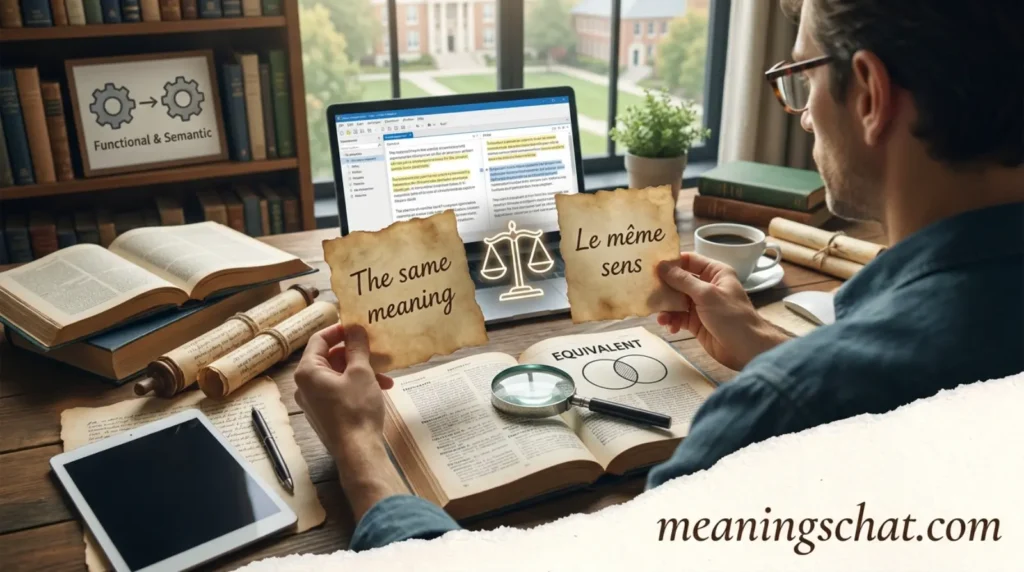
- One phrase in another language may have an equivalent meaning.
The exact meaning depends on the context.
Where Is Equivalent Used?
The word equivalent is widely used across many situations both online and offline.
Text Messages
Friends may compare items or experiences.
Example:
“This phone is the equivalent of last year’s model.”
Social Media
People often compare products, trends, or experiences.
Example:
“This movie is basically the equivalent of the original.”
School
Teachers and students use equivalent when discussing:
- Math
- Science
- Grammar
- Vocabulary
- Literature
Example:
“These fractions are equivalent.”
Business
Companies compare salaries, products, qualifications, or services.
Example:
“Your experience is equivalent to five years in management.”
Gaming
Gamers compare weapons, characters, or equipment.
Example:
“This sword is the equivalent of the legendary weapon.”
Everyday Conversations
People use equivalent whenever comparing similar things.
Example:
“Walking for thirty minutes is roughly equivalent to burning 150 calories.”
Examples of Equivalent in Conversation
Here are realistic examples showing how people naturally use the word.
Friendly Conversation
Alex: Is this drink the same as the expensive one?
Sam: Yes, it’s basically the equivalent.
Shopping
Emma: I can’t afford that brand.
Lily: This cheaper one is the equivalent quality.
School
Teacher: These two fractions are equivalent.
Student: So they have the same value?
Teacher: Exactly.
Work
Manager: Your previous role is equivalent to this position.
Employee: Great. That makes the transition easier.
Online Chat
Jake: What’s the English equivalent of this word?
Mia: It means almost the same thing.
Fitness Discussion
Chris: Is cycling as good as running?
Taylor: It’s an equivalent workout for many people.
Travel
Sara: What’s the dollar equivalent of this price?
David: Around twenty dollars.
When to Use and When Not to Use Equivalent
Knowing when to use this word makes communication much clearer.
Use Equivalent When
- Comparing two similar things
- Talking about equal value
- Explaining similar meanings
- Comparing qualifications
- Discussing money or measurements
- Translating between languages
- Explaining educational levels
Examples:
- “This certificate is equivalent to a diploma.”
- “Five kilometers is equivalent to about three miles.”
Avoid Using Equivalent When
- You’re talking casually with young friends who may simply say “same.”
- You’re describing completely different things.
- The comparison is only an opinion instead of a factual similarity.
- You’re trying to sound informal in quick text messages.
Instead of saying:
“Your pizza is equivalent to mine.”
Many people simply say:
“Your pizza is basically the same as mine.”
Is Equivalent Formal or Casual?
The word equivalent is considered neutral.
That means it works well in both formal and informal situations.
Formal
- Business emails
- School assignments
- Academic writing
- Professional reports
- Research papers
Casual
- Text messages
- Social media
- Conversations with friends
- Online forums
Because it is standard English, you can safely use it almost anywhere.
Does Equivalent Have Multiple Meanings?
Yes.
Although the main idea stays the same, the meaning changes slightly depending on the context.
Equal Value
“This coupon has the equivalent value of $20.”
Equal Function
“This software is the equivalent of the paid version.”
Equal Meaning
“This English word has no exact equivalent in Japanese.”
Equal Qualification
“My diploma is equivalent to a bachelor’s degree.”
Equal Measurement
“One liter is equivalent to 1,000 milliliters.”
Similar Words and Alternatives
If you want to avoid repeating equivalent, here are several useful alternatives.
Equal
Having the same value or amount.
Example:
“Both offers are equal.”
Same
Exactly alike.
Example:
“We bought the same shoes.”
Comparable
Similar enough to compare.
Example:
“These products are comparable.”
Matching
Corresponding with another item.
Example:
“The colors are matching.”
Similar
Nearly the same but not identical.
Example:
“Their opinions are similar.”
Identical
Exactly the same.
Example:
“The twins wore identical jackets.”
Common Mistakes When Using Equivalent
Many English learners make these mistakes.
Confusing Equivalent With Identical
Equivalent means equal in value or purpose.
Identical means exactly the same.
Example:
A bicycle and public transportation may provide equivalent ways to travel.
They are not identical.
Using It Without Comparison
Equivalent almost always compares two things.
Incorrect:
“This phone is equivalent.”
Better:
“This phone is equivalent to the newer model.”
Thinking It Is Slang
Equivalent is not internet slang.
It is a regular English vocabulary word used worldwide.
Why Is Equivalent Important?
Learning this word improves communication because it helps you:
- Compare products
- Explain ideas
- Understand translations
- Discuss education
- Describe qualifications
- Compare prices
- Talk about measurements
It is one of the most useful comparison words in English.
Equivalent Meaning in Different Situations
In Mathematics
Equivalent means having the same value.
Example:
1/2 and 2/4 are equivalent fractions.
In Science
Equivalent often refers to equal measurements or chemical values.
Example:
Equivalent weight is a scientific term.
In Business
Companies compare salaries, job positions, and experience.
Example:
“This certification is equivalent to three years of work experience.”
In Language
Translators search for the equivalent word in another language.
Example:
“There isn’t an exact English equivalent.”
In Shopping
Customers compare products.
Example:
“This budget phone is the equivalent of the premium model.”
Tips for Using Equivalent Correctly
Here are a few easy tips.
- Compare two things.
- Explain what is equal.
- Use “equivalent to” for clear sentences.
- Avoid using it alone.
- Remember it is a standard English word, not slang.
Examples:
- “This degree is equivalent to a master’s qualification.”
- “The new model is equivalent to the previous version.”
- “The euro equivalent is around fifty dollars.”
FAQs
What does equivalent mean from a girl?
It has the same meaning regardless of who uses it. It simply refers to something that is equal or similar in value, meaning, or purpose.
Is equivalent slang?
No. Equivalent is a standard English vocabulary word rather than internet slang or a texting abbreviation.
Can I use equivalent in professional chats?
Yes. It is appropriate for business emails, workplace conversations, academic writing, and professional communication.
Does equivalent have a flirty meaning?
No. The word itself has no romantic or flirty meaning. Any emotional tone comes from the rest of the conversation.
Is equivalent still commonly used in 2025?
Yes. Equivalent remains a common word in education, business, social media, online discussions, and everyday English.
Conclusion
The equivalent meaning is simple once you understand it. It refers to something that has the same value, purpose, function, or meaning as something else. Unlike internet slang, equivalent is a standard English word that fits both casual conversations and professional communication. You will often see it in texting, school, business, translations, mathematics, and daily life. The next time you come across the word, remember that it is simply helping compare two things that are equal in an important way.

William Jones is a dedicated writer at Meaningschat who specializes in explaining text slang, abbreviations, and online language trends. He enjoys creating simple, engaging, and reader-friendly content that helps people understand modern digital communication with ease. His writing style is clear, conversational, and informative, making complex internet terms easy for everyone to follow. In his free time, William loves exploring social media trends, reading about digital culture, and discovering how online language continues to evolve.