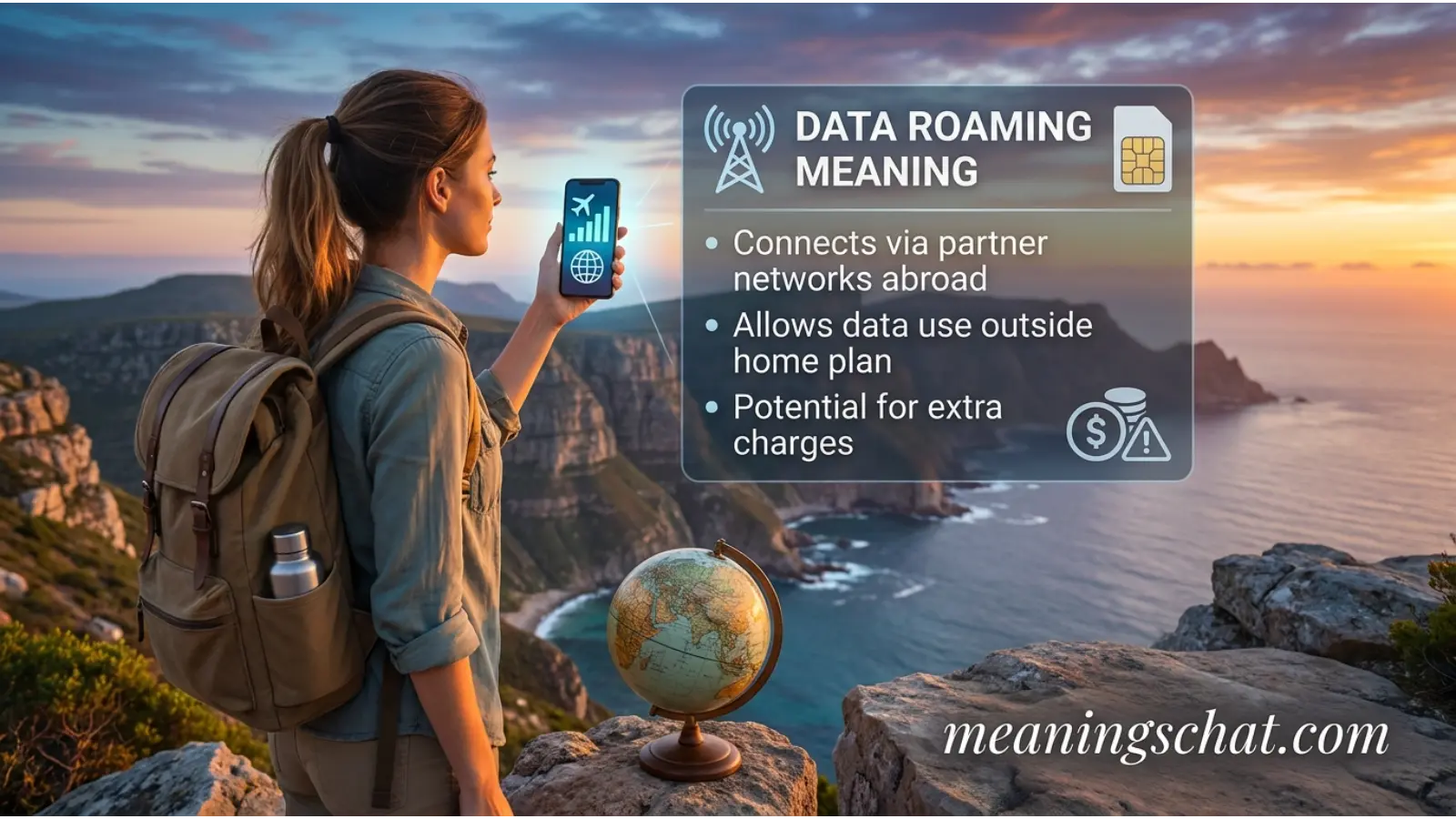
Data roaming meaning usually refers to using your mobile internet connection when your phone connects to a network outside your normal carrier’s coverage area, often while traveling to another country. If you have ever seen “Data Roaming” in your phone settings or received a message about roaming charges, you may have wondered what it actually means.
The term can sound technical, but the basic idea is simple. Your phone normally uses your carrier’s network for mobile data. When you travel somewhere your carrier does not directly operate, your phone may connect to a partner network so you can still browse the internet, use apps, receive messages, and access online services.
Understanding data roaming can help you avoid unexpected mobile charges, especially during international travel.
Quick Answer:
Data roaming means using mobile data through another network when your regular carrier’s network is unavailable, commonly while traveling. It can work automatically, but extra charges may apply depending on your mobile plan.
What Does Data Roaming Meaning in Text Refer To?
The phrase data roaming meaning in text does not normally represent internet slang or a texting abbreviation. Instead, it describes a mobile phone feature related to cellular data.
When your phone leaves your carrier’s regular network area, it can sometimes connect to another carrier’s network. This arrangement allows you to continue using mobile internet.
For example, imagine you have a mobile plan from a carrier in the United States and travel to France. Your usual carrier may not have its own network infrastructure in France. Your phone can connect to a French partner network, allowing you to access mobile data.
That process is called data roaming.
It can support activities such as:
- Browsing websites
- Checking email
- Using Google Maps
- Sending messages through internet apps
- Checking social media
- Streaming music
- Using ride sharing apps
- Downloading files
- Receiving app notifications
The exact service and cost depend on your carrier and plan.
Data Roaming Full Form and Definition
There is no complicated abbreviation behind the phrase. Data roaming simply refers to mobile data usage while your phone is connected to a network outside your primary carrier’s network.
The two words explain the concept:
Data: Internet information transferred through your cellular connection.
Roaming: Your phone uses a network other than its normal home network.
Together, data roaming means using cellular internet services while connected to another network.
This differs from using Wi-Fi. If you connect your phone to hotel Wi-Fi, your mobile carrier generally does not treat that connection as cellular data roaming.
Is Data Roaming Rude, Offensive, or Neutral?
Data roaming is a neutral technical term. It is not rude, offensive, or slang.
You can safely use the phrase in:
- Text messages
- Emails
- Customer support conversations
- Travel discussions
- Technical articles
- Social media posts
- Phone settings
- Business communication
For example:
“Should I turn on data roaming when I land?”
That sentence simply asks about a phone setting. It does not carry a hidden or offensive meaning.
Where Is Data Roaming Commonly Used?
You will most often see the term in mobile phone settings, carrier messages, travel guides, and customer support conversations.
It becomes especially relevant when someone travels outside their usual network coverage.
Common situations include:
International Travel
International travel is one of the most common situations involving data roaming.
A traveler may land in another country and notice that their phone connects to a local carrier. Data roaming can allow mobile internet access through that network.
Domestic Travel
Roaming can also happen within the same country. Some carriers use partner networks to provide coverage in areas where their own network has limited availability.
The exact behavior depends on the carrier and service agreement.
Remote Locations
People traveling through rural or remote areas may encounter partner networks if their normal carrier has limited coverage.
Cruise Ships and Airplanes
Special network arrangements can sometimes apply on cruise ships and aircraft. These connections can be expensive, so travelers should check their carrier’s rules before using mobile data.
Real-Life Examples of Data Roaming Usage
Here are some natural examples showing how people use the term in everyday conversations.
Friendly Example
Alex: “Did your phone work when you arrived in Spain?”
Sam: “Yes, but I had to turn on data roaming.”
Casual Example
Mia: “Why isn’t my mobile internet working?”
Noah: “Check your data roaming setting. You might be outside your normal network.”
Travel Example
Traveler: “Should I enable data roaming before my flight?”
Friend: “Check your plan first. It can sometimes cost extra.”
Customer Support Example
Customer: “My phone shows a roaming notification. What does that mean?”
Agent: “It means your phone has connected to another network.”
Social Media Example
“Just landed and remembered to check my data roaming settings before opening Instagram!”
These examples show that the phrase is practical rather than slang.
What Does Data Roaming Stand For?
People sometimes search for what does data roaming stand for, but it is not an abbreviation that has a separate hidden full form.
Data roaming stands for the use of cellular data while your phone is connected to a network outside your regular carrier network.
Your carrier may have agreements with other networks that allow customers to remain connected while traveling.
The exact rules can differ between carriers, countries, and mobile plans.
How Does Data Roaming Work?
The process may seem complicated, but you can think of it as your phone borrowing access to another compatible network.
Here is a simple breakdown:
- Your phone loses access to your normal carrier network.
- It searches for available compatible networks.
- It connects to an approved partner network.
- The partner network provides cellular service.
- Your carrier handles the usage according to your plan or roaming agreement.
For data services, your phone can then use the partner network to access the internet.
Your carrier may charge you for this service, include it in your plan, or offer a separate roaming package.
Is Data Roaming Expensive?
Data roaming can be expensive, but the cost varies significantly.
Some modern mobile plans include international roaming at no additional charge in certain countries. Other plans charge based on the amount of data you use.
Potential charges can come from:
- Mobile browsing
- Video streaming
- Automatic app updates
- Cloud backups
- Photo synchronization
- Social media
- Music streaming
- Background app activity
A phone can use data without you actively opening an app. For this reason, travelers should review their carrier’s roaming policy before enabling the feature.
Data Roaming vs Mobile Data
These terms are closely connected, but they are not identical.
Mobile data refers to using your carrier’s cellular network to access the internet.
Data roaming refers specifically to mobile data used while your phone is connected through another network.
For example, you might use mobile data every day at home without roaming.
When you travel and your phone connects to a partner network, that same type of internet access may become roaming data.
Data Roaming vs Wi-Fi
Wi-Fi and data roaming provide internet access in different ways.
| Feature | Data Roaming | Wi-Fi |
|---|---|---|
| Connection | Cellular network | Wireless local network |
| Requires mobile carrier | Usually yes | Usually no |
| Common while traveling | Yes | Yes |
| Can create carrier charges | Potentially | Usually not |
| Works without a Wi-Fi hotspot | Yes | No |
| Uses cellular data | Yes | No |
If you are traveling internationally, connecting to trusted hotel, airport, or home Wi-Fi can help reduce cellular data usage.
When Should You Avoid Data Roaming?
You may want to keep data roaming disabled when you do not need cellular internet through another network.
Consider turning it off if:
- Your carrier charges high roaming rates.
- You have no international data package.
- You are traveling for an extended period.
- You plan to use Wi-Fi instead.
- You have a limited data allowance.
- You want to prevent unexpected charges.
However, disabling data roaming can affect your ability to access mobile internet when your regular network is unavailable.
When Should You Turn On Data Roaming?
You may need data roaming when traveling outside your normal network coverage and you want cellular internet access.
For example, you might need it to:
- Navigate using maps
- Contact someone through an internet messaging app
- Book transportation
- Check travel information
- Access online tickets
- Use translation apps
- Receive important notifications
Before switching it on, check your carrier’s roaming terms.
How to Avoid Unexpected Roaming Charges
A few simple steps can protect you from surprise bills.
Check Your Mobile Plan
Look at your carrier’s international and domestic roaming policies before traveling.
Buy a Roaming Package
Some carriers offer temporary travel packages with a fixed amount of data.
Use Wi-Fi
Trusted Wi-Fi networks can reduce your reliance on cellular data.
Disable Automatic Updates
Automatic downloads and updates can consume data quickly.
Monitor Data Usage
Your phone’s settings can usually show how much mobile data you have used.
Download Maps Before Traveling
Offline maps can reduce the amount of cellular data needed for navigation.
Consider a Travel eSIM
Depending on your phone and destination, a travel eSIM may provide another way to access mobile data without relying on your normal carrier’s roaming service.
Is Data Roaming Safe?
Data roaming itself is not inherently unsafe. The main concern is often cost and data usage, rather than the roaming feature itself.
Still, you should use normal mobile security practices when traveling.
Avoid entering sensitive information on questionable websites, keep your phone updated, and use trusted networks whenever possible.
Also remember that turning off data roaming does not automatically make every connection private or secure. Your overall online safety still depends on the network and services you use.
Is Data Roaming Safe for Social Media?
Yes, you can use social media while data roaming if your phone has an active roaming connection.
Apps such as Instagram, Facebook, TikTok, Snapchat, and X can consume significant amounts of data because they often load images and videos automatically.
If your roaming plan has limited data, social media can use your allowance surprisingly quickly.
To reduce usage, consider:
- Using Wi-Fi for video-heavy apps
- Disabling automatic media downloads
- Limiting background data
- Avoiding high-quality video streaming
- Checking your data usage regularly
Data Roaming Meaning Slang: Is It Actually Slang?
The phrase data roaming meaning slang can be misleading because data roaming is not normally considered slang.
It is a standard telecommunications term.
People may use it casually in text messages, such as:
“Turn off data roaming before you travel.”
But using a technical term casually does not make it slang.
This distinction matters because people searching for the phrase may expect an informal internet meaning when the term actually refers to a mobile network feature.
Why Do People Search for Data Roaming Meaning?
Many people encounter the term unexpectedly on their phones.
A notification might say that roaming is active, or a phone setting might display a data roaming switch.
People commonly search for the meaning because they want to know:
- Why the setting appeared
- Why their phone says “roaming”
- If roaming costs money
- If they should turn it on
- If they can use mobile internet abroad
- How roaming differs from Wi-Fi
- How to avoid extra charges
Understanding the term makes it easier to make informed decisions about mobile connectivity.
Impact of Data Roaming on Communication
Data roaming can make communication much easier while traveling.
Without cellular internet access, travelers may have difficulty using online messaging apps, maps, email, transportation services, and travel platforms when Wi-Fi is unavailable.
With an appropriate roaming plan, a person can stay connected almost normally.
However, the convenience comes with a responsibility to monitor data usage and understand the carrier’s pricing.
Friendly and Casual Text Examples
Here are additional examples you might see in everyday conversations:
Friendly:
“Hey, check your data roaming before you land!”
Casual:
“My data roaming is on, so I can still use Maps.”
Travel-related:
“Does your plan include data roaming in Italy?”
Problem-solving:
“My internet stopped working after I crossed the border. Maybe data roaming is disabled.”
Social media:
“I forgot to turn off data roaming and my phone was busy downloading everything!”
Argumentative:
“I told you to check data roaming before using mobile data abroad!”
Even the argumentative example is not offensive. The tone comes from the conversation, not the phrase itself.
Similar Mobile Terms You Should Know
Several terms can appear alongside data roaming.
| Term | Meaning |
|---|---|
| Mobile Data | Internet access through a cellular network |
| Data Roaming | Cellular data used through another network |
| Wi-Fi | Internet access through a wireless network |
| International Roaming | Roaming service used in another country |
| Cellular Network | Network that provides mobile phone service |
| Roaming Charges | Fees that may apply to roaming usage |
| eSIM | A digital SIM that can provide cellular service |
| SIM Card | A physical or digital identity used to connect a device to a mobile network |
Knowing these terms can make your phone settings much easier to understand.
When to Avoid Using the Term
There is no major social situation where you need to avoid the phrase data roaming because it is neutral and widely understood in telecommunications.
The main issue is clarity.
If you are speaking with someone who is not familiar with mobile technology, you can explain it in simpler language.
For example, instead of saying:
“Your device needs data roaming enabled.”
You could say:
“Your phone needs permission to use mobile internet through another network.”
That explanation may be easier for beginners.
Polite Alternatives to Data Roaming
Because data roaming is not offensive, it does not require a polite alternative.
Still, you can use simpler expressions depending on your audience:
- Mobile data while traveling
- Roaming internet
- Cellular data abroad
- International mobile data
- Mobile internet through another network
These phrases can make the concept easier to understand in casual conversations.
Common Mistakes About Data Roaming
People often misunderstand what the feature actually does.
Mistake 1: Thinking Roaming Means No Internet
Roaming usually exists to help your phone stay connected when your normal network is unavailable.
Mistake 2: Assuming Roaming Is Always Free
Some plans include roaming, while others charge additional fees.
Mistake 3: Confusing Roaming With Wi-Fi
Wi-Fi and roaming are separate connection methods.
Mistake 4: Assuming Turning It On Always Starts a Charge
The exact billing rules depend on your carrier and plan. Some plans include roaming data, while others charge based on usage.
Mistake 5: Forgetting Background Data
Apps can use mobile data even when you are not actively using them.
FAQs:
What does data roaming mean in text?
Data roaming means using cellular internet through another network when your regular carrier network is unavailable. It commonly happens while traveling.
What is the data roaming full form?
Data roaming is not an abbreviation, so it does not have a separate expanded full form. The phrase describes mobile data usage through another network.
What does data roaming stand for?
It refers to using mobile data while connected to a network outside your normal carrier network.
Is data roaming free?
It depends on your mobile plan. Some plans include roaming, while others charge extra fees.
Should I turn data roaming on or off?
Turn it on when you need cellular internet through another network and your plan supports it. Turn it off when you want to prevent roaming data usage.
Is data roaming the same as Wi-Fi?
No. Data roaming uses a cellular network, while Wi-Fi uses a wireless internet connection provided by a router or hotspot.
Conclusion
Understanding data roaming meaning is important if you use a smartphone while traveling. Data roaming allows your phone to access mobile internet through another network when your usual carrier network is unavailable.
The term is not slang or offensive. It is a standard telecommunications phrase that appears in phone settings, carrier notifications, travel conversations, and customer support.
Before enabling it, check your mobile plan and understand the possible costs. Using Wi-Fi, monitoring data usage, and choosing an appropriate travel package can help you stay connected without unexpected charges.
Once you understand how data roaming works, that little roaming notification on your phone becomes much less confusing.