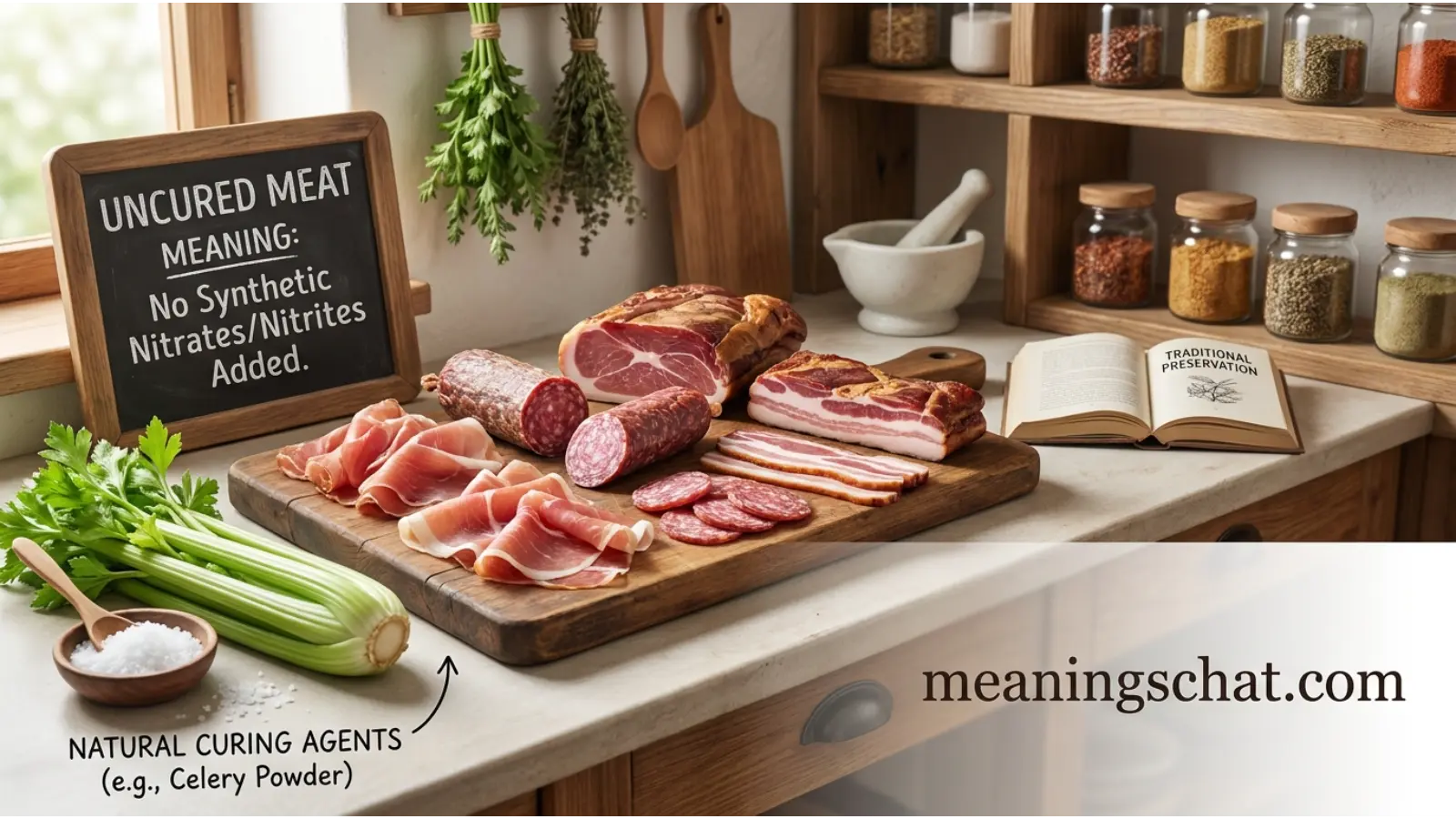
Uncured Meat Meaning can seem confusing when you see the term on bacon, ham, hot dogs, sausages, or other meat packages. Many shoppers assume that “uncured” means the meat has not been treated with preservatives at all. However, the label can have a more specific meaning, especially under U.S. meat-labeling rules.
The confusion usually comes from the way manufacturers use natural sources of nitrates and nitrites, such as celery powder, in products that traditionally use curing agents. These products can develop characteristics similar to conventionally cured meat while still carrying an “uncured” label. USDA materials explain that some natural sources provide nitrate or nitrite that can contribute to the curing process.
If you are wondering what uncured meat means, how it differs from cured meat, and what the label actually tells you, this guide breaks it down in simple language.
Quick Answer:
Uncured meat generally refers to meat that is not cured with conventional curing agents such as added sodium nitrite or sodium nitrate. Some products labeled “uncured” can still contain naturally occurring nitrates or nitrites from ingredients such as celery powder.
What Does Uncured Meat Mean?
Uncured meat is meat that has not been processed using conventional curing agents in the traditional way.
Curing is a preservation process that can use salt, nitrate, nitrite, or related ingredients to help preserve meat and create familiar characteristics such as color, flavor, and texture. USDA’s National Agricultural Library describes cured foods as foods treated with salt, nitrate, or nitrite for preservation.
The word “uncured” can therefore be misleading if you interpret it as meaning “completely untreated.”
In the U.S., some meat products use natural sources of nitrate or nitrite, including celery powder or vegetable-based ingredients. These products may be labeled “uncured” under applicable labeling rules even though the natural ingredients can provide curing-related compounds.
So, the simplest way to understand the term is:
Uncured meat does not necessarily mean meat with zero nitrates or nitrites.
Instead, look closely at the ingredient list and the additional statements on the package.
Uncured Meat Full Form and Definition
There is no “full form” for uncured meat because it is not an abbreviation.
The term simply combines:
- Uncured: Not conventionally cured with approved curing agents in the traditional process
- Meat: A food product made from animal muscle or related edible animal tissues
Together, uncured meat describes a meat product that does not use conventional curing treatment in the same way as traditionally cured meat.
The exact formulation can vary from one product to another, so reading the package is important.
What Does Uncured Meat Stand For?
If you searched for “what does uncured meat stand for,” the answer is straightforward.
It stands for meat that is labeled as not conventionally cured.
The term does not mean the product is automatically:
- Fresh meat
- Chemical-free
- Preservative-free
- Nitrate-free
- Healthier than every cured alternative
- Free from all processing
This distinction matters because natural ingredients can sometimes provide nitrate or nitrite. USDA information specifically notes that ingredients such as celery powder can provide natural sources of these compounds.
Is Uncured Meat the Same as Raw Meat?
No.
This is one of the biggest misunderstandings about the term.
Uncured does not mean raw.
Uncured meat can be cooked, smoked, dried, seasoned, packaged, or processed depending on the product.
For example, an uncured sausage may be ready to cook, while an uncured deli meat product may already be cooked. The word “uncured” describes the curing method or labeling status, not simply whether the meat is cooked.
Always follow the preparation and storage instructions printed on the package.
Is Uncured Meat Healthier?
This question does not have a simple yes-or-no answer.
Some shoppers choose uncured products because they want to avoid conventional added curing agents. That can be a personal food preference.
However, the word “uncured” alone does not prove that a product is healthier.
An uncured meat product can still contain:
- Salt
- Fat
- Calories
- Sugar
- Natural nitrate sources
- Other food ingredients
- Preservatives or processing aids, depending on the product
The nutrition facts panel and ingredient list provide more useful information than the word “uncured” by itself.
FDA explains that preservatives can serve several purposes in foods, including slowing spoilage and helping maintain freshness, flavor, color, or texture. Cured meats are among the food categories where preservatives can be used.
Does Uncured Meat Contain Nitrates or Nitrites?
Sometimes, yes.
This is where the label can become confusing.
Some products marketed as uncured use natural ingredients that contain nitrate. Celery and celery-based ingredients are common examples.
During processing, naturally occurring nitrate can be converted into nitrite. That nitrite can contribute to characteristics associated with cured meat.
USDA research explains that vegetable juice and celery juice powders can provide nitrate or nitrite in meat products made using natural curing systems.
That means a product can be labeled “uncured” while still containing naturally occurring nitrate or nitrite from its ingredients.
This is why you should not assume that “uncured” automatically means “nitrate-free.”
Why Does Uncured Meat Look Like Cured Meat?
You may notice that uncured bacon, ham, sausage, or hot dogs can still have the familiar pink or reddish appearance associated with cured meat.
That happens because natural sources of nitrate or nitrite can help create some of the same characteristics found in traditionally cured products.
USDA materials explain that natural sources such as celery powder can be used in meat products to develop properties similar to conventionally cured products.
So, appearance alone cannot tell you whether a product is cured or uncured.
The label and ingredient list provide better information.
Cured Meat vs. Uncured Meat
The easiest way to understand the difference is to compare how the products are processed and labeled.
| Feature | Cured Meat | Uncured Meat |
|---|---|---|
| Conventional curing agents | May use approved curing agents | Generally not conventionally cured with them |
| Natural nitrate sources | May or may not contain them | May contain them |
| Celery powder | Sometimes used | Common in some natural-style products |
| Appearance | Often pink or reddish | Can also appear pink or reddish |
| Flavor | Often salty and savory | Can taste similar to cured meat |
| Label meaning | Indicates conventional curing | Indicates an uncured labeling category |
| Nitrate-free assumption | Not necessarily | Not necessarily |
| Ingredient list | Important | Especially important |
The key point is that uncured does not automatically mean free from nitrate or nitrite.
Uncured Meat Meaning Slang: Is It Slang?
No.
“Uncured meat meaning slang” is not a typical slang definition because “uncured meat” is a food and labeling term.
People searching for the phrase may simply be trying to understand a grocery label, restaurant menu, recipe, or nutrition discussion.
Unlike internet slang such as “LOL” or “BRB,” uncured meat has a literal food-related meaning.
Where Is the Term Uncured Meat Commonly Used?
You can commonly find the term on food packaging and in discussions about meat products.
Examples include:
- Uncured bacon
- Uncured ham
- Uncured hot dogs
- Uncured sausage
- Uncured deli meat
- Uncured salami
- Uncured pepperoni
- Uncured meat snacks
The term can also appear in:
- Grocery store product descriptions
- Restaurant menus
- Recipes
- Food blogs
- Nutrition discussions
- Ingredient comparisons
- Online shopping pages
USDA’s meat-labeling resources explain that federal inspection authorities oversee the truthfulness and accuracy of meat and poultry labeling.
Why Do Companies Use the Term “Uncured”?
Food labels can communicate how a product was made and which ingredients were used.
Some manufacturers create meat products with natural sources of nitrate or nitrite instead of conventional curing agents.
For consumers looking for products that avoid conventional added nitrites, the “uncured” label may be appealing.
However, it is important to look beyond the front of the package.
The ingredient list can reveal whether a product contains ingredients such as celery powder or other natural nitrate sources.
In other words, the front label attracts attention, but the ingredient list provides more detail.
Real-Life Examples of Uncured Meat
Example 1: Uncured Bacon
You pick up a package labeled “uncured bacon.”
You might think:
“This bacon contains no nitrates or nitrites.”
But the ingredient list may identify celery powder or another natural source of nitrate.
That is why the complete label matters.
Example 2: Uncured Hot Dogs
A package of hot dogs may use natural sources of nitrate or nitrite rather than conventional curing agents.
The product can still have the familiar color, flavor, and texture associated with hot dogs.
USDA guidance gives hot dogs and corned beef as examples of products that may use celery powder instead of conventional sodium or potassium nitrite and consequently carry an “uncured” label with a qualifying statement.
Example 3: Grocery Shopping
Imagine you are comparing two bacon packages.
One says “cured bacon.”
The other says “uncured bacon.”
Instead of immediately assuming the second one is healthier, compare:
- Sodium
- Saturated fat
- Calories
- Serving size
- Ingredient list
- Preservatives
- Added sugars
That gives you a more complete picture.
What Ingredients Can Appear in Uncured Meat?
Ingredients vary by manufacturer and product.
You may see:
- Salt
- Sugar
- Celery powder
- Celery juice powder
- Spices
- Water
- Natural flavorings
- Vinegar
- Other seasoning ingredients
Celery-based ingredients are particularly relevant because they can naturally contain nitrate.
USDA research has documented the use of vegetable juice powder and celery juice powder in natural curing systems.
Always check the actual ingredient list because formulations can change.
Is Uncured Meat Safe to Eat?
Commercial meat products must follow applicable food safety requirements, but “uncured” itself is not a guarantee that a product is safer or less safe.
Food safety depends on several factors, including:
- How the meat was processed
- How it was stored
- How it was handled
- Cooking temperature
- Packaging
- Shelf life
- Product formulation
Some meat products that rely on natural nitrate or nitrite systems can still require careful handling and refrigeration.
USDA materials also emphasize that natural curing systems are designed around food safety and product characteristics, rather than simply being a different name for ordinary fresh meat.
Follow the storage and cooking instructions on the package.
When Should You Be Careful With the Term?
Be careful when you see marketing language that makes broad health claims based only on the word “uncured.”
For example, do not automatically assume:
Uncured = healthy
or
Uncured = nitrate-free
or
Uncured = preservative-free
Those conclusions require more information.
Instead, check the full package.
Look at the nutrition facts, ingredients, serving size, and preparation instructions.
What Is the Difference Between “Uncured” and “No Nitrates Added”?
These phrases can sound similar, but they should not be treated as identical.
A product may state that it has no nitrates or nitrites added while also explaining that naturally occurring nitrates or nitrites are present from a particular ingredient.
USDA labeling guidance specifically discusses qualifying statements for products using natural sources such as celery powder.
That is why reading the smaller text on the package can be surprisingly useful.
The food label may tell you more than the large words printed on the front.
Uncured Meat vs. Fresh Meat
Uncured meat and fresh meat are not always the same thing.
Fresh meat generally refers to meat that has not undergone certain preservation or processing treatments.
Uncured meat focuses specifically on the absence of conventional curing treatment or the applicable labeling category.
An uncured processed meat product can still undergo other processing methods.
So, do not use “uncured” as a synonym for “fresh.”
Why People Choose Uncured Meat
Consumers may choose uncured meat for different reasons.
Common reasons include:
- Avoiding conventional curing agents
- Preference for natural-style ingredients
- Interest in ingredient labels
- Dietary preferences
- Personal taste
- Curiosity about food processing
- Preference for products marketed with natural ingredients
The best choice depends on your individual dietary needs and preferences.
Instead of relying on one marketing term, compare the entire product label.
How to Read an Uncured Meat Label
Reading the label does not have to feel like solving a grocery-store mystery.
Use this quick checklist:
- Read the product name.
- Look for the “uncured” statement.
- Check the ingredient list.
- Look for celery powder or celery juice powder.
- Check sodium per serving.
- Review saturated fat.
- Check serving size.
- Read storage instructions.
- Follow cooking instructions when applicable.
- Compare similar products.
This simple process helps you make a more informed decision.
Common Misconceptions About Uncured Meat
Misconception 1: Uncured Means Completely Untreated
Not necessarily.
Uncured meat can still undergo processing, seasoning, cooking, smoking, drying, or other treatments.
Misconception 2: Uncured Means Zero Nitrates
Not always.
Natural ingredients such as celery powder can provide nitrate or nitrite.
Misconception 3: Uncured Always Means Healthier
Not necessarily.
The nutrition profile depends on the entire product.
Misconception 4: Uncured Means Raw
It does not.
Uncured describes curing, not simply cooking status.
Misconception 5: Uncured Meat Always Tastes Different
Not necessarily.
Some products are specifically formulated to provide familiar cured-meat characteristics.
FAQs:
What does uncured meat mean?
Uncured meat generally means the product has not been conventionally cured using approved curing agents in the traditional manner. Some products can still contain natural nitrate or nitrite sources such as celery powder.
Is uncured meat healthier than cured meat?
Not automatically. Compare the nutrition facts and ingredients because uncured products can still contain significant amounts of sodium, fat, or other ingredients.
Does uncured meat contain nitrates?
It can. Some uncured products use natural nitrate sources, including celery-based ingredients, which can contribute nitrate or nitrite during processing.
What does uncured meat stand for?
It describes meat that is not conventionally cured with traditional approved curing agents. It is a food-labeling term, not slang or an abbreviation.
Is uncured bacon really uncured?
The answer depends on how the product is formulated and labeled. Some uncured bacon products use natural nitrate sources such as celery powder, so the ingredient list is important.
Does uncured mean nitrate-free?
No. “Uncured” should not automatically be interpreted as “nitrate-free.” Natural sources of nitrate can be present in some uncured products.
Conclusion
Understanding the Uncured Meat Meaning becomes much easier once you know that “uncured” does not simply mean untreated or completely free from nitrates and nitrites.
The term generally describes meat that has not been conventionally cured with traditional curing agents. However, some products use natural sources such as celery powder that can provide nitrate or nitrite and create characteristics associated with cured meat.
If you see “uncured” on a package, do not stop at the front label. Check the ingredient list, nutrition facts, storage information, and preparation instructions. That gives you a clearer understanding of what you are actually buying.
In short, uncured does not automatically mean healthier, raw, preservative-free, or nitrate-free. Context and the complete food label matter most.