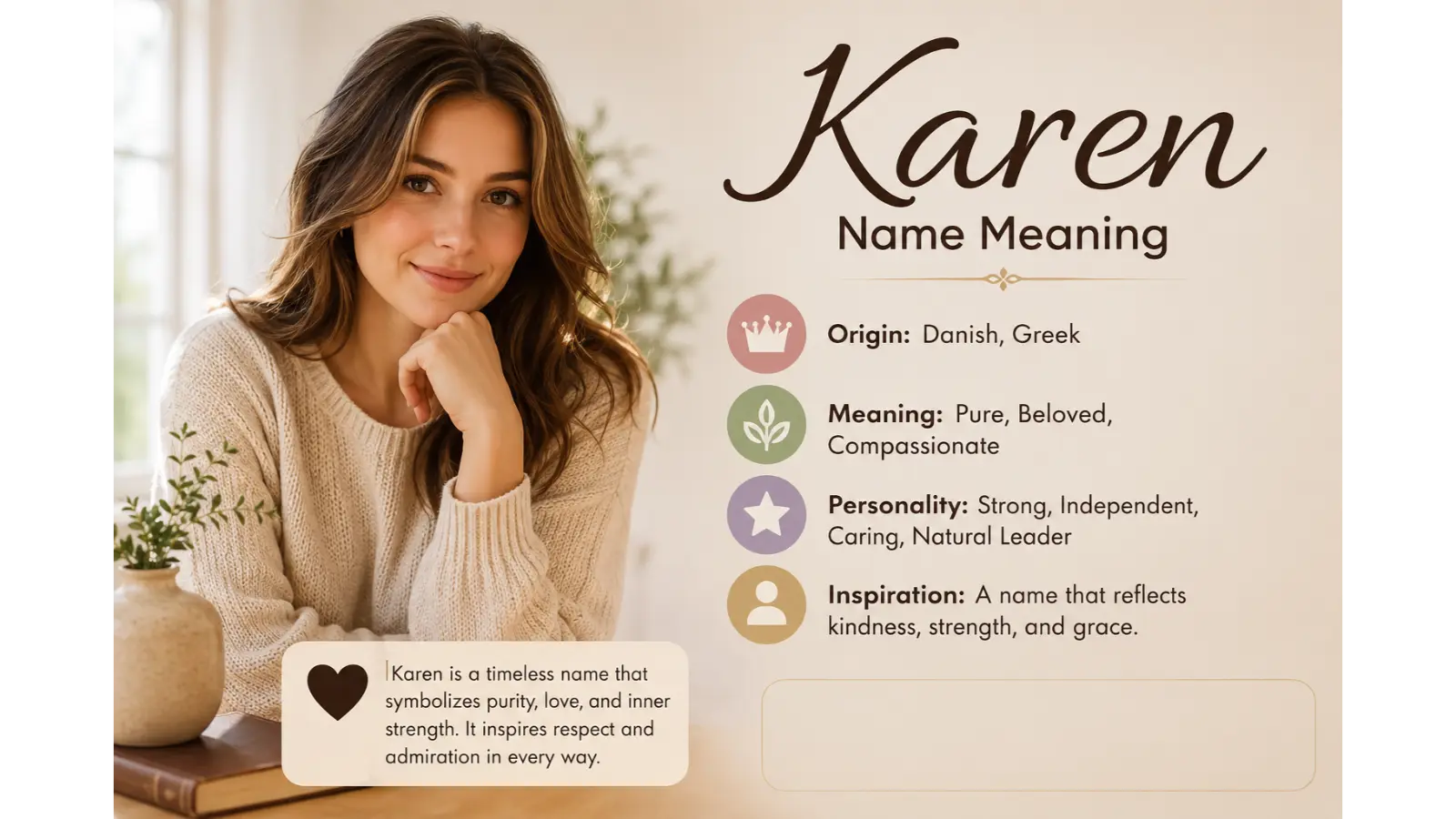
Karen name meaning is a popular search because the name has a much deeper history than its modern internet slang usage might suggest. Karen is traditionally a feminine given name with roots connected to the name Katherine or Catherine. Over time, it became associated with meanings such as “pure” and “clear,” while also developing a rich history across different cultures and generations.
Today, the word “Karen” can have two very different meanings. It can simply refer to someone named Karen, or it can describe a particular stereotype in modern internet culture. This difference often creates confusion, especially for people researching the name, its meaning, or its slang use.
In this guide, we will explore the Karen name meaning, origin, history, personality associations, cultural background, modern slang meaning, and examples.
Quick Answer:
Karen traditionally means “pure” or “clear” and is commonly considered a form of Katherine or Catherine. In modern slang, “Karen” can describe someone viewed as overly demanding, entitled, or quick to complain.
What Does Karen Name Meaning Refer To?
The Karen name meaning traditionally relates to the name Katherine or Catherine. Karen developed as a shortened or Scandinavian form of Katherine and became especially popular in countries such as Denmark and Norway.
The traditional meaning is generally connected with “pure” or “clear.”
This traditional meaning has little connection to the modern slang meaning of “Karen.” The slang developed much later through internet culture and popular conversations about customer complaints, entitlement, and social behavior.
So, when someone searches for “Karen name meaning,” they may be looking for two separate things:
- The traditional meaning of the personal name
- The modern meaning of Karen as internet slang
Understanding the context makes the difference clear.
Karen Name Full Meaning and Definition
The name Karen is commonly regarded as a form of Katherine, which traces its history through Greek and later European naming traditions.
The name is often associated with the idea of purity. Some historical discussions connect Katherine with the Greek word katharos, meaning “pure” or “clean.”
Over centuries, Katherine appeared in many languages and variations. Karen became one of the familiar forms used in Scandinavian countries and later became widely recognized in English speaking countries.
Today, Karen can represent:
- Purity
- Clarity
- A traditional feminine name
- Scandinavian naming heritage
- A familiar English language first name
The meaning of a personal name can also vary across historical sources, languages, and naming traditions, so “pure” is best understood as the commonly cited traditional interpretation rather than a single universal definition.
What Does Karen Stand For?
If you are asking “what does Karen stand for?” as a personal name, it does not normally stand for a phrase or acronym.
Karen is a given name rather than an abbreviation.
Its historical development is connected to Katherine or Catherine. As a result, its traditional meaning is generally associated with purity or cleanness.
In modern online conversations, however, “Karen” may stand for a social stereotype rather than a literal name meaning.
For example:
“She complained to the manager over something very minor.”
Someone might jokingly call that behavior “Karen behavior.”
The expression describes the behavior in that particular context. It does not mean that every person named Karen behaves that way.
Is Karen a Rude or Offensive Word?
The answer depends heavily on context.
Karen is not inherently a rude or offensive name. Millions of people have Karen as their genuine first name, and the traditional name has a long history.
The slang version can be insulting because it labels someone with a negative stereotype.
Calling a stranger a “Karen” can suggest that the person is:
- Entitled
- Difficult
- Demanding
- Aggressive
- Excessively concerned with rules
- Quick to complain
- Insistent on speaking to a manager
Because of these associations, using “Karen” as an insult can easily offend someone.
A respectful approach is to describe the actual behavior instead of relying on a stereotype.
For example, instead of saying:
“She is such a Karen.”
You could say:
“She is being unnecessarily demanding.”
That statement communicates the behavior without turning a person’s name into an insult.
Where Is the Name Karen Commonly Used?
Karen has been used in several countries and languages, particularly in Northern Europe and English speaking countries.
The name became especially familiar in the United States during the twentieth century. It was particularly popular among girls born during certain decades of the mid twentieth century.
You may encounter the name in:
- The United States
- Canada
- Denmark
- Norway
- Sweden
- The United Kingdom
- Other English speaking communities
Its popularity has changed over time, but the name remains recognizable.
The modern slang meaning has also made the word much more widely discussed online.
Origin and Background of the Name Karen
The history of Karen is connected to Katherine and Catherine.
Katherine has a long history in European naming traditions and became associated with religious and cultural traditions over many centuries. Different languages created their own variations of the name.
Karen became especially established as a Scandinavian form.
The name’s development can be summarized like this:
Katherine/Catherine → regional variations → Karen
This history explains why Karen has a traditional meaning that predates the modern internet stereotype by many centuries.
The name should therefore be understood in its historical context rather than judged solely by its modern slang usage.
Karen Name Meaning in Different Contexts
The meaning of Karen changes depending on how someone uses the word.
As a Personal Name
When Karen appears as someone’s first name, it is simply a traditional feminine given name.
Example:
“Karen is my aunt’s name.”
There is no negative meaning in this sentence.
As a Slang Term
When someone uses “Karen” to criticize another person’s behavior, it takes on a modern slang meaning.
Example:
“He complained about the restaurant for twenty minutes. Everyone called him a Karen.”
Here, the word describes a stereotype involving excessive complaints or entitlement.
In Pop Culture
Movies, television shows, memes, social media posts, and online discussions have helped spread the slang meaning.
This has created an interesting situation where a traditional personal name now has a second cultural meaning.
Why Did Karen Become Internet Slang?
The modern slang usage developed gradually rather than appearing from one single event.
Internet users began using “Karen” as a shorthand label for a recognizable type of behavior. Memes and social media helped popularize the expression.
The stereotype often involves someone making an exaggerated complaint, demanding special treatment, or insisting on speaking with a manager.
The phrase “Can I speak to the manager?” became strongly associated with the stereotype.
As social media expanded, the term became easier to spread. Videos, memes, comments, and viral posts frequently used “Karen” to describe people perceived as acting entitled or confrontational.
However, the slang can also oversimplify complicated situations. A person making a legitimate complaint does not automatically deserve the label.
Karen Name Meaning vs Karen Slang Meaning
These two meanings are worth keeping separate.
| Context | Meaning | Tone |
|---|---|---|
| Personal name | Traditional feminine given name | Neutral |
| Traditional meaning | Commonly associated with purity | Positive |
| Internet slang | Person seen as demanding or entitled | Usually negative |
| Meme culture | Exaggerated complaint based stereotype | Humorous or insulting |
| Formal context | Usually refers to a person’s name | Neutral |
This distinction is important because using a person’s name as slang can feel personal.
Real Life Examples of Karen Name Meaning
Friendly Example
“Karen helped me prepare for the presentation.”
Here, Karen is simply someone’s name.
Family Example
“My grandmother’s name is Karen, and she loves the traditional meaning of her name.”
This sentence refers to the historical meaning.
Casual Slang Example
“That guy asked for the manager because his coffee had one ice cube too many. What a Karen moment.”
Here, Karen is being used as slang.
Social Media Example
“The video shows a customer arguing with staff over a minor issue, and commenters started calling him a Karen.”
The word describes the behavior according to the commenters.
Argumentative Example
“Don’t call me a Karen just because I asked about the problem.”
Here, the speaker rejects the negative label.
Gaming Example
“Our teammate became a total Karen when the game server went down.”
The term is being used humorously to describe someone complaining intensely.
Workplace Example
“She wasn’t being a Karen. She reported a genuine safety issue.”
This example shows why context matters. A legitimate complaint should not automatically become a stereotype.
Similar Terms and Their Meanings
Several expressions overlap with the modern slang meaning of Karen, although they are not exact synonyms.
| Term | General Meaning | Tone |
|---|---|---|
| Karen | Person viewed as demanding or entitled | Negative or humorous |
| Entitled | Someone expecting special treatment | Negative |
| Complainer | Person who frequently complains | Usually negative |
| Difficult customer | Customer who creates problems | Negative |
| Busybody | Person who interferes in others’ affairs | Negative |
| Rule enforcer | Someone focused strongly on rules | Neutral or negative |
The term “Karen” is more culturally specific than these alternatives.
When Should You Avoid Using Karen as Slang?
It is better to avoid the slang usage in situations where it could unfairly target or embarrass someone.
Be cautious in:
- Professional conversations
- Workplace communication
- Formal writing
- Customer service disputes
- Conversations involving strangers
- Sensitive discussions
- Situations where you do not know the full story
A complaint does not automatically make someone unreasonable.
Before using the label, consider the actual behavior and circumstances.
Polite Alternatives to Calling Someone a Karen
If you want to describe difficult behavior without using slang, choose specific language.
You can say:
- “They are being demanding.”
- “They seem frustrated.”
- “They are complaining excessively.”
- “They are acting entitled.”
- “They are being unreasonable.”
- “They are being confrontational.”
- “They are insisting on special treatment.”
These phrases provide more information and reduce the chance of insulting someone simply because of their name or identity.
Why Do People Use the Word Karen?
People often use slang because it communicates an idea quickly.
Instead of explaining a long situation, someone may write:
“That was such a Karen moment.”
The reader may immediately understand that the person appeared demanding, entitled, or overly focused on complaining.
Other reasons include:
- Humor
- Memes
- Social media culture
- Quick communication
- Sarcasm
- Group identity
- Commentary about behavior
The downside is that slang can sometimes replace a more accurate description of what actually happened.
Impact of Using Karen in Communication
Language can influence how people perceive an event.
Calling someone a “Karen” may make a story sound humorous, but it can also make the audience judge the person before hearing the full situation.
For example, compare:
“A customer complained about the service.”
with:
“A Karen caused a scene at the restaurant.”
The second sentence carries a much stronger judgment.
This is why context and tone matter. Casual slang can work among friends, but it may create misunderstandings in professional or serious situations.
Is Karen Safe to Use on Social Media?
The word itself is generally safe to encounter on social media, but its use can still cause problems.
Using “Karen” as someone’s personal name is completely normal.
Using it as an insult may lead to:
- Arguments
- Hurt feelings
- Negative reactions
- Misunderstandings
- Online conflict
- Accusations of stereotyping
If you are creating public content, focus on the behavior rather than attacking an individual.
For example:
Better:
“The customer repeatedly interrupted the employee and demanded special treatment.”
This gives readers useful information without relying on a label.
Is Karen Still a Popular Name?
Karen remains a recognizable name, although its popularity has changed significantly over generations.
Names often move through popularity cycles. A name that becomes extremely common during one period may become less popular among younger parents later.
Karen is now particularly familiar because many adults and older generations carry the name, while internet culture has given the word an additional meaning.
This creates an unusual situation where an established personal name has gained a separate slang identity.
Karen Name Meaning and Personality Associations
People sometimes search for personality traits associated with the name Karen.
Traditional name meanings do not scientifically determine someone’s personality. A person’s character develops through many factors, including family, culture, experiences, education, and personal choices.
Still, popular name discussions may associate Karen with qualities such as:
- Strength
- Confidence
- Independence
- Clarity
- Traditional values
- Determination
These are cultural associations rather than proven personality characteristics.
It is important not to assume that someone named Karen has a particular personality because of their name.
Common Misunderstanding About the Name Karen
One of the biggest misunderstandings is assuming that every Karen has a connection to the slang stereotype.
That is not true.
A personal name and a slang term can share the same spelling while having completely different meanings.
For example:
“Karen invited us to dinner.”
This uses Karen as a name.
“The customer was acting like a Karen.”
This uses Karen as slang.
The surrounding words make the intended meaning clear.
FAQs:
What is the Karen name meaning?
The traditional Karen name meaning is commonly associated with “pure” or “clear.” Karen is generally considered a form of Katherine or Catherine.
What does Karen stand for?
Karen is a personal name rather than an acronym. Its historical development is connected to Katherine and Catherine.
Is Karen a Scandinavian name?
Karen is strongly associated with Scandinavian naming traditions, particularly as a form of Katherine used in countries such as Denmark and Norway.
Why is Karen used as slang?
Modern internet culture uses “Karen” as a label for someone perceived as demanding, entitled, confrontational, or excessively focused on complaints.
Is Karen an offensive word?
Karen is not inherently offensive when used as someone’s name. The slang version can be insulting because it carries a negative stereotype.
Does the name Karen mean something negative?
No. The traditional meaning of Karen is generally associated with purity or clarity. The negative association comes from its modern slang usage, not from its historical name meaning.
Conclusion
The Karen name meaning has a much richer history than its modern internet reputation suggests. Traditionally, Karen is a feminine given name connected to Katherine or Catherine and is commonly associated with the meaning “pure” or “clear.” It has strong Scandinavian connections and has been widely recognized in English speaking countries.
Modern internet culture gave the word a second meaning. In slang, “Karen” can describe someone perceived as demanding, entitled, confrontational, or overly eager to complain. This usage can be humorous in casual conversations, but it may also offend people when used unfairly.
The key is context. When Karen refers to someone’s name, it is simply a traditional personal name. When it describes behavior, it carries a very different tone. Understanding both meanings helps you communicate clearly, respectfully, and accurately.