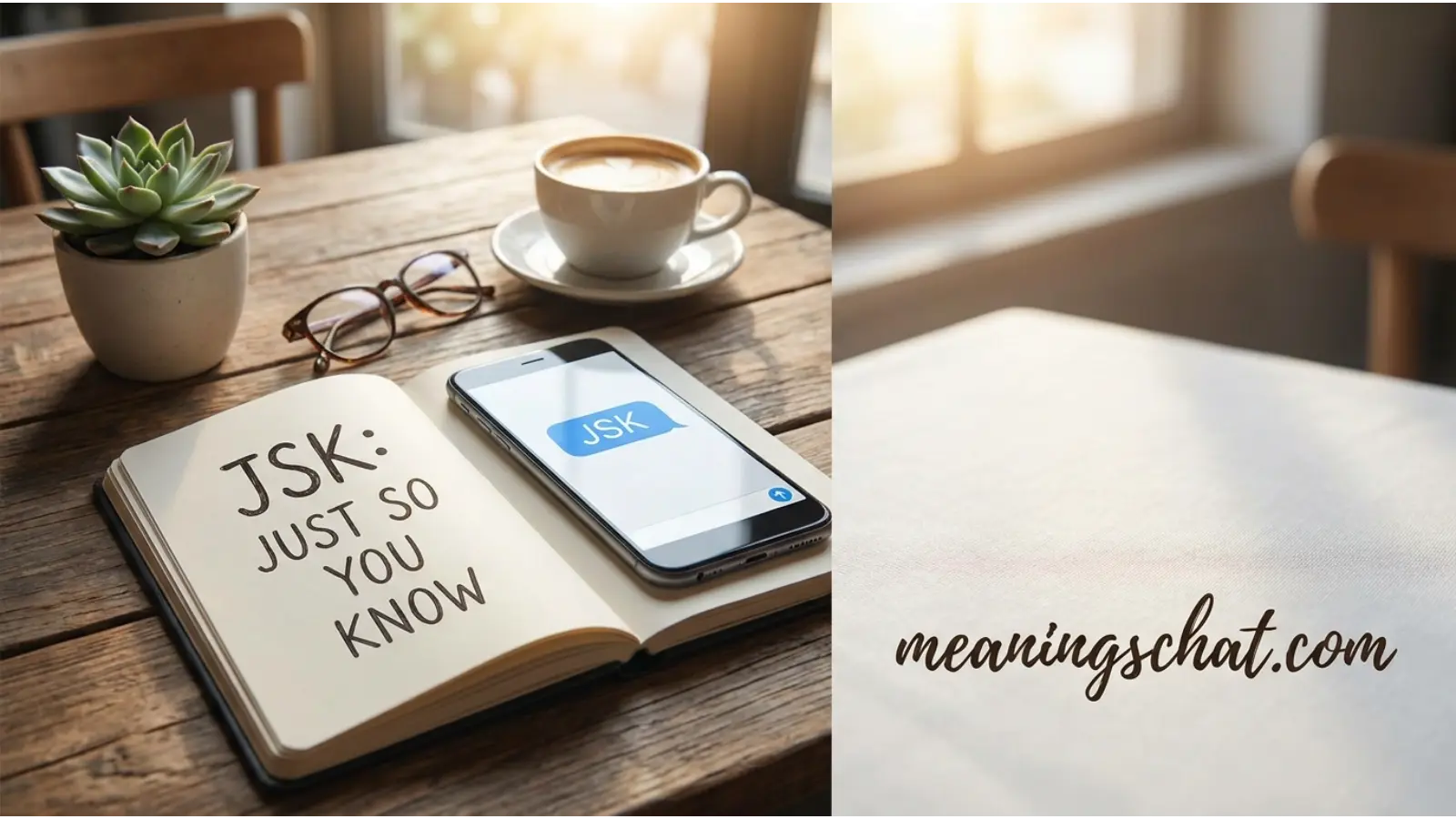
jsk meaning in text can be confusing when you first see these three letters in a message, comment, or social media conversation. Internet slang changes quickly, and the same abbreviation can carry different meanings depending on the person, community, or situation.
In casual online communication, JSK can have more than one meaning. Some people use it to mean “Just Kidding,” while others use it for “Jai Shree Krishna” or, in some online communities, “Just So Know.” The intended meaning usually becomes clear from the surrounding message and the conversation.
That is why context matters when someone sends you “JSK.” Instead of guessing, look at what the person was discussing before and after the abbreviation.
Quick Answer
JSK usually has a context-dependent meaning in text. It can mean “Just Kidding” in casual conversations or “Jai Shree Krishna” in cultural and religious contexts. Some users also use it as “Just So Know.”
What Does JSK Mean in Text?
The jsk meaning in text does not have one universally accepted definition. Unlike common abbreviations such as LOL or BRB, JSK appears with several meanings across different online communities.
The most relevant meanings include:
- Just Kidding — used to show that a previous statement was a joke.
- Jai Shree Krishna — used as a cultural or devotional greeting.
- Just So Know — used by some people as a casual way to give information or a quick heads-up.
Some slang references also list other specialized meanings, so the conversation provides the strongest clue.
For example:
“You actually believed me? JSK 😂”
Here, JSK most likely means “Just Kidding.”
Now consider:
“Good morning! JSK 🙏”
In this context, JSK may refer to “Jai Shree Krishna.”
The difference shows why you should never interpret an abbreviation without considering the message around it.
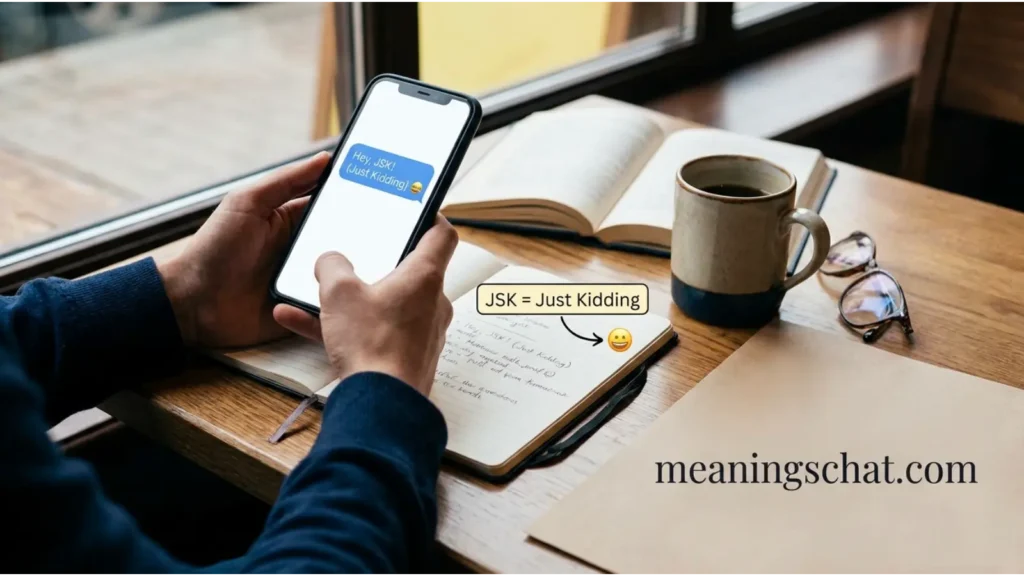
JSK Full Form
If you are searching for the JSK full form, there are several possibilities.
JSK as “Just Kidding”
In casual texting, JSK can be used to tell someone that a previous statement was meant humorously.
For example:
“I’m never talking to you again. JSK 😂”
The first sentence sounds serious, but JSK changes the tone and tells the reader that the speaker is joking.
That said, JK is the more established abbreviation for “Just Kidding.” J
JSK as “Jai Shree Krishna”
JSK can also stand for “Jai Shree Krishna,” a greeting or devotional expression associated with Krishna. Acronym references specifically list this expansion, and slang references show it being used as a greeting.
Example:
“JSK 🙏 Have a wonderful day!”
In this setting, the abbreviation is cultural rather than humorous.
JSK as “Just So Know”
Some online slang users use JSK to mean “Just So Know,” essentially giving someone information or a quick heads-up. One slang reference describes it as an informal replacement for “JSYK,” meaning “Just So You Know.”
Example:
“JSK, the store closes at 8.”
Here, the writer is simply sharing useful information.
Is JSK Rude, Offensive, or Neutral?
Generally, JSK is not inherently rude or offensive. Its tone depends on what it means and how someone uses it.
JSK means “Just Kidding,” it usually creates a playful or humorous tone.
It means “Jai Shree Krishna,” it can function as a respectful cultural or devotional greeting.
It means “Just So Know,” it works as a casual information-sharing expression.
However, confusion can happen if the recipient does not know which meaning the sender intended.
For example:
“JSK, I already told you.”
If the reader interprets JSK differently from the sender, the message may become confusing.
When clarity matters, spelling out the phrase is better.
Where Is JSK Commonly Used?
You may encounter JSK in informal digital spaces, including:
- Text messages
- WhatsApp conversations
- Instagram DMs
- Snapchat chats
- TikTok comments
- Facebook conversations
- Discord communities
- Gaming chats
- Online cultural communities
The exact meaning can change according to the platform and audience.
For instance, a gamer joking with a friend might use JSK differently from someone participating in a cultural or religious conversation.
This is one reason internet abbreviations can be difficult for new users. The same three letters may belong to completely different communication styles.
Real-Life Examples of JSK in Text
Seeing the abbreviation in context makes the JSK meaning slang much easier to understand.
Friendly Example
: “You forgot my birthday!”
: “Nooo, I would never! JSK 😂 I already bought your gift.”
Here, JSK is being used playfully to indicate that the previous tone was a joke.
Casual Example
Friend 1: “Are you coming to dinner?”
Friend 2: “JSK, I’m already on my way.”
If the sender uses JSK as an information-sharing abbreviation, it can function as a casual heads-up.
Playful Example
: “You are officially the worst cook ever.”
: “Wow, rude 😂”
: “JSK! Your pasta was actually good.”
Here, the abbreviation helps soften the teasing.
Cultural Example
Person 1: “Have a peaceful and blessed morning.”
Person 2: “JSK 🙏”
In this context, JSK can mean “Jai Shree Krishna.”
Gaming Example
: “You almost lost that match!”
: “I had it under control 😂”
: “JSK, that was way too close.”
The meaning here depends on the community and the conversation. In a gaming environment, context is especially important because players use many different abbreviations.
Social Media Example
“That prank was wild 😂 JSK!”
Here, the writer may be using JSK as a playful expression. Again, the surrounding conversation helps determine the intended meaning.
Origin and Background of JSK
There is no single confirmed origin story for every use of JSK.
The abbreviation has developed through different online and cultural communities. Internet users often shorten phrases to save typing time, create an informal tone, or build a sense of community.
The “Just Kidding” interpretation connects with the long-standing use of JK, which means “Just Kidding.” Some online writers have extended or altered abbreviations in informal digital communication.
The “Jai Shree Krishna” interpretation comes from a completely different context. JSK is used as an abbreviation for that phrase in online slang and acronym references.
The “Just So Know” interpretation is another informal internet usage documented by slang sources.
Because these meanings come from different communities, there is no single definition that works in every conversation.
What Does JSK Stand For?
If someone asks, “What does JSK stand for?”, the safest answer is:
It depends on the context.
Common interpretations include:
| JSK Meaning | Typical Context | Tone |
|---|---|---|
| Just Kidding | Casual jokes and teasing | Playful |
| Jai Shree Krishna | Cultural or devotional conversations | Respectful |
| Just So Know | Casual information sharing | Friendly |
| Jumper Skirt | Fashion communities | Informational |
The final meaning listed above is a specialized usage. Acronym references identify JSK as “Jumper Skirt,” particularly in fashion-related contexts.
Therefore, the surrounding words matter more than the abbreviation alone.
JSK vs Similar Slang Terms
JSK can easily be confused with other short forms. Comparing them can help you understand the difference.
| Slang | Full Form | Main Meaning | Common Use |
|---|---|---|---|
| JSK | Context dependent | Joke, greeting, or information | Informal chats |
| JK | Just Kidding | Shows that something was a joke | Casual texting |
| JSYK | Just So You Know | Gives information or a heads-up | Texting and social media |
| FYI | For Your Information | Shares information | Casual and professional communication |
| LOL | Laugh Out Loud | Shows amusement | Texting and social media |
| BTW | By the Way | Adds another point | Casual conversations |
One important distinction is that JK is much more commonly recognized as “Just Kidding,” while JSK has multiple interpretations.
Likewise, JSYK is a more recognizable form of “Just So You Know” than JSK.
When Should You Avoid Using JSK?
Although JSK is generally harmless, it is not ideal for every situation.
Avoid using unexplained slang when communicating in:
- Professional emails
- Job applications
- Academic assignments
- Legal documents
- Official announcements
- Serious customer-service conversations
- Important business communication
The main issue is not that JSK is offensive. The issue is clarity.
If the reader does not know the abbreviation, they may misunderstand your message.
For example, instead of writing:
“JSK, the meeting moved to 3.”
A professional message would be clearer as:
“Just so you know, the meeting has moved to 3 p.m.”
Clear language is especially important when a message involves deadlines, money, work responsibilities, or sensitive topics.
Polite Alternatives to JSK
If you are unsure whether your audience understands JSK, use the complete phrase instead.
For a joking meaning:
- “Just kidding.”
- “I’m joking.”
- “I was only teasing.”
- “Haha, I’m kidding.”
- “Just so you know.”
- “FYI.”
- “I wanted to let you know.”
- “Please note that…”
Why Do People Use JSK?
People use abbreviations like JSK because digital communication rewards speed and simplicity.
Common reasons include:
1. It Saves Time
Typing three letters is faster than writing an entire phrase.
2. It Feels Casual
Abbreviations can make a conversation feel relaxed and informal.
3. It Adds Personality
A short expression can help communicate humor, friendliness, or cultural identity.
4. It Fits Social Media
Social platforms encourage short comments, captions, and quick replies.
5. It Builds Community
Specific abbreviations can help people communicate naturally within a shared online or cultural group.
Impact of JSK on Communication
Slang can make digital conversations faster and more expressive, but it can also create confusion.
Positive Effects
JSK can:
- Keep casual conversations short
- Add a playful tone
- Help people communicate quickly
- Reflect community language
- Make informal messages feel natural
Possible Problems
JSK can also:
- Confuse people unfamiliar with the term
- Create misunderstandings
- Cause tone problems
- Look inappropriate in formal writing
- Have a different meaning in another community
This is why context remains the most important part of understanding jsk meaning in text.
Is JSK Safe for Social Media?
Yes, JSK is generally safe for social media because the abbreviation itself is not inherently harmful or offensive.
You can see abbreviations like this in comments, DMs, gaming chats, and group conversations.
Still, remember that social media audiences can be diverse. A person from another community may interpret JSK differently.
If your message could be misunderstood, use the complete phrase instead.
For example:
“Just kidding 😂”
is much clearer than:
“JSK 😂”
when you are speaking to someone who may not know the abbreviation.
How to Understand JSK From Context
When someone sends you “JSK,” use these clues to figure out the intended meaning.
Look at the Previous Sentence
If the sender just made an exaggerated or funny statement, “Just Kidding” may make sense.
Look at the Topic
If the conversation involves religion or culture, “Jai Shree Krishna” may be more likely.
Look at the Message Structure
If JSK appears before a useful fact or reminder, the sender may intend an information-sharing meaning such as “Just So Know.”
Consider the Person
Someone from a particular online community may use an abbreviation differently from your usual contacts.
Ask If Necessary
If the meaning remains unclear, simply ask:
“What do you mean by JSK?”
That is better than responding based on an incorrect assumption.
Common Misunderstandings About JSK
JSK Always Means “Just Kidding”
Not necessarily. “Just Kidding” is one possible interpretation, but JSK can have other meanings.
JSK Is the Same as JK
Not exactly. JK is the standard abbreviation for “Just Kidding,” while JSK has several possible expansions.
JSK Is Always a Religious Greeting
No. It can have cultural meaning in some conversations, but online users may use it differently.
Everyone Knows What JSK Means
Definitely not. Internet slang varies between age groups, platforms, countries, and communities.
JSK Is a Formal Abbreviation
No. Most uses of JSK belong to informal or specialized communication.
FAQs:t
What does JSK mean in text?
JSK can have several meanings in text. Common interpretations include “Just Kidding,” “Jai Shree Krishna,” and, in some online communities, “Just So Know.”
What is the JSK full form?
There is no single universal JSK full form. The intended expansion depends on the context. “Just Kidding” and “Jai Shree Krishna” are two recognized interpretations.
Is JSK the same as JK?
No. JK commonly means “Just Kidding.” JSK can have multiple meanings, so context is necessary to understand it correctly.
Is JSK rude?
JSK is generally neutral and not inherently rude. Its tone depends on the phrase it represents and how the sender uses it.
What does JSK mean on social media?
On social media, JSK can mean different things depending on the community. It may indicate a joke, a cultural greeting, or an informal information-sharing phrase.
What does JSK stand for in texting?
In texting, JSK may stand for “Just Kidding,” “Jai Shree Krishna,” or another context-specific phrase. There is no single meaning that applies to every message.
Conclusion
Understanding jsk meaning in text requires more than memorizing one definition. JSK is a context-dependent abbreviation with several recognized uses. In casual conversations, it can mean “Just Kidding.” In cultural or devotional settings, it can mean “Jai Shree Krishna.” Some online communities also use it as “Just So Know.”
The best way to understand JSK is to examine the surrounding message, the topic, and the person using it. If the meaning is unclear, asking for clarification is always better than guessing.
For casual chats and social media, JSK can work naturally when everyone understands the intended meaning. For professional or formal communication, use the full phrase instead. That small change can make your message clearer, more respectful, and easier to understand.