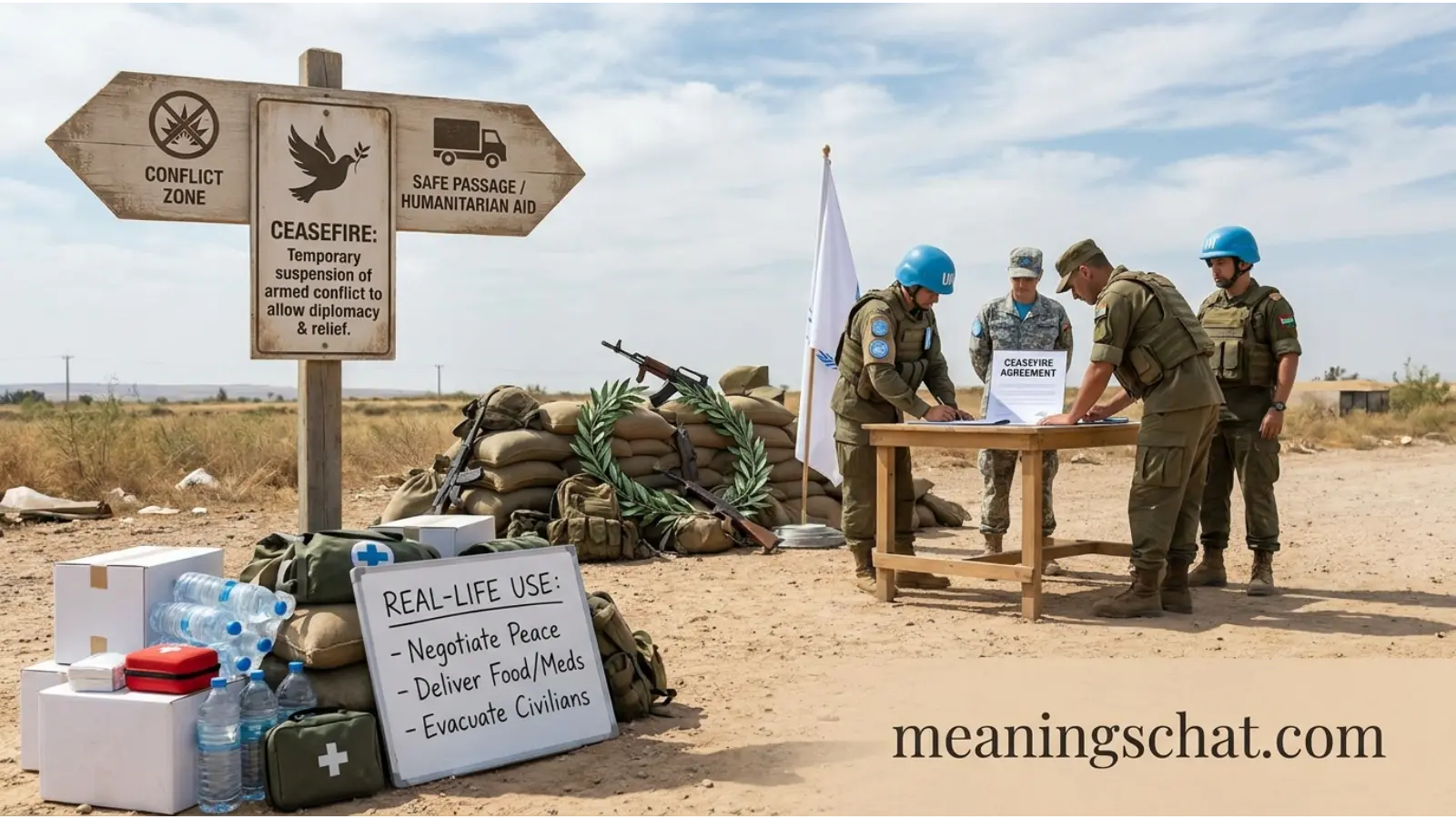
Ceasefire meaning refers to an agreement or decision to temporarily stop fighting or military attacks between opposing sides. You may come across this word in news reports, social media posts, political discussions, history lessons, or conversations about conflicts. Many people search for the meaning because ceasefire sounds formal and can be confusing when it appears in headlines.
Understanding this term helps you follow conversations about wars, peace negotiations, and international events more easily. Unlike casual internet slang, ceasefire is a standard English word used in serious contexts. Its meaning can also change slightly depending on the situation, so context matters.
Quick Answer:
A ceasefire is an agreed pause or stoppage in fighting between opposing groups or countries. It can be temporary or, in some cases, serve as a step toward a longer peace agreement.
What Does Ceasefire Mean?
A ceasefire means a temporary or permanent agreement to stop fighting, shooting, bombing, or other military actions between two or more opposing sides.
The word combines:
- Cease = to stop
- Fire = shooting or use of weapons
So, the basic idea behind the word is “stop firing” or “stop fighting.”
For example:
“The two sides announced a ceasefire after several days of fighting.”
This means both sides agreed to stop their military actions.
A ceasefire does not always mean that the conflict itself has ended. The underlying disagreement may still exist, but the parties agree to pause or stop hostilities.
Ceasefire Full Form and Definition
People sometimes search for the ceasefire full form, but ceasefire is not an abbreviation. It is a normal English compound word made from cease and fire.
The dictionary-style definition is:
Ceasefire: An agreement or order to stop fighting or military attacks for a specific period or indefinitely.
A ceasefire can involve:
- Two countries
- Governments and armed groups
- Military forces
- Rival groups within a country
- Multiple parties involved in a conflict
The terms of a ceasefire can vary. Some may last for a few hours, while others can continue for days, weeks, or longer.
Is Ceasefire Slang?
No, ceasefire is not slang.
If you searched for ceasefire meaning slang, you may have seen the word used casually online. However, its standard meaning remains the same. People may use it metaphorically in informal conversations, but the word itself is formal and widely recognized.
For example, someone might jokingly say:
“Can we call a ceasefire on this argument?”
Here, the speaker uses the word figuratively to mean “let’s stop arguing.” The original meaning still comes from stopping conflict.
What Does Ceasefire Stand For?
If you are wondering what does ceasefire stand for, it simply refers to a stopping of fighting or hostile military action.
It does not stand for a longer phrase like an acronym.
In simple English:
Ceasefire = an agreement or decision to stop fighting.
The word can describe an official agreement between opposing parties or an informal decision to pause a conflict.
Where Is the Word Ceasefire Commonly Used?
The word ceasefire appears most often in serious or formal contexts.
News Reports
Journalists frequently use the word when reporting on armed conflicts.
Example:
“Leaders called for an immediate ceasefire.”
Politics
Politicians and diplomats may discuss ceasefires during negotiations.
Example:
“The government supported talks aimed at securing a ceasefire.”
History
History books often use the term when describing wars and military conflicts.
Example:
“The ceasefire marked an important step toward ending the conflict.”
International Relations
Organizations and governments may discuss ceasefires when working toward peace.
Everyday Conversations
People can also use ceasefire metaphorically to describe stopping an argument or disagreement.
Example:
“Let’s have a ceasefire and talk about this calmly.”
Real Life Examples of Ceasefire
Here are several examples showing how people use the word naturally:
Formal:
“The parties agreed to a ceasefire after lengthy negotiations.”
News style:
“Officials announced that the ceasefire would begin at midnight.”
Casual:
“Can we have a ceasefire for five minutes and figure this out?”
Figurative:
“The siblings finally called a ceasefire after arguing all afternoon.”
Historical:
“The ceasefire brought an end to the immediate fighting.”
Ceasefire Examples in Different Tones
Friendly Example
“Okay, ceasefire! Let’s stop arguing and order some pizza.”
Here, ceasefire is used humorously to suggest ending a friendly disagreement.
Casual Example
“I think we need a ceasefire before this conversation gets worse.”
This sounds informal and uses the word metaphorically.
Argumentative Example
“We should agree to a ceasefire and discuss the issue without shouting.”
The word suggests stopping an argument or hostile behavior.
Social Media Example
“Can everyone call a ceasefire in the comments?”
Here, the writer uses the word figuratively to ask people to stop fighting online.
Gaming Example
“Ceasefire for one minute while we decide teams.”
In gaming, someone might use the word playfully to suggest that players temporarily stop attacking one another.
Difference Between Ceasefire and Peace
Ceasefire and peace are related, but they do not mean exactly the same thing.
A ceasefire usually means that fighting has stopped. Peace generally refers to a broader condition in which conflict has been resolved or significantly reduced.
Think of it this way:
Ceasefire = Stop fighting
Peace = Conflict has been resolved or peaceful relations exist
A ceasefire can become part of a larger peace process, but a ceasefire alone does not necessarily guarantee lasting peace.
Ceasefire vs Truce vs Armistice
These terms are closely related, but there are small differences in how they are commonly used.
| Term | Simple Meaning | Common Use |
|---|---|---|
| Ceasefire | Stop fighting or military action | Conflicts and negotiations |
| Truce | An agreement to temporarily stop fighting | Wars or disputes |
| Armistice | A formal agreement to stop fighting | Military and historical contexts |
| Peace treaty | Formal agreement intended to establish peace | Ending or resolving conflicts |
| Peace | A condition without active conflict | General and international contexts |
A truce often emphasizes a temporary pause. An armistice usually sounds more formal and is associated with military conflicts. A peace treaty goes further by establishing formal terms between parties.
Is Ceasefire Rude or Offensive?
No. Ceasefire is normally neutral and non-offensive.
It is a standard term that can appear in serious discussions about military conflicts, diplomacy, and peace efforts.
However, context matters.
Using the word casually can sometimes sound insensitive if you use it to make light of a real tragedy or serious conflict.
For example, saying:
“Let’s call a ceasefire because we’re fighting over pizza.”
is harmless among friends.
Using the same joke while discussing victims of an actual war could be inappropriate.
When Should You Avoid Using Ceasefire?
You do not normally need to avoid the word itself. Instead, consider the context and your audience.
Avoid using it jokingly when:
- Discussing recent tragedies
- Speaking with people directly affected by conflict
- Talking about serious political or humanitarian events
- Writing formal reports where precise terminology matters
- Making comments that could appear to mock victims
In sensitive situations, use the term accurately and respectfully.
Polite Alternatives to Ceasefire
The best alternative depends on what you mean.
For military conflict:
- Stop fighting
- Suspension of hostilities
- Halt in fighting
- Temporary pause in hostilities
- End to military action
About everyday disagreements:
- Let’s take a break
- Let’s stop arguing
- Let’s pause this discussion
- Let’s calm down
- Let’s settle this peacefully
To example:
“Let’s take a break and discuss the issue later.”
This sounds more natural than using ceasefire in many everyday situations.
Why Do People Use the Word Ceasefire?
People use ceasefire because it clearly communicates the idea of stopping active fighting.
The term is especially useful because it can describe an agreed action without necessarily suggesting that every disagreement has been solved.
For example, two opposing groups can agree to stop fighting while continuing negotiations about the larger conflict.
This distinction makes the word useful in journalism, diplomacy, history, and political discussions.
What Happens During a Ceasefire?
The exact conditions depend on the agreement.
A ceasefire may require opposing sides to:
- Stop military attacks
- Stop firing weapons
- Remain in designated areas
- Allow humanitarian assistance
- Exchange information
- Protect civilians
- Continue peace negotiations
- Follow agreed monitoring procedures
Some ceasefires are highly detailed, while others may be much less formal.
A ceasefire can also have a specific start and end time.
For example:
“The ceasefire will begin at 8 p.m. and remain in effect for 48 hours.”
That means the fighting is expected to stop during that specified period.
Does a Ceasefire Mean the War Is Over?
Not necessarily.
This is one of the most important points to understand.
A ceasefire means that fighting has stopped or is supposed to stop. It does not automatically mean that the larger conflict has ended.
A conflict may continue politically or diplomatically even after a ceasefire begins.
For this reason, news reports may describe a ceasefire as a step toward negotiations rather than the final end of a war.
Ceasefire in Social Media and Text Messages
You may see ceasefire used in texts, comments, memes, and social media posts.
In these situations, it can have either its literal meaning or a playful metaphorical meaning.
For example:
“Ceasefire in the group chat 😂”
This usually means people should stop arguing.
Another example:
“We need a ceasefire before this debate gets out of control.”
Again, the word is being used figuratively.
Unlike many texting abbreviations, ceasefire does not have a special internet full form.
Is Ceasefire Safe to Use on Social Media?
Yes. The word itself is not offensive or inappropriate.
However, social media discussions involving wars and political conflicts can be sensitive. Use the word accurately and avoid making jokes about real suffering.
When discussing a current conflict, it is also important to distinguish between:
- A proposed ceasefire
- An announced ceasefire
- An agreed ceasefire
- A temporary ceasefire
- A ceasefire that is currently being observed
These phrases can communicate different situations.
Common Misunderstandings About Ceasefire
Misunderstanding 1: Ceasefire Always Means Permanent Peace
It does not. A ceasefire can be temporary.
Misunderstanding 2: Ceasefire Is an Acronym
It is not. It is a compound English word.
Misunderstanding 3: Ceasefire Means Everyone Agrees
Not necessarily. The parties may only agree to stop fighting while disagreements remain.
Misunderstanding 4: Ceasefire Is Slang
No. It is a standard English term.
Misunderstanding 5: Ceasefire Always Refers to War
The literal meaning relates to fighting, but people sometimes use it figuratively for arguments or disagreements.
Ceasefire Meaning in Simple English
If you need the easiest possible explanation:
Ceasefire means an agreement or decision to stop fighting.
Imagine two groups arguing and attacking each other. They agree to put their weapons down and stop fighting for a while. That pause is a ceasefire.
The conflict may not be completely solved, but the active fighting has stopped.
FAQs:
What is the simple meaning of ceasefire?
Ceasefire means a temporary or permanent stop to fighting or military attacks between opposing sides.
Is ceasefire a slang word?
No. Ceasefire is a standard English word, although people sometimes use it casually as a metaphor for ending an argument.
What does ceasefire stand for?
Ceasefire does not stand for an acronym. It is formed from the words “cease,” meaning stop, and “fire,” referring to shooting or weapons.
Is a ceasefire permanent?
Not always. Many ceasefires are temporary and can last for a specific period.
What is the difference between ceasefire and peace?
A ceasefire means fighting has stopped, while peace generally describes a broader state in which conflict has ended or been resolved.
Can I use ceasefire in everyday conversation?
Yes. You can use it figuratively to mean stopping an argument or disagreement, especially in a humorous or casual situation.
Conclusion
Ceasefire meaning is simple: it refers to an agreement or decision to stop fighting or military attacks. The word is not slang or an abbreviation, although people sometimes use it humorously in everyday conversations to describe ending an argument.
Understanding the context is important because a ceasefire does not automatically mean permanent peace. It may simply represent a temporary pause that allows negotiations, humanitarian assistance, or further discussions to take place.
For everyday situations, phrases such as “let’s stop arguing” or “let’s take a break” may sound more natural. In news, history, politics, and international discussions, ceasefire remains the precise and widely understood term.