Plead the fifth meaning in text can be confusing when you first see it in a message, comment, or social media post. Someone might reply, “I plead the fifth 😂,” and you may wonder if they are refusing to answer, making a joke, or talking about the law.
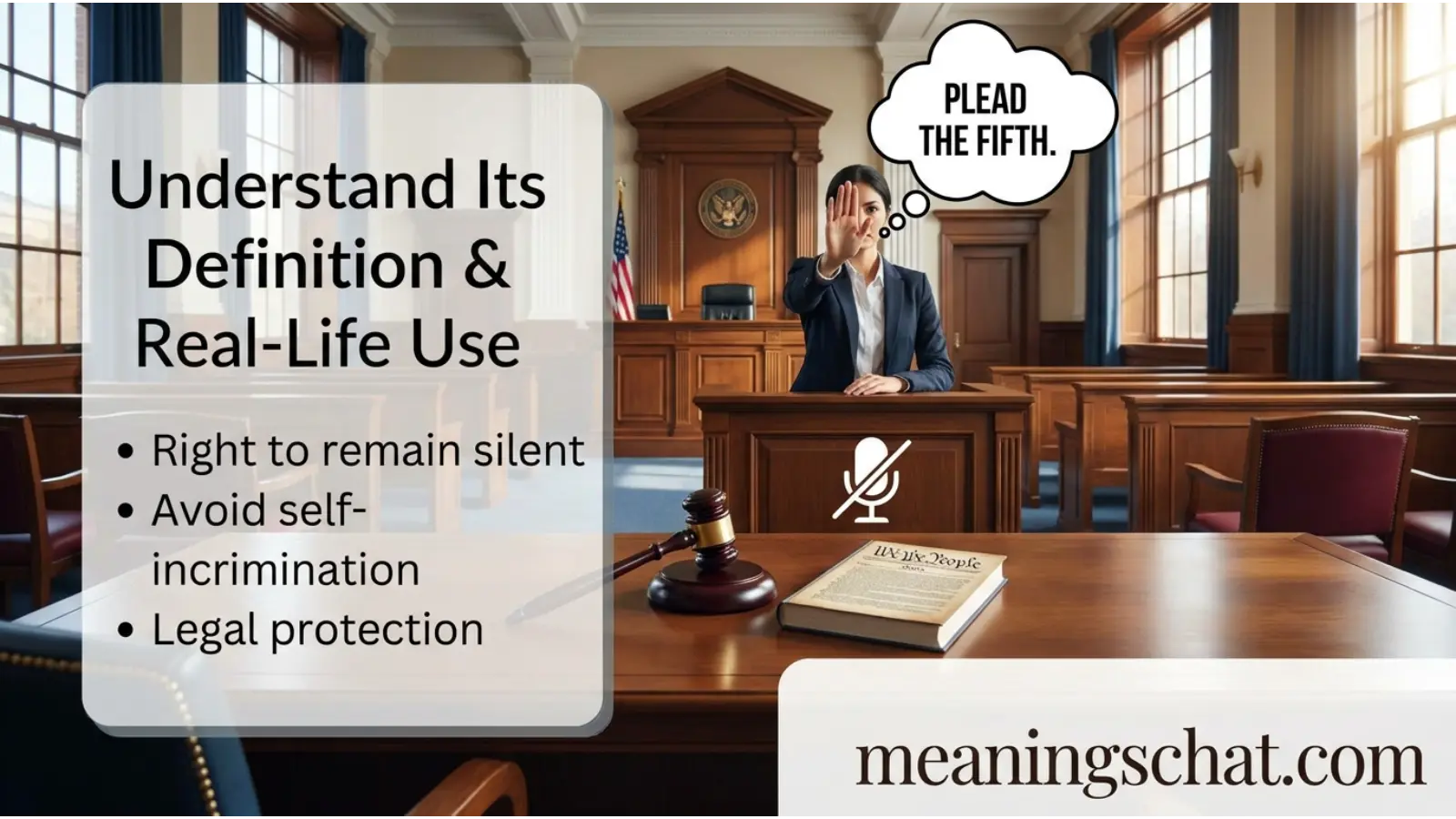
The phrase comes from the Fifth Amendment to the U.S. Constitution, which protects a person from being forced to give self incriminating testimony. In everyday conversations, however, people often use it in a much more casual and humorous way. It usually means, “I choose not to answer that question because my answer might get me into trouble.”
Quick Answer:
“I plead the fifth” means “I refuse to answer because my answer could reveal something embarrassing, incriminating, or uncomfortable.” In casual texting, it is often used jokingly.
What Does Plead the Fifth Mean in Text?
The plead the fifth meaning in text is usually a playful way to avoid answering a question.
For example, imagine your friend asks:
“Did you eat the last slice of pizza?”
You could reply:
“I plead the fifth 😂”
You are not necessarily making a serious legal claim. You are jokingly saying that you are not going to admit or deny anything.
In texting, the phrase can communicate:
- “I’m not answering that.”
- “I’m keeping that information to myself.”
- “My answer could get me in trouble.”
- “You already know the answer, but I’m not admitting it.”
- “Let’s just leave that question alone.”
The meaning depends heavily on context and tone.
Plead the Fifth Full Form and Definition
Many people search for the plead the fifth full form, but technically, “plead the fifth” is not an abbreviation.
It refers to the Fifth Amendment of the U.S. Constitution.
One part of the Fifth Amendment protects people from being compelled to act as witnesses against themselves in criminal cases. In simple terms, a person generally has a constitutional right to refuse to answer certain questions when answering could expose them to criminal self incrimination.
The everyday phrase developed from this legal protection.
So, when someone says:
“I plead the fifth.”
they may literally be referring to their legal right, but in casual conversation, they are often simply avoiding a question.
What Does Plead the Fifth Stand For?
If you are wondering what does plead the fifth stand for, the phrase refers to the Fifth Amendment of the U.S. Constitution.
The expression does not stand for a set of individual words like a texting abbreviation. Instead, it refers to a constitutional protection.
In casual speech, people have turned the legal concept into a common expression for refusing to answer.
For example:
Question: “Who told you about the surprise party?”
Reply: “I plead the fifth.”
The speaker is basically saying, “I am not going to tell you.”
Is Plead the Fifth Rude, Offensive, or Neutral?
“Plead the fifth” is generally neutral, but its tone can change depending on how someone uses it.
When friends use it jokingly, it can sound funny and playful.
For example:
“Did you really text your ex last night?”
“I plead the fifth. 😂”
This sounds lighthearted.
However, using the phrase with a serious question can sound evasive or dismissive. In a professional conversation, it may also come across as too casual.
It is not normally considered an offensive expression, but context matters.
Where Is Plead the Fifth Commonly Used?
The phrase appears in several types of communication.
Text Messages
Friends often use it when they do not want to answer a personal or embarrassing question.
“Did you buy another pair of sneakers?”
“I plead the fifth. 😅”
Social Media
People use it in comments, captions, memes, and posts.
“Who stayed up until 3 AM watching movies?”
“I plead the fifth.”
Casual Conversations
It can also work in spoken conversations among friends, family members, or coworkers who have a relaxed relationship.
Legal Discussions
In actual legal situations, the phrase has a much more serious meaning. The Fifth Amendment provides specific constitutional protections, and using the phrase casually should not be confused with exercising a legal right in court.
Real Life Examples of Plead the Fifth
Here are several examples showing how people may use the phrase naturally.
Friendly Example
Friend: “Did you finish the cookies I made?”
You: “I plead the fifth 😂.”
This jokingly avoids admitting that you ate them.
Casual Example
Friend: “How much did that new phone cost?”
You: “I plead the fifth.”
Here, the person does not want to reveal the price.
Embarrassing Example
Friend: “Did you actually dance alone in your room?”
You: “I plead the fifth! 😂”
The phrase creates a humorous way to avoid admitting something embarrassing.
Argumentative Example
Person A: “You knew this would happen, didn’t you?”
Person B: “I plead the fifth.”
In an argument, this could sound defensive or sarcastic rather than friendly.
Gaming Example
Player 1: “Who accidentally triggered the boss fight?”
Player 2: “I plead the fifth 😎.”
The player jokingly refuses to confess.
Social Media Example
Comment: “Who keeps checking their ex’s profile?”
Reply: “I plead the fifth 😂.”
The response suggests the person does not want to admit it.
Origin and Background of Plead the Fifth
The phrase comes from American constitutional law.
The Fifth Amendment is part of the Bill of Rights, which contains the first ten amendments to the U.S. Constitution.
One of its protections prevents the government from forcing a person to provide self incriminating testimony in certain circumstances.
Over time, “taking the Fifth” and “pleading the Fifth” became common expressions in American English.
Eventually, the phrase moved beyond courtrooms and legal discussions. People began using it humorously in everyday situations.
That is why you may see someone type:
“I plead the fifth 😂”
when a friend asks an awkward question.
The modern casual meaning is much broader than its original legal context.
Plead the Fifth Meaning as Slang
When people search for plead the fifth meaning slang, they are usually looking for the informal interpretation rather than the constitutional one.
As slang or casual language, it means:
“I am not going to answer that question.”
It often suggests that the answer might be embarrassing, revealing, or troublesome.
For example:
“Did you send that message?”
“I plead the fifth.”
The speaker is avoiding a direct answer.
The expression can also create playful suspense because it may make the other person even more curious.
Plead the Fifth vs. Similar Expressions
Several expressions have a similar meaning, but they do not always carry the same tone.
| Expression | Meaning | Typical Tone |
|---|---|---|
| Plead the fifth | Refuse to answer | Playful or evasive |
| No comment | Decline to give information | Neutral or serious |
| I’m not telling | Refuse to reveal something | Casual |
| That’s private | Keep information personal | Firm |
| I’d rather not say | Politely avoid answering | Polite |
| I can’t answer that | Avoid giving information | Neutral |
| Mind your business | Tell someone not to ask | Direct or rude |
“Plead the fifth” is especially recognizable because it has a humorous connection to American law.
When Should You Avoid Using Plead the Fifth?
Although the expression is common, it is not suitable for every situation.
Avoid using it when a clear and serious answer is necessary.
For example, a workplace manager asking about an important project probably needs a direct response. Saying “I plead the fifth” could make you sound unserious or uncooperative.
You should also avoid using it to make a serious legal situation sound like a joke.
Use the expression mainly in relaxed conversations where the other person understands your humor.
Polite Alternatives to Plead the Fifth
Sometimes you want to avoid answering without sounding sarcastic.
Try these alternatives:
- “I’d rather keep that private.”
- “I’m not comfortable answering that.”
- “I’d prefer not to say.”
- “That’s a little personal.”
- “I’m keeping that to myself.”
- “Let’s talk about something else.”
- “I’d rather not get into that.”
These alternatives work better in professional, formal, or sensitive situations.
Why Do People Use Plead the Fifth?
People use the phrase because it gives them an easy and recognizable way to avoid a question.
It can also make an awkward moment more entertaining.
For example, saying:
“I don’t want to answer.”
sounds direct.
But saying:
“I plead the fifth 😂”
can make the same refusal sound playful.
The phrase also works well because many Americans recognize its connection to the Fifth Amendment.
In online conversations, short expressions like this can communicate a complete attitude without requiring a long explanation.
Impact of Plead the Fifth in Communication
The phrase can change the mood of a conversation.
In a friendly setting, it can create laughter and keep the conversation light.
In a serious setting, however, it can create confusion. Someone may wonder if you are hiding something or deliberately avoiding responsibility.
Tone is especially important in text messages because readers cannot hear your voice or see your facial expression.
Adding an emoji can sometimes clarify your intention.
For example:
“I plead the fifth 😂”
usually sounds more playful than:
“I plead the fifth.”
The first version signals humor, while the second could sound more serious or defensive.
Is Plead the Fifth Safe for Social Media?
Yes, the phrase itself is generally fine for ordinary social media conversations.
People commonly use it in jokes, comments, memes, and casual posts.
However, remember that saying “I plead the fifth” online does not automatically create a legal privilege. The phrase has a specific legal background, while its social media use is often just humorous.
If a post involves an actual legal matter, avoid assuming that casual wording has the same effect as formally exercising a constitutional right.
Plead the Fifth in Different Tones
The meaning can shift depending on how you deliver it.
Funny
“Did you eat my fries?”
“I plead the fifth. 🍟😂”
The speaker is clearly joking.
Playful
“Who told you my secret?”
“I plead the fifth!”
This creates a teasing mood.
Sarcastic
“Did you really spend all your money on clothes?”
“I plead the fifth.”
The speaker may be joking while admitting nothing.
Serious
“Are you responsible for what happened?”
“I plead the fifth.”
Here, the phrase can sound much more serious and defensive.
Common Misunderstanding About Plead the Fifth
One common mistake is assuming that “plead the fifth” simply means “I am guilty.”
That is not correct.
Refusing to answer does not automatically mean someone is admitting guilt.
In casual conversation, the phrase can suggest that the person does not want to reveal something, but it does not necessarily mean the person did anything wrong.
For example:
“Did you buy me a birthday gift?”
“I plead the fifth.”
The person could simply be trying to keep the gift a surprise.
Is Plead the Fifth a Texting Abbreviation?
No.
“Plead the fifth” is a phrase rather than an abbreviation.
Unlike texting terms such as “LOL” or “BRB,” it does not shorten a longer expression into initials.
Its meaning comes from a constitutional reference that became part of everyday American English.
FAQs:
What does plead the fifth mean in text?
It usually means someone refuses to answer a question because the answer could be embarrassing, revealing, or troublesome. In texting, it is often used humorously.
What does “I plead the fifth” mean?
It means, “I choose not to answer that question.” The phrase comes from the Fifth Amendment of the U.S. Constitution.
Is plead the fifth slang?
It can function as casual slang or an idiomatic expression in everyday communication. Its original meaning, however, comes from U.S. constitutional law.
Is saying “I plead the fifth” rude?
Usually, no. Among friends, it can sound playful. In serious or professional situations, it may sound evasive or inappropriate.
Can I use plead the fifth on social media?
Yes. People commonly use it in casual posts, comments, jokes, and conversations. Its social media use is usually informal.
Does pleading the fifth mean you are guilty?
No. Refusing to answer does not automatically mean a person is guilty. In casual conversation, the phrase can simply mean that someone does not want to reveal information.
Conclusion
The plead the fifth meaning in text is usually simple: “I am not going to answer that.” People often use it as a funny or playful response when a question feels embarrassing, personal, or potentially troublesome.
The expression comes from the Fifth Amendment and its protection against compelled self incrimination in certain legal circumstances. In everyday texting, however, it has become a familiar way to dodge a question without giving a direct answer.
Use it freely in relaxed conversations when the tone is clear, but choose more direct or polite wording for professional and serious situations. Understanding the context helps you know when “I plead the fifth” sounds funny and when it might sound evasive.