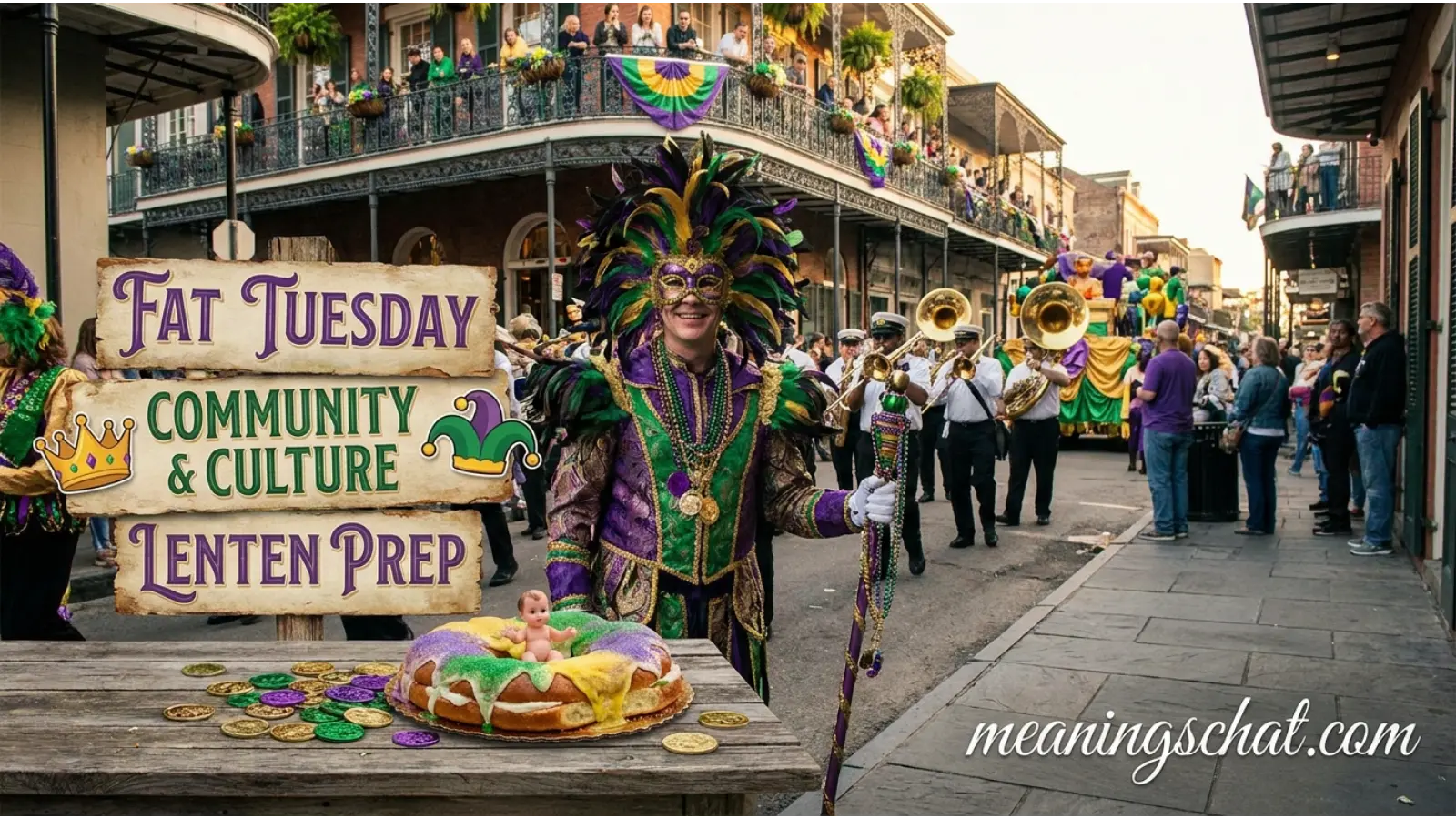
mardi gras meaning is a common search for people who have heard the phrase during carnival season but are not quite sure what it actually means. You may have seen colorful beads, masks, parades, costumes, and festive parties connected with Mardi Gras and wondered where these traditions came from.
Mardi Gras is more than a party. It is a festive season with deep historical, religious, and cultural roots. The phrase is French for “Fat Tuesday,” a name connected with the tradition of enjoying rich foods before the Christian season of Lent begins.
Today, Mardi Gras is celebrated in different ways around the world, with especially famous festivities in places such as New Orleans.
Quick Answer:
Mardi Gras means “Fat Tuesday,” the traditional day of celebration before Ash Wednesday and the beginning of Lent. Today, it commonly refers to the larger carnival season filled with parades, music, costumes, food, and community celebrations.
What Does Mardi Gras Meaning Refer To?
The mardi gras meaning comes directly from the French words Mardi Gras, which translate to “Fat Tuesday.”
“Mardi” means Tuesday, while “gras” means fat. The name reflects an old tradition of eating rich and indulgent foods before the fasting and self discipline associated with Lent.
Over time, Mardi Gras developed beyond a single Tuesday. In many places, the term now describes an entire carnival season that can include:
- Colorful parades
- Costumes and masks
- Live music
- Dancing
- Festive foods
- Floats
- Beads and other throws
- Street celebrations
- Family gatherings
- Cultural performances
The celebration can look different depending on the location and local traditions.
Mardi Gras Full Form and Definition
People sometimes search for the Mardi Gras full form, but Mardi Gras is not an abbreviation. It is a French phrase.
Here is the simple breakdown:
| French Word | English Meaning |
|---|---|
| Mardi | Tuesday |
| Gras | Fat |
| Mardi Gras | Fat Tuesday |
The term traditionally refers to the Tuesday immediately before Ash Wednesday.
Ash Wednesday marks the beginning of Lent in many Christian traditions. Lent lasts for approximately 40 days before Easter, excluding Sundays in traditional counting.
The idea behind “Fat Tuesday” comes from using up rich ingredients such as butter, eggs, meat, and other foods before the Lenten period of fasting or dietary restriction.
Is Mardi Gras Religious or Cultural?
Mardi Gras has Christian historical roots, particularly its connection with the period before Lent.
However, modern Mardi Gras celebrations can also have strong cultural and social identities. Many people participate for reasons that are not specifically religious.
For example, someone may attend a Mardi Gras parade because they enjoy:
- Music
- Art
- Costumes
- Local traditions
- Food
- Community events
- Family activities
- Carnival culture
This makes Mardi Gras both a historical religious tradition and a major cultural celebration in many communities.
Where Is Mardi Gras Commonly Celebrated?
Mardi Gras is associated with carnival traditions in many parts of the world.
In the United States, New Orleans, Louisiana, is particularly famous for its Mardi Gras celebrations. The city has developed a distinctive style featuring elaborate floats, marching groups, costumes, music, balls, and neighborhood traditions.
Other places also celebrate Mardi Gras or related carnival events, including communities across Louisiana and other parts of the United States.
Outside the United States, similar pre Lent celebrations exist under different names and with different customs. Carnival traditions are particularly important in countries and regions with historic Catholic and European influences.
The details can vary greatly, so there is no single way to celebrate Mardi Gras.
What Are the Traditional Mardi Gras Colors?
Three colors are strongly associated with New Orleans Mardi Gras:
- Purple represents justice.
- Green represents faith.
- Gold represents power.
These colors appear on decorations, costumes, flags, floats, beads, signs, and clothing.
If you see a combination of purple, green, and gold during carnival season, there is a good chance Mardi Gras is involved.
The colors have become an important visual part of the celebration and help create the bright, energetic atmosphere people associate with Mardi Gras.
What Happens During Mardi Gras?
A typical Mardi Gras celebration can include much more than one parade.
Depending on the location, festivities may involve organized parades, marching bands, decorated floats, costumes, dances, concerts, food events, and community gatherings.
One of the most recognizable traditions involves throws. During some parades, people on floats throw small items to spectators. Beads, cups, coins, toys, and other souvenirs can become part of the experience.
Mardi Gras also includes formal events in some communities, such as masquerade balls and private gatherings.
For families, Mardi Gras can include daytime parades, music, crafts, food, and kid friendly activities.
Mardi Gras Beads and Throws
Beads are among the most recognizable symbols of Mardi Gras.
During many parades, members of carnival organizations throw beads and other small items toward people watching along the parade route.
These items are often called throws.
Common examples include:
- Beaded necklaces
- Cups
- Coins
- Small toys
- Decorative items
- Collectible souvenirs
The tradition adds excitement to parades because spectators often cheer and reach out to catch the items.
The specific throws can vary between different parade organizations and locations.
Mardi Gras Masks and Costumes
Masks and costumes are another important part of Mardi Gras culture.
Historically, masks could provide a sense of anonymity and allow participants to step outside their everyday identities. Today, masks can also simply be decorative and artistic.
Costumes may include:
- Bright colors
- Feathers
- Sequins
- Glitter
- Elaborate headpieces
- Themed outfits
- Traditional carnival designs
Some costumes are simple, while others require extensive planning and craftsmanship.
This creative side of Mardi Gras is one reason the celebration has become visually recognizable around the world.
Mardi Gras Origin and Background
The history of Mardi Gras connects to older European carnival traditions and Christian observances before Lent.
In medieval Europe, communities developed traditions of feasting and celebration before the Lenten period. These customs evolved differently across regions.
French traditions eventually influenced celebrations in parts of North America. Louisiana became especially important in the development of the Mardi Gras traditions now associated with the United States.
New Orleans developed its own distinctive carnival culture over many generations. Social organizations known as krewes became an important part of the celebration.
Krewes organize parades, balls, events, and other Mardi Gras activities. Each organization may have its own history, themes, symbols, and traditions.
As a result, modern Mardi Gras represents a combination of religious history, European carnival traditions, local culture, music, food, art, and community identity.
What Is a Mardi Gras Krewe?
A krewe is an organization that participates in Mardi Gras celebrations, particularly through organizing parades and related events.
Krewes can have different structures and traditions. Some are historic organizations, while others are newer groups created around particular themes or communities.
A krewe may organize:
- A parade
- A themed float
- A formal ball
- Community events
- Special throws
- Costumes
- Social gatherings
The concept of the krewe is especially important to understanding the unique Mardi Gras culture of New Orleans.
Mardi Gras Meaning Compared With Carnival
Mardi Gras and Carnival are closely connected, but the terms are not always identical.
| Term | Basic Meaning |
|---|---|
| Mardi Gras | “Fat Tuesday,” traditionally the day before Ash Wednesday |
| Carnival | A broader festive season before Lent |
| Fat Tuesday | English translation of Mardi Gras |
| Shrove Tuesday | Another name for the Tuesday before Lent in some traditions |
| Ash Wednesday | Beginning of Lent in many Christian traditions |
In everyday conversation, people may use “Mardi Gras” to describe the entire celebration rather than only the final Tuesday.
This is why you may hear phrases such as “Mardi Gras season” or “Mardi Gras parade.”
When Is Mardi Gras Celebrated?
Mardi Gras does not fall on the same calendar date every year.
Its date is connected to Easter, which means the timing changes from year to year.
Mardi Gras takes place on the Tuesday before Ash Wednesday. Ash Wednesday then begins Lent in many Christian traditions.
This means you should check the calendar for the specific year if you want to attend a Mardi Gras event.
The broader celebration can also begin weeks before Fat Tuesday, depending on local customs and event schedules.
How Do People Use “Mardi Gras” in Conversation?
Unlike internet slang, Mardi Gras is normally used as the name of a celebration, season, or cultural tradition.
Here are some natural examples:
Friendly:
“Are you going to the Mardi Gras parade this weekend?”
Casual:
“I bought some purple and gold decorations for Mardi Gras.”
Excited:
“Mardi Gras is finally here. Let’s celebrate!”
Travel context:
“I’m visiting New Orleans during Mardi Gras season.”
Food context:
“We made a big meal for Mardi Gras.”
Social media:
“Ready for the colors, music, and parade! 🎭”
These examples show that the phrase is generally festive rather than slang.
Is Mardi Gras Rude or Offensive?
The phrase Mardi Gras itself is not rude or offensive.
It is the traditional name of a celebration. However, individual Mardi Gras events can have different atmospheres and customs.
Some events are family friendly, while others may be designed primarily for adults.
It is also important to respect local communities and cultural traditions. Avoid assuming that every Mardi Gras celebration is the same.
If you are attending an event, check the event rules and local expectations beforehand.
Why Do People Celebrate Mardi Gras?
People celebrate Mardi Gras for several connected reasons.
Cultural Tradition
For many communities, Mardi Gras is an important part of local identity and heritage.
Religious History
The celebration has historical connections to the period before Lent.
Community
Parades and public events bring families, friends, performers, artists, and visitors together.
Creativity
Floats, costumes, masks, music, and decorations allow people to express themselves creatively.
Food and Celebration
Mardi Gras has long been associated with feasting before the Lenten season.
Entertainment
For many modern participants, the music, parades, costumes, and festive atmosphere are the main attraction.
Is Mardi Gras Safe for Social Media?
Yes. The phrase Mardi Gras is generally safe and appropriate for social media.
You can use it in captions, posts, videos, travel content, and event announcements.
Examples include:
- “Mardi Gras vibes are here! 🎭”
- “Celebrating Mardi Gras with friends.”
- “The colors of Mardi Gras are impossible to miss.”
- “Mardi Gras parade day!”
- “Exploring New Orleans during Mardi Gras season.”
However, the content of a post matters more than the phrase itself. Some Mardi Gras events may feature adult themes, so make sure your content matches the platform and audience.
Mardi Gras Related Words and Phrases
If you are researching the Mardi Gras meaning slang or general meaning, you may also encounter these related terms:
- Fat Tuesday
- Carnival
- Krewe
- Parade
- Float
- Throws
- Beads
- Masquerade
- Lent
- Ash Wednesday
- Carnival season
- New Orleans Mardi Gras
- Mardi Gras colors
- Mardi Gras traditions
These terms can help you understand articles, social media posts, travel guides, and conversations about the celebration.
What Does Mardi Gras Stand For?
People sometimes search “what does Mardi Gras stand for?”
Technically, Mardi Gras does not “stand for” an abbreviation or acronym. Instead, it is a French phrase.
Mardi Gras = Fat Tuesday.
The phrase refers traditionally to the final day before Ash Wednesday and the beginning of Lent.
The broader cultural meaning has expanded over time, especially in places where Mardi Gras developed into a major public festival.
Real Life Mardi Gras Examples
Here are a few examples showing how the term can appear in everyday communication.
Friendly Example
“Hey! Are you joining us for the Mardi Gras celebration tonight?”
This sounds warm and social.
Casual Example
“I forgot it was Mardi Gras today until I saw all the decorations.”
This uses the term naturally in everyday conversation.
Travel Example
“We’re planning our trip around Mardi Gras so we can see the parades.”
Here, Mardi Gras refers to the broader celebration and season.
Social Media Example
“Purple, green, gold, music, and good vibes. Happy Mardi Gras! 🎭”
This is a typical festive social media use.
Informational Example
“Do you know the Mardi Gras meaning? It literally translates to ‘Fat Tuesday.’”
This introduces the historical definition.
Family Example
“The kids loved watching the Mardi Gras parade and catching beads.”
This highlights a family friendly aspect of the celebration.
When Should You Avoid Using the Term?
There is generally no reason to avoid the phrase Mardi Gras in ordinary conversation.
Still, context matters.
You may want to be more careful when discussing:
- Religious traditions
- Historical practices
- Local cultural customs
- Adult themed events
- Sensitive cultural topics
Use accurate language and avoid presenting one city’s traditions as though they represent every Mardi Gras celebration.
Respect for local customs is always a good approach.
Polite Alternatives to “Mardi Gras”
Because Mardi Gras is a proper name, there are not really “polite alternatives” in the way there are for offensive slang.
Depending on your meaning, you can say:
- Fat Tuesday
- Mardi Gras season
- Carnival season
- Mardi Gras celebration
- Carnival celebration
- Pre Lent celebration
However, these terms are not always exact substitutes.
For example, Fat Tuesday specifically refers to the Tuesday before Ash Wednesday, while Carnival season can refer to a broader period of festivities.
The Impact of Mardi Gras on Communication
Understanding the mardi gras meaning can prevent confusion when you see the phrase in conversations, travel content, advertisements, or social media.
Someone mentioning Mardi Gras may be talking about:
- A specific Tuesday
- A parade
- A festival
- A season of events
- New Orleans culture
- Carnival traditions
- Food and parties
- Religious history
Context tells you which meaning applies.
This is especially useful for travelers and people unfamiliar with carnival traditions. Knowing the background can make conversations about Mardi Gras much easier to understand.
FAQs:
What does Mardi Gras mean?
Mardi Gras is French for “Fat Tuesday.” It traditionally refers to the Tuesday before Ash Wednesday and is now also used for a broader carnival celebration.
What is the Mardi Gras full form?
Mardi Gras is not an abbreviation. It is a French phrase meaning “Fat Tuesday.”
What does Mardi Gras stand for?
It does not stand for separate words like an acronym. The phrase itself comes from French, with “Mardi” meaning Tuesday and “Gras” meaning fat.
Is Mardi Gras a religious celebration?
Mardi Gras has Christian historical roots because it occurs immediately before Lent. Modern celebrations can also have strong cultural and social elements.
Why does Mardi Gras use purple, green, and gold?
These three colors are strongly associated with New Orleans Mardi Gras. They are traditionally linked with justice, faith, and power.
Is Mardi Gras only celebrated in New Orleans?
No. Mardi Gras and related Carnival traditions are celebrated in many places. New Orleans is simply one of the world’s most famous destinations for Mardi Gras celebrations.
Conclusion
The mardi gras meaning is simple at its core: Mardi Gras is French for “Fat Tuesday.” Traditionally, it refers to the Tuesday before Ash Wednesday, marking the transition into Lent in Christian traditions.
Today, Mardi Gras has grown into a colorful cultural celebration known for parades, music, costumes, masks, food, floats, beads, and community events. Its traditions can differ from one place to another, with New Orleans being especially famous for its unique Mardi Gras culture.
Understanding the history behind the phrase makes the celebration even more interesting. So the next time you see purple, green, gold, masks, beads, and parade floats everywhere, you will know that Mardi Gras is about much more than simply having a good time.