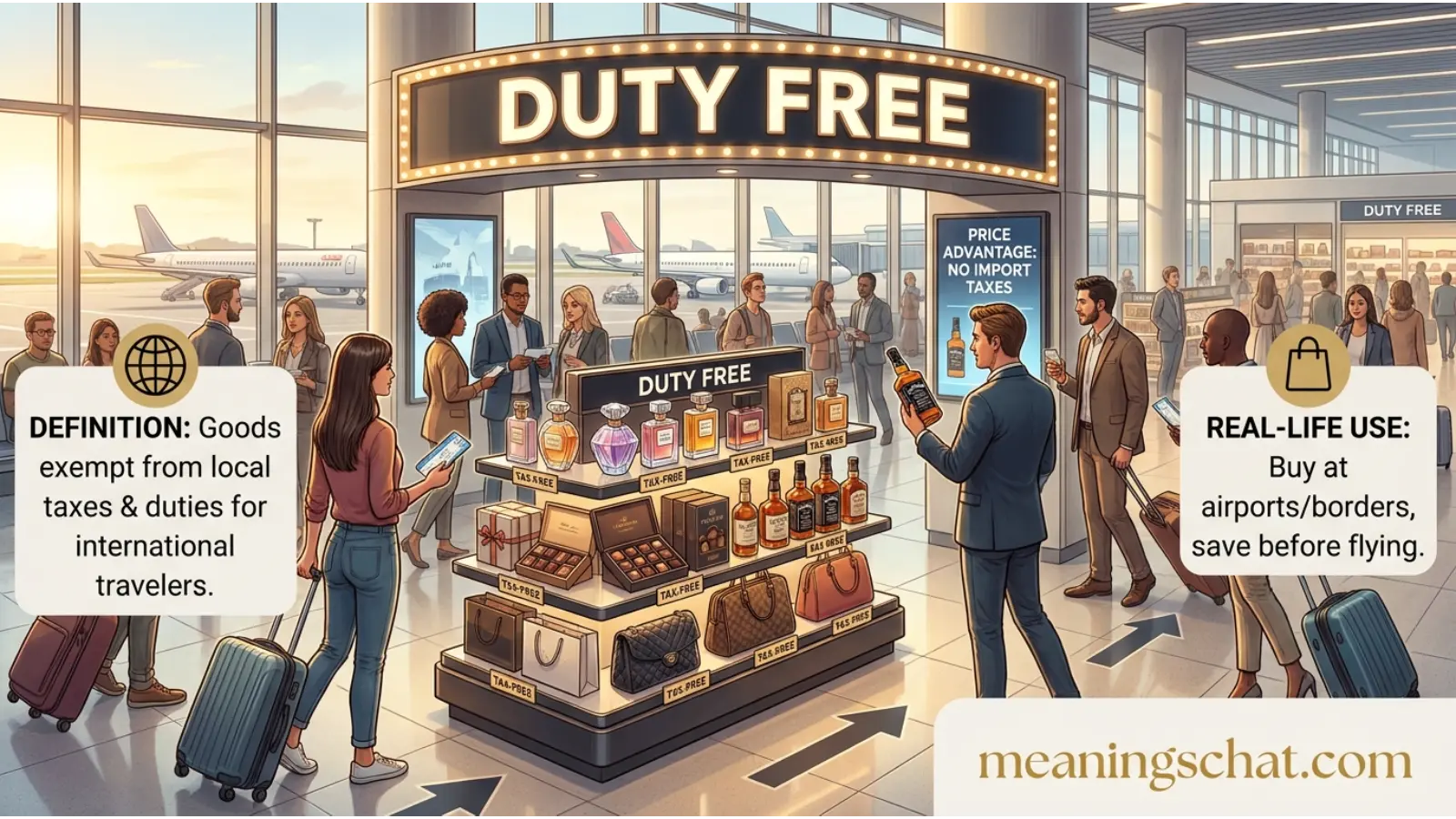
Duty free meaning usually refers to goods sold without certain local taxes or customs duties. You may see the term at airports, international borders, ports, and other travel locations. For many travelers, “duty free” sounds like a simple way to save money, but the rules can be a little confusing.
People often search for the duty free meaning because they want to understand why a product costs less, which items qualify, and if they can bring those purchases into another country without paying additional charges. The answer depends on where you buy the product, where you are traveling, and the import rules of your destination.
Quick Answer:
Duty free means certain goods are sold without specific taxes or customs duties that normally apply to products. Duty free shops mainly serve international travelers, but purchase and import limits can still apply.
What Does Duty Free Mean?
Duty free describes products that are exempt from certain taxes or customs duties under specific conditions.
The word “duty” refers to a tax charged by a government on certain goods, especially products entering a country. “Free” means that the applicable duty is not charged at the point of sale under the relevant rules.
For example, you might see a duty free shop at an international airport. The store may sell items such as:
- Perfume
- Cosmetics
- Chocolate
- Watches
- Jewelry
- Electronics
- Tobacco products
- Alcoholic beverages
However, duty free does not automatically mean every product is completely tax free. Different countries have different tax systems and import regulations.
The most important point is that duty free refers to specific taxes or duties, not necessarily every possible tax or charge.
Duty Free Full Meaning and Definition
If you are looking for the duty free full meaning, the simplest definition is:
Duty free means a product is sold without certain customs duties or taxes that would normally apply under particular circumstances.
The term is especially common in international travel.
Suppose you are traveling from one country to another and stop at an airport duty free shop. You may find a perfume that has a different price from the same perfume in a regular local store.
The difference can come from taxes and duties that do not apply to the duty free transaction.
Still, you should check the rules of your destination country. You may have to declare your purchases when you arrive.
What Does Duty Free Stand For?
People sometimes search for “what does duty free stand for?” Unlike an abbreviation, duty free does not stand for a longer phrase.
It is an ordinary English expression made from two words:
- Duty: A government imposed charge or customs tax on certain goods.
- Free: Not subject to that particular charge under the applicable conditions.
Together, duty free describes qualifying goods sold without certain duties or taxes.
How Does Duty Free Shopping Work?
Duty free shopping usually happens in places connected to international travel.
A typical process looks like this:
- You travel internationally.
- You enter an eligible duty free shopping area.
- You choose products that qualify under the store’s rules.
- You pay the listed price.
- The retailer handles the relevant duty free requirements.
- You take the products with you according to travel and customs rules.
The exact process varies by country and airport.
Some stores may ask to see your passport and boarding pass. Others may have special packaging requirements for liquids or restricted products.
That is why travelers should always check the purchase conditions before buying expensive items.
Where Is Duty Free Commonly Used?
The phrase duty free is most commonly associated with international travel.
You may encounter it in:
- International airports
- Border crossings
- Seaports
- Cruise terminals
- Certain travel retail stores
- Some special customs controlled areas
You might see signs such as:
Duty Free Shopping
Role Free Cosmetics
Function Free Liquor
Task Free Tobacco
The phrase is not normally used to describe an ordinary shop in a neighborhood.
Duty Free vs Tax Free
Duty free and tax free can sound identical, but they can refer to different things.
| Term | General Meaning |
|---|---|
| Duty free | Certain customs duties or taxes are not charged under specific conditions |
| Tax free | Certain taxes are removed, refunded, or not charged under applicable rules |
| Regular retail | Normal taxes and duties may be included according to local law |
| Customs allowance | A traveler can bring a limited quantity or value of goods without paying certain import charges |
The exact definitions depend on the country’s laws.
A product can be described as duty free while other taxes, restrictions, or import requirements still apply.
Is Duty Free the Same as Cheap?
No.
A duty free product is not automatically the cheapest option available.
A store may remove certain duties or taxes, but its retail price, exchange rate, operating costs, and promotions can affect the final amount you pay.
Before buying an expensive item, compare the duty free price with prices from reputable retailers.
This is particularly useful for:
- Designer fragrances
- Watches
- Electronics
- Luxury cosmetics
- Jewelry
A “duty free” label tells you about the tax treatment, not necessarily the quality or best possible price.
Real Life Examples of Duty Free Usage
Here are some natural examples showing how people use the phrase.
Friendly Example
Friend 1: “Did you buy anything at the airport?”
Friend 2: “Yes, I found some perfume in the duty free shop.”
Casual Example
“I always check the duty free stores before my international flight.”
Travel Example
“Are we allowed to buy duty free products before boarding?”
Shopping Example
“This watch was available at a duty free store, so I compared its price with local shops.”
Social Media Example
“Airport duty free shopping is dangerous for my wallet! 😂”
Informative Example
“Remember to check your destination’s customs allowance before purchasing duty free goods.”
Family Travel Example
“My parents bought chocolates and perfume from the duty free store.”
Duty Free Example in a Sentence
Here are a few additional examples:
- “I bought this fragrance at the duty free shop.”
- “The airport has a large duty free section.”
- “Check the customs rules before bringing duty free goods home.”
- “She compared the duty free price with the price at a local store.”
- “We stopped at the duty free shop during our international trip.”
These examples show that duty free normally describes a type of shopping or the products available through that shopping system.
Who Can Shop at Duty Free Stores?
Duty free stores mainly serve travelers who meet the requirements established by the relevant country or location.
At many international airports, travelers may need to show travel documents before completing a purchase.
Eligibility can depend on:
- Your destination
- Your travel route
- Your citizenship or residency
- The type of product
- The quantity purchased
- Local customs regulations
Not every traveler qualifies for every duty free purchase.
If you are unsure, ask the store staff before paying.
Are Duty Free Purchases Completely Free of Taxes?
Not necessarily.
This is one of the biggest misunderstandings about the phrase.
Duty free usually means that certain duties or taxes are not applied under particular conditions. It does not mean that the item has no connection to taxes at all.
When you arrive in another country, customs authorities may apply import taxes or duties if your purchases exceed the permitted allowance.
For this reason, duty free at the airport does not always mean duty free when you enter your destination country.
Always check the customs rules that apply to your trip.
Duty Free and Customs Allowances
Customs allowances are limits that determine how much of certain goods a traveler can bring into a country without paying applicable import charges.
These allowances can vary based on:
- Country
- Product category
- Quantity
- Value
- Traveler’s age
- Travel route
For example, alcohol and tobacco products often have specific quantity limits.
Luxury goods may also be subject to value based rules in some countries.
If you exceed an allowance, you may need to declare the goods and pay applicable charges.
When Should You Be Careful With Duty Free Shopping?
Duty free shopping can be convenient, but travelers should pay attention to the rules.
Be especially careful when buying:
- Large quantities of alcohol
- Tobacco products
- High value jewelry
- Expensive electronics
- Food products
- Restricted items
- Large amounts of liquids
Keep your receipts until you reach your final destination.
Receipts can help demonstrate what you purchased and how much you paid if customs officials ask questions.
Common Misunderstandings About Duty Free
Several myths can make duty free shopping confusing.
Myth 1: Everything Is Tax Free
Not necessarily. Duty free normally relates to specific taxes or customs duties.
Myth 2: You Can Bring Unlimited Products Home
Usually not. Destination countries can impose quantity and value limits.
Myth 3: Duty Free Always Means the Cheapest Price
Not always. You should compare prices before making a major purchase.
Myth 4: You Never Need to Declare Duty Free Goods
Incorrect. Some purchases may need to be declared when you enter your destination country.
Myth 5: Duty Free Means You Can Ignore Customs Rules
No. Duty free shopping and customs requirements are separate issues.
Why Do People Shop Duty Free?
Travelers choose duty free stores for several reasons.
Potential Savings
Removing certain duties or taxes can sometimes reduce the final price.
Convenience
Airports and other travel hubs make shopping convenient while travelers wait for transportation.
Product Selection
Duty free stores often focus on internationally popular brands, fragrances, cosmetics, confectionery, and travel related products.
Travel Experience
For some travelers, visiting a duty free store has become part of the airport experience.
Gifts
Travelers often purchase chocolates, perfumes, cosmetics, and other products as gifts.
Duty Free Meaning in Simple English
In very simple English:
Duty free means you can buy certain products without paying specific taxes or customs duties that normally apply.
The phrase is mostly connected with international travel.
For example:
“I bought perfume at the duty free shop.”
This means the perfume was purchased from a store operating under duty free rules.
Is Duty Free an English Slang Term?
No.
Duty free is not slang.
It is a standard English term used in travel, shopping, customs, aviation, and international commerce.
You can use it in both casual and formal conversations.
For example:
Casual: “I grabbed some chocolates from duty free.”
Formal: “Passengers should review the applicable duty free allowance before entering the country.”
The meaning remains the same, but the surrounding language changes depending on the situation.
Comparison With Similar Terms
| Term | Meaning |
|---|---|
| Duty free | Certain duties or taxes are not charged under specific conditions |
| Tax free | Certain taxes are not charged or may be refunded |
| Customs duty | A government charge on certain imported goods |
| Import tax | A tax that may apply when goods enter a country |
| Duty free shop | A retailer that sells qualifying goods under duty free rules |
| Customs allowance | The amount or value of goods that can enter under specified exemptions |
Understanding these terms can make international shopping much easier.
Is Duty Free Safe to Use on Social Media?
Yes.
Since duty free is a standard English term rather than offensive slang, you can safely use it on social media.
For example:
- “Duty free shopping before my flight ✈️”
- “Found a great fragrance at duty free!”
- “Airport duty free always gets me 😂”
- “Checking duty free prices before heading home.”
The phrase is suitable for travel posts, captions, comments, and ordinary conversations.
When Should You Avoid Using Duty Free?
There is no major social reason to avoid the phrase because it is neutral and widely accepted.
However, avoid making absolute claims such as:
“Everything here is completely tax free.”
That statement may be inaccurate.
Instead, use clearer wording:
“This product is available under duty free shopping rules.”
You should also avoid assuming that a duty free purchase is automatically exempt from customs requirements after you arrive in another country.
Why Do People Search for Duty Free Meaning?
People commonly search for the term when they:
- See “duty free” at an airport
- Plan an international trip
- Want to understand airport prices
- Need to know customs allowances
- See duty free on a receipt
- Want to buy gifts abroad
- Are confused about taxes on imported goods
The phrase looks simple, but the rules behind it can vary significantly.
FAQ:
What is the duty free meaning?
Duty free means certain goods can be sold without specific customs duties or taxes under applicable rules and conditions.
What does duty free stand for?
Duty free does not stand for an abbreviation. It is a standard phrase describing goods that qualify for exemption from certain duties or taxes.
Is duty free the same as tax free?
Not always. The terms can overlap, but duty free generally refers to customs duties and certain taxes, while tax free can refer more broadly to tax exemptions or refunds.
Can anyone buy duty free products?
Eligibility depends on the store, travel route, destination, and local regulations. International travelers commonly use duty free stores.
Does duty free mean the product is cheaper?
Not necessarily. Removing certain taxes or duties can reduce a price, but travelers should still compare prices before buying.
Do I have to declare duty free purchases?
You may need to declare certain purchases when entering your destination country, especially if you exceed applicable allowances. Always check the relevant customs rules.
Conclusion
The duty free meaning is simple: duty free describes qualifying goods sold without certain customs duties or taxes under specific conditions. You will most commonly encounter the term while traveling internationally, especially at airports and border locations.
Duty free is not slang, and it is perfectly normal to use in everyday conversation, travel discussions, and social media posts. The important thing to remember is that duty free shopping does not automatically remove every tax or customs requirement.
Before making a large purchase, compare prices, keep your receipts, and check the customs allowance for your destination. Understanding the rules can help you enjoy duty free shopping without an unpleasant surprise when you arrive home.