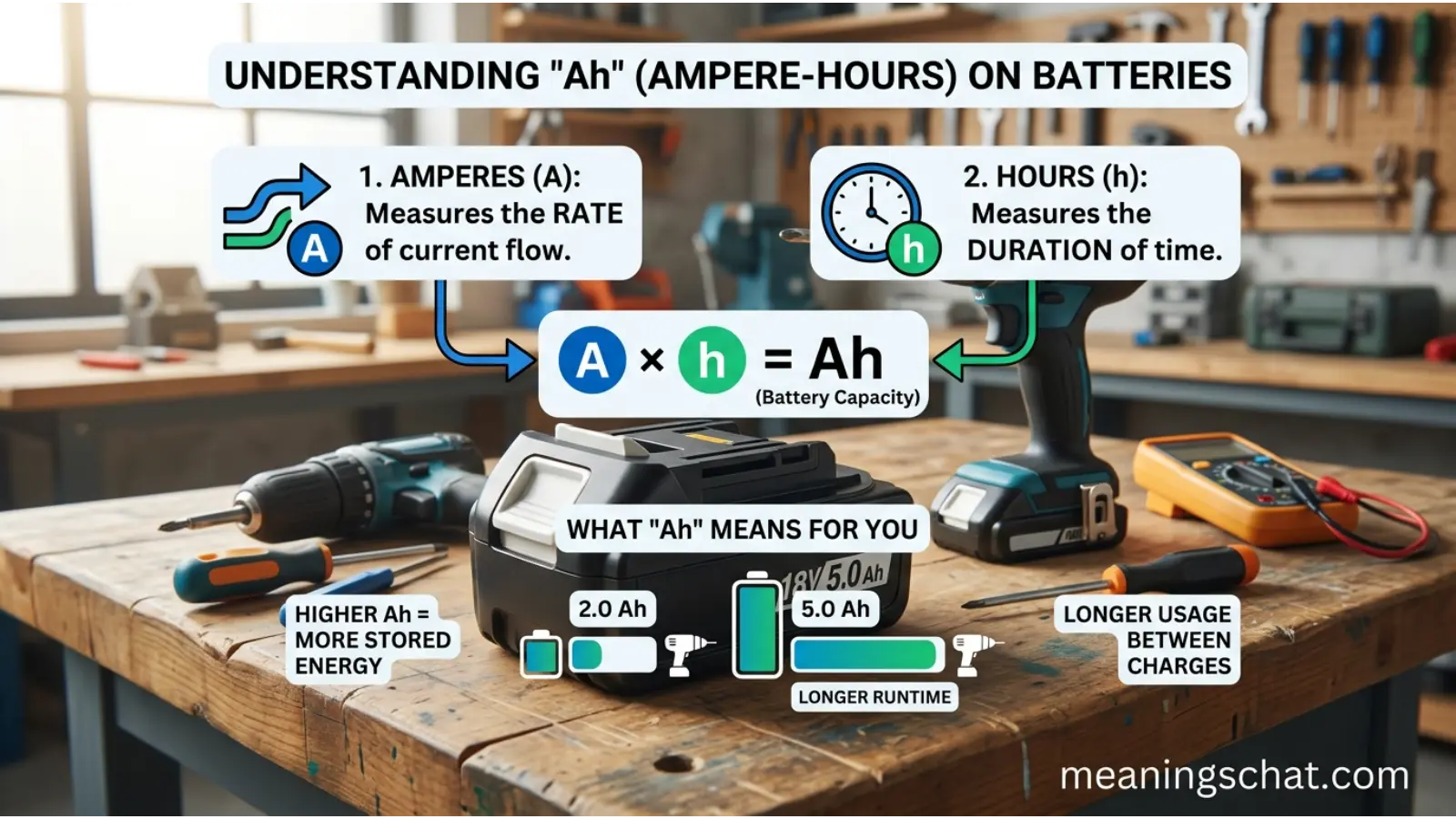
AH meaning on battery refers to ampere hour, a measurement used to describe a battery’s electrical capacity. If you have ever looked at a car battery, solar battery, UPS battery, motorcycle battery, or rechargeable battery and noticed labels such as 20Ah, 50Ah, or 100Ah, you may have wondered what those letters actually mean.
The term can seem confusing because “AH” also appears in texting and casual conversations, where it may have completely different meanings. On a battery label, however, AH is a technical measurement, not internet slang. Understanding it can help you choose the right battery and estimate how long it may power your devices.
Quick Answer:
AH on a battery stands for ampere hour. It indicates the battery’s capacity, or roughly how much electrical current the battery can deliver over a specified period under stated testing conditions.
What Does AH Mean on a Battery?
AH stands for ampere hour, sometimes written as Ah.
It measures a battery’s capacity. In simple terms, the AH rating gives you an idea of how much electrical charge a battery can provide.
For example, a battery rated at 50Ah could theoretically provide:
- 5 amps for about 10 hours
- 10 amps for about 5 hours
- 25 amps for about 2 hours
These examples are simplified calculations. Actual battery performance can vary because of temperature, battery chemistry, discharge rate, age, efficiency, and other factors.
The basic relationship is:
Amp hours = Current in amps × Time in hours
So, if a battery supplies 10 amps for 5 hours:
10A × 5 hours = 50Ah
This is why AH is an important number when comparing batteries.
What Is the AH Full Form?
The AH full form is ampere hour.
An ampere, represented by A, measures electric current. An hour represents a period of time. When combined, ampere hour describes the amount of electrical charge that can be delivered over time.
You may see the term written in several ways:
- Ah
- AH
- amp hour
- ampere hour
- amp hours
In technical battery specifications, Ah is the standard style you will commonly see.
For instance, a battery may be labeled:
12V 100Ah
This tells you two different things:
- 12V describes the battery’s nominal voltage.
- 100Ah describes its rated capacity.
Voltage and amp hours are not the same thing. A battery with a higher AH rating does not automatically have a higher voltage.
What Does AH Stand For in Battery Terms?
If you are wondering what does AH stand for, the answer is ampere hour.
Think of AH as the size of the battery’s electrical fuel tank.
A larger AH rating generally means the battery can store and deliver more charge than a similar battery with a lower AH rating. However, AH alone does not tell you the complete amount of energy available.
For energy calculations, voltage also matters.
A simple estimate is:
Watt hours = Volts × Amp hours
For example:
A 12V 100Ah battery has a nominal energy rating of approximately:
12 × 100 = 1,200Wh
That equals approximately 1.2kWh of nominal energy.
In real-world use, you may not be able to use all of that energy. Battery chemistry, recommended depth of discharge, inverter efficiency, temperature, and other factors can reduce usable capacity.
Is AH a Battery Capacity Rating?
Yes. AH is primarily used as a battery capacity rating.
When manufacturers specify a battery’s AH rating, they are describing its rated ability to deliver electrical charge under defined testing conditions.
A higher AH rating generally means more capacity.
For example:
| Battery Rating | General Capacity |
|---|---|
| 20Ah | Lower capacity |
| 50Ah | Medium capacity |
| 100Ah | Higher capacity |
| 200Ah | Very high capacity |
However, you should not compare AH ratings without considering voltage and battery chemistry.
A 100Ah 12V battery and a 100Ah 48V battery both have a 100Ah rating, but the 48V battery has much more nominal energy.
That is why watt hours can be more useful when comparing batteries with different voltages.
AH Meaning on Different Types of Batteries
The meaning of AH remains generally the same across different battery applications, but the way you use the rating can differ.
Car Batteries
Car batteries may use AH ratings, although automotive batteries are also commonly described using CCA, or cold cranking amps.
AH tells you about capacity, while CCA focuses on the battery’s ability to deliver a large current for starting an engine in cold conditions.
So, AH and CCA measure different characteristics.
Motorcycle Batteries
Motorcycle batteries often have relatively small AH ratings because motorcycles usually require less stored energy than larger vehicles.
You may see ratings such as 5Ah, 8Ah, 10Ah, or similar values depending on the motorcycle.
Solar Batteries
AH is very common in solar battery specifications.
For example, a 12V 100Ah battery may be used in a small solar power system. To determine how long it can operate a particular appliance, you need to consider the appliance’s wattage and the battery’s usable energy.
UPS Batteries
UPS systems often use batteries rated in AH.
A higher capacity battery can potentially keep equipment running longer, assuming the UPS and battery system are designed to support that capacity.
Lithium Batteries
Lithium iron phosphate, or LiFePO4, batteries are frequently sold with AH ratings such as 50Ah, 100Ah, and 200Ah.
Their usable capacity can differ significantly from some traditional lead acid batteries because lithium batteries can often be discharged more deeply.
How Long Will a Battery Last Based on AH?
One of the most common questions about AH is how long a battery will last.
A simple estimate is:
Runtime = Battery capacity in Ah ÷ Load in amps
For example, suppose you have a 100Ah battery and your device draws 10 amps.
100Ah ÷ 10A = 10 hours
That is a theoretical estimate.
Actual runtime may be shorter because batteries do not always deliver their rated capacity at every discharge rate. Temperature, battery condition, age, wiring losses, inverter losses, and the manufacturer’s testing conditions can all affect performance.
For devices that use watts rather than amps, you can first estimate energy in watt hours.
For example:
12V × 100Ah = 1,200Wh
If your appliance consumes 120 watts, a basic theoretical estimate would be:
1,200Wh ÷ 120W = 10 hours
Again, real runtime will usually differ from the theoretical result.
Does a Higher AH Battery Last Longer?
Generally, yes, when comparing batteries with the same voltage, chemistry, and similar operating conditions.
For example, a 100Ah battery generally provides more capacity than a 50Ah battery of the same voltage.
You can think of it like comparing two fuel tanks.
A larger tank can hold more fuel, but the vehicle’s fuel consumption still determines how long that fuel lasts.
The same idea applies to batteries:
Higher AH + same load = potentially longer runtime
But AH is not the only specification you should consider.
Also check:
- Voltage
- Battery chemistry
- Usable capacity
- Maximum continuous current
- Peak current
- Recommended depth of discharge
- Charging requirements
- Temperature range
- Physical size
- Manufacturer specifications
AH vs Wh: What Is the Difference?
AH and Wh are closely related, but they are not identical.
AH measures electrical charge capacity, while Wh measures energy.
The relationship is:
Wh = V × Ah
For example, consider a 12V 100Ah battery:
12V × 100Ah = 1,200Wh
Now consider a 24V 100Ah battery:
24V × 100Ah = 2,400Wh
Both batteries have 100Ah, but the 24V battery has twice the nominal energy.
This is why watt hours are useful when comparing batteries with different voltage ratings.
AH vs CCA
People sometimes confuse AH with CCA, especially when shopping for car batteries.
They measure different things.
| Specification | Meaning | Main Purpose |
|---|---|---|
| AH | Ampere hour | Measures capacity |
| CCA | Cold cranking amps | Measures starting performance in cold conditions |
| V | Voltage | Measures electrical potential |
| Wh | Watt hours | Measures energy |
A car battery can have strong starting performance without necessarily having the largest AH rating.
Always choose a battery based on the requirements of the equipment or vehicle rather than focusing on one number.
AH Meaning in Text: Is It the Same Thing?
No. AH meaning in text can be different from AH meaning on a battery.
In texting, “ah” is often an informal expression rather than a technical abbreviation. Depending on the conversation, someone might use “ah” to express realization, hesitation, surprise, understanding, or a reaction.
For example:
“Ah, now I understand.”
Here, “ah” is simply an interjection.
On a battery label, however, Ah means ampere hour.
Context is therefore extremely important.
If someone says, “This battery is 100Ah,” they are talking about battery capacity.
If someone texts, “Ah, okay,” they are expressing a conversational reaction.
AH Meaning Slang vs Battery Meaning
The phrase AH meaning slang can lead to confusion because abbreviations often have multiple meanings.
| AH Usage | Meaning |
|---|---|
| Battery specification | Ampere hour |
| Texting | Informal reaction or interjection |
| Casual writing | Expression of realization or emotion |
| Electrical context | Ampere hour |
The surrounding words usually make the intended meaning clear.
For example:
“My battery is 100Ah.”
Here, AH clearly means ampere hour.
But:
“Ah, I forgot my keys.”
Here, “ah” is a conversational expression.
Real Life Examples of AH on a Battery
Friendly Example
Alex: “What size battery did you buy?”
Sam: “I got a 100Ah battery for the solar setup.”
In this conversation, AH refers to battery capacity.
Casual Example
“This 12V 100Ah battery should give me more capacity than my old 50Ah battery.”
The speaker is comparing battery capacity.
Technical Example
“Check the manufacturer’s specifications before assuming a 100Ah battery will deliver 100 amps for one hour.”
This is important because the rated AH capacity depends on defined testing conditions.
Solar Power Example
“I’m using a 12V 100Ah battery with my small solar system.”
Here, the battery’s voltage and capacity help determine its nominal energy storage.
Gaming Context
“My controller battery is rated at 2Ah, so I’m checking how long it should run.”
The AH rating describes the battery’s capacity, although actual runtime depends on power consumption and other factors.
Social Media Example
“Anyone know what Ah means on this battery?”
A helpful response would be:
“It means ampere hour, which is a measure of the battery’s capacity.”
How to Read a Battery Label
Suppose you see this on a battery:
12V 100Ah
Here is what it means.
12V: The battery has a nominal voltage of 12 volts.
100Ah: The battery has a rated capacity of 100 ampere hours.
You can use these values to estimate nominal energy:
12 × 100 = 1,200Wh
That means approximately 1,200 watt hours of nominal energy.
However, do not assume that you can always use exactly 1,200Wh. The actual usable energy depends on the battery type, operating conditions, discharge limits, and equipment efficiency.
Why Do People Use AH Ratings?
Battery manufacturers use AH ratings because they provide a convenient way to describe battery capacity.
Consumers can use the rating to compare batteries designed for similar applications.
For example, someone choosing a battery for an RV may compare a 50Ah battery with a 100Ah battery. Someone building a backup power system may consider 100Ah, 200Ah, or larger options.
The AH rating helps users estimate whether a battery has enough capacity for their expected load.
Still, it should never be the only specification considered.
Common Mistakes When Understanding AH
Several misunderstandings appear frequently when people shop for batteries.
Mistake 1: Thinking AH Means Voltage
It does not.
A battery can be 12V 100Ah, 24V 100Ah, or 48V 100Ah.
The voltage and capacity are separate specifications.
Mistake 2: Assuming 100Ah Means 100 Amps for One Hour
That is an oversimplification.
The rated capacity is measured under specific conditions. Actual performance can change depending on the battery and discharge rate.
Mistake 3: Ignoring Battery Chemistry
A 100Ah lead acid battery and a 100Ah lithium battery may have different usable capacities and performance characteristics.
Mistake 4: Ignoring Energy Consumption
A high AH rating does not automatically mean long runtime.
A powerful appliance can drain a battery much faster than a low power device.
When Should You Check the AH Rating?
You should pay attention to AH when you are:
- Buying a replacement battery
- Building a solar power system
- Selecting an RV battery
- Choosing a backup battery
- Comparing UPS batteries
- Planning portable power
- Checking motorcycle batteries
- Estimating approximate runtime
- Designing a battery bank
Always compare the AH rating with your equipment’s voltage and power requirements.
Is AH Safe to Use on Social Media?
Yes. There is nothing offensive or inappropriate about using Ah to discuss battery specifications.
For example:
“This battery is rated at 100Ah.”
That is a normal technical statement.
The only potential issue is confusion when people use “AH” in a conversation without explaining what they mean. Since AH can have different meanings, adding context makes communication clearer.
Instead of simply writing:
“I need a higher AH.”
You could write:
“I need a battery with a higher Ah capacity.”
That makes your meaning much easier to understand.
Polite and Clear Alternatives to AH
If you are explaining battery specifications to someone unfamiliar with electrical terms, use plain language.
You can say:
- Battery capacity
- Ampere hour rating
- Battery capacity in Ah
- Rated capacity
- Electrical capacity
For example:
“This battery has a 100Ah capacity.”
That is clearer for beginners than simply saying:
“It has 100Ah.”
AH Meaning on Battery: Key Points to Remember
The most important facts are simple:
- AH stands for ampere hour.
- Ah is a measurement of battery capacity.
- A higher Ah rating generally means greater capacity when comparing similar batteries.
- AH does not mean voltage.
- Watt hours can be calculated using voltage × amp hours.
- Actual battery runtime depends on the load and operating conditions.
- Battery chemistry can affect usable capacity.
- AH in a battery specification is different from “ah” used in casual texting.
- Always check the manufacturer’s specifications before selecting a battery.
FAQs:
What does AH mean on a battery?
AH means ampere hour. It describes the battery’s rated capacity and helps indicate how much electrical charge it can deliver under specified conditions.
What is the AH full form?
The AH full form is ampere hour. It is commonly used to describe battery capacity.
What does 100Ah mean on a battery?
A 100Ah rating means the battery has a rated capacity of 100 ampere hours under the manufacturer’s specified testing conditions. It does not guarantee a fixed runtime because actual performance depends on the load and other factors.
Is a higher Ah battery better?
A higher Ah battery can provide greater capacity, but it is not automatically better. You should also consider voltage, chemistry, physical size, charging requirements, discharge limits, and the equipment’s specifications.
What does AH mean in text?
In texting, “ah” can work as an informal interjection showing realization, understanding, hesitation, or another conversational reaction. Its meaning depends on context.
How do I calculate battery watt hours from Ah?
Multiply the nominal voltage by the amp hour rating.
Wh = V × Ah
For example, a 12V 100Ah battery has approximately 1,200Wh of nominal energy.
Conclusion
AH meaning on battery is straightforward once you know the basic electrical terms. AH, or ampere hour, measures a battery’s rated capacity and helps you estimate how much electrical charge it can provide. A larger AH rating generally means greater capacity when comparing batteries with similar voltage and characteristics.
Remember that AH is different from voltage, watt hours, and CCA. Each specification tells you something different about battery performance. Also keep context in mind when searching for AH meaning in text, because “ah” in a conversation may simply be an informal expression rather than a battery measurement.
When choosing a battery, look beyond the AH number. Check the voltage, chemistry, usable capacity, discharge limits, manufacturer specifications, and the power requirements of your equipment. Understanding these details will help you make a smarter and safer battery choice.