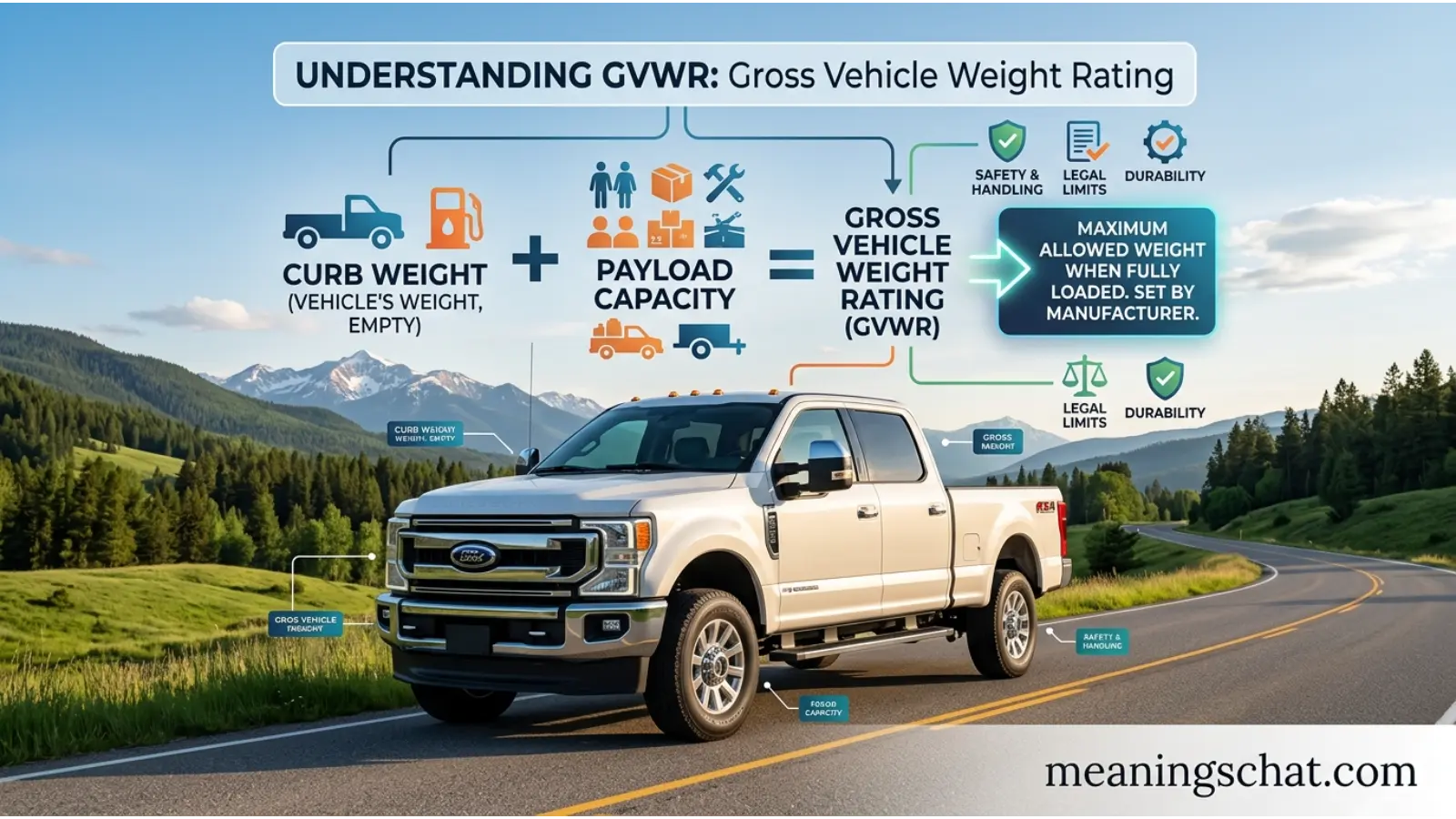
GVWR meaning can be confusing if you see it on a vehicle label, truck specification sheet, trailer document, or online discussion. Unlike popular texting abbreviations, GVWR is not usually internet slang. It is a standard automotive abbreviation that tells you the maximum weight a vehicle is designed to safely carry when fully loaded.
People often search for the GVWR meaning in text because they encounter these four letters while shopping for a truck, checking a vehicle door sticker, towing a trailer, or comparing vehicle specifications. Understanding the term can help you avoid overloading your vehicle and make smarter decisions about towing and hauling.
Quick Answer:
GVWR stands for Gross Vehicle Weight Rating. It is the maximum total weight a vehicle is rated to carry, including the vehicle itself, passengers, cargo, fuel, and other items inside or attached to it.
What Does GVWR Mean?
GVWR means Gross Vehicle Weight Rating.
It refers to the maximum total weight that a vehicle is designed and rated to handle safely. This rating comes from the vehicle manufacturer and takes into account important components such as the frame, suspension, brakes, tires, wheels, and other systems.
For example, imagine a pickup truck has a GVWR of 7,000 pounds. The truck’s total actual weight should not exceed 7,000 pounds when you include:
- The truck itself
- The driver
- Passengers
- Fuel
- Tools
- Equipment
- Cargo
- Certain tongue or pin weight from a trailer
The important point is that GVWR is a rating, not the vehicle’s current weight.
A truck may weigh 5,000 pounds when empty but have a GVWR of 7,000 pounds. In that situation, the remaining capacity is generally related to the vehicle’s available payload, subject to the manufacturer’s specifications and other limits.
What Is the GVWR Full Form?
The GVWR full form is Gross Vehicle Weight Rating.
Here is what each part means:
- Gross: The complete or total amount.
- Vehicle: The automobile, truck, van, or other vehicle being rated.
- Weight: The total weight being carried.
- Rating: The maximum weight limit established by the manufacturer.
So, Gross Vehicle Weight Rating essentially describes the maximum loaded weight a vehicle is designed to safely support.
What Does GVWR Stand For?
If you’re wondering what does GVWR stand for, the answer is Gross Vehicle Weight Rating.
You may find the GVWR listed on a certification label attached to the vehicle. On many vehicles, this information appears around the driver’s side door area or door frame.
The exact label and location can vary by vehicle, so checking your owner’s manual and manufacturer’s information is always a good idea.
Is GVWR Slang or a Texting Abbreviation?
No. GVWR is not normally slang or a texting abbreviation.
Someone might search for “GVWR meaning slang” because they see the abbreviation online and do not recognize it. However, GVWR belongs to the automotive and transportation vocabulary rather than casual texting language.
You are most likely to see GVWR in:
- Truck specifications
- SUV specifications
- Vehicle identification labels
- Trailer information
- Towing discussions
- Automotive forums
- Dealership listings
- Owner’s manuals
- Transportation documents
- Vehicle comparison articles
So, if someone sends you “GVWR” in a message about a truck, trailer, or towing setup, they are almost certainly referring to Gross Vehicle Weight Rating.
GVWR vs. Actual Vehicle Weight
One of the easiest mistakes is confusing GVWR with the vehicle’s current weight.
These terms are different.
GVWR is the maximum permitted or rated loaded weight established by the manufacturer.
Actual vehicle weight is how much the vehicle weighs at a particular moment.
For example:
A vehicle may have:
- GVWR: 8,000 pounds
- Empty weight: 5,500 pounds
- People and cargo: 1,000 pounds
Its actual loaded weight would be approximately 6,500 pounds.
That means it remains below its 8,000-pound GVWR, assuming all other applicable limits are also respected.
GVWR vs. Payload Capacity
GVWR and payload are closely connected, but they are not the same thing.
Payload generally describes how much additional weight the vehicle can carry. A simplified way to think about it is:
Payload capacity ≈ GVWR − vehicle’s actual empty or curb weight
However, real-world payload calculations can vary depending on the manufacturer’s definitions and equipment.
For example, if a truck has a GVWR of 7,500 pounds and its relevant empty weight is 5,500 pounds, you might have roughly 2,000 pounds of available payload.
That capacity may need to cover:
- Passengers
- Cargo
- Tools
- Accessories
- Fuel
- Trailer tongue weight
Always use the manufacturer’s specific ratings rather than relying only on a simple calculation.
GVWR vs. GVW
These terms look almost identical, but they describe different things.
GVWR means Gross Vehicle Weight Rating. It is the maximum rated loaded weight established by the manufacturer.
GVW means Gross Vehicle Weight. It refers to the vehicle’s actual total weight at a particular time.
Think of it this way:
| Term | Meaning |
|---|---|
| GVWR | Maximum rated total vehicle weight |
| GVW | Actual total vehicle weight |
| Payload | Weight the vehicle carries |
| Curb Weight | Vehicle weight in a specified unloaded condition |
This distinction becomes especially important when you’re loading a truck or preparing a vehicle for towing.
GVWR and Towing
GVWR is important when towing because part of the trailer’s weight can transfer onto the tow vehicle.
For example, the trailer itself may have a large total weight, but the portion placed on the truck through the hitch can contribute to the truck’s loaded weight.
That means towing capacity is not simply about asking, “How heavy is the trailer?”
You also need to consider the tow vehicle’s:
- GVWR
- Payload capacity
- Gross Axle Weight Rating
- Trailer rating
- Hitch rating
- Tire ratings
- Gross Combined Weight Rating
A vehicle can have enough engine power to pull something but still exceed another important weight rating. That’s why checking all relevant manufacturer specifications matters.
Real-Life Examples of GVWR
Here are several simple examples that show how people might use the term.
Example 1: Casual Conversation
Person A: “I’m looking at a new pickup truck.”
Person B: “Check the GVWR before deciding. You need to know how much weight it can handle.”
Here, GVWR refers to the truck’s Gross Vehicle Weight Rating.
Example 2: Buying a Truck
“The truck has a GVWR of 7,000 pounds, so I’m checking its payload before buying it.”
This use is common when comparing different trucks.
Example 3: Towing Discussion
“Make sure the loaded truck stays under its GVWR when you add passengers and trailer tongue weight.”
This is a practical use of the term in a towing conversation.
Example 4: Social Media
“Does anyone know the GVWR for this model?”
Someone might ask this in a Facebook group, Reddit discussion, automotive forum, or truck community.
Example 5: Gaming Context
GVWR is uncommon in gaming slang.
However, a realistic driving or truck simulation game may display vehicle specifications that include GVWR. In that situation, the term still means Gross Vehicle Weight Rating, not gaming slang.
Where Is GVWR Commonly Used?
GVWR appears most often in situations involving vehicles and weight management.
You may encounter it when:
- Shopping for a truck
- Comparing SUVs
- Choosing a work van
- Researching towing
- Buying a trailer
- Reading vehicle specifications
- Checking a vehicle label
- Discussing payload
- Planning a road trip with heavy cargo
- Comparing commercial vehicles
People who frequently tow boats, campers, utility trailers, or equipment tend to encounter GVWR more often.
Why Does GVWR Matter?
GVWR matters because exceeding a vehicle’s weight rating can create safety and handling concerns.
When a vehicle carries too much weight, important systems can experience additional stress. Extra weight can affect braking, handling, suspension performance, tire loading, and other aspects of vehicle operation.
Understanding GVWR helps drivers make better decisions about:
- How much cargo to carry
- How many passengers to transport
- Which truck to purchase
- How to plan a towing setup
- Which vehicle is appropriate for heavy loads
GVWR is only one rating, though. It should not be treated as the only number that matters when towing or hauling.
When Should You Check GVWR?
You should pay particular attention to GVWR when you’re planning to carry unusually heavy loads.
Check it before:
- Loading a truck with equipment
- Adding several passengers and luggage
- Towing a heavy trailer
- Installing heavy aftermarket equipment
- Choosing a vehicle for work
- Comparing trucks for towing
- Buying a camper or trailer
- Transporting construction or landscaping equipment
A few minutes spent checking the vehicle’s ratings can prevent costly mistakes later.
When to Avoid Guessing About GVWR
Don’t estimate GVWR based on the vehicle’s appearance, engine size, or how powerful the truck feels.
A large truck is not automatically capable of carrying unlimited weight.
Two trucks that look similar can have different weight ratings because of differences in:
- Engine configuration
- Suspension
- Axles
- Tires
- Brakes
- Wheelbase
- Cab configuration
- Factory equipment
- Vehicle design
For accurate information, check the manufacturer’s label, owner’s manual, or official vehicle documentation.
Similar Automotive Abbreviations
GVWR is often confused with other vehicle weight terms. Understanding the differences makes vehicle specifications much easier to read.
| Abbreviation | Full Form | Basic Meaning |
|---|---|---|
| GVWR | Gross Vehicle Weight Rating | Maximum rated loaded vehicle weight |
| GVW | Gross Vehicle Weight | Actual loaded vehicle weight |
| GCWR | Gross Combined Weight Rating | Maximum combined weight rating for vehicle and trailer combination |
| GAWR | Gross Axle Weight Rating | Maximum weight rating for a specific axle |
| Curb Weight | Curb Weight | Vehicle weight in a specified unloaded condition |
| Payload | Payload Capacity | Weight the vehicle can carry |
These ratings work together. Looking at only one number can give you an incomplete picture of what a vehicle can safely carry or tow.
GVWR Meaning in Text Messages
If someone writes “Check the GVWR” in a text message, they are most likely discussing a vehicle’s weight rating.
For example:
“Before we load the trailer, check the truck’s GVWR.”
In this sentence, GVWR does not have a hidden slang meaning. It simply uses an automotive abbreviation in casual communication.
Another example is:
“What’s the GVWR on your Silverado?”
Again, the person is asking about the vehicle’s Gross Vehicle Weight Rating.
Is GVWR Rude, Offensive, or Neutral?
GVWR is completely neutral.
It is not rude, insulting, offensive, or inappropriate. You can use the abbreviation in professional and casual conversations about vehicles.
It is suitable for:
- Work conversations
- Automotive forums
- Text messages
- Social media
- Dealership discussions
- Vehicle specifications
- Towing conversations
The only issue is that someone unfamiliar with automotive terminology may not understand it immediately.
Why Do People Use GVWR Instead of the Full Phrase?
People use GVWR because the full phrase, Gross Vehicle Weight Rating, is long.
The abbreviation makes communication faster and easier, especially for mechanics, truck owners, dealerships, engineers, fleet managers, and towing enthusiasts.
For example, saying:
“What is the Gross Vehicle Weight Rating of this truck?”
takes longer than:
“What’s the GVWR?”
Once people understand the abbreviation, it becomes much more convenient.
Is GVWR Safe to Use on Social Media?
Yes. GVWR is safe and normal to use on social media.
You may see it in posts about:
- Pickup trucks
- RVs
- Campers
- Trailers
- Towing
- Vehicle modifications
- Work trucks
- Vehicle reviews
For a general audience, it can help to write the full term the first time you mention it.
For example:
“The truck has a Gross Vehicle Weight Rating (GVWR) of 7,000 pounds.”
After that, you can simply use GVWR.
Common Mistakes About GVWR
A few misconceptions appear frequently in vehicle discussions.
Mistake 1: Thinking GVWR Means Empty Weight
It does not. GVWR represents the maximum rated loaded weight.
Mistake 2: Assuming GVWR Equals Towing Capacity
It does not. Towing capacity and GVWR are separate specifications.
Mistake 3: Ignoring Passengers
Passengers contribute to the vehicle’s loaded weight.
Mistake 4: Looking Only at Engine Power
A powerful engine does not automatically mean a vehicle can carry any amount of weight.
Mistake 5: Using an Online Guess
Vehicle ratings can vary by configuration, so use the manufacturer’s information for your specific vehicle.
FAQs About GVWR
What does GVWR stand for?
GVWR stands for Gross Vehicle Weight Rating. It is the maximum total weight a vehicle is rated to carry when loaded.
What is the GVWR full form?
The GVWR full form is Gross Vehicle Weight Rating, an important automotive specification used to describe a vehicle’s maximum rated loaded weight.
What does GVWR mean in text messages?
In text messages, GVWR usually has the same automotive meaning: Gross Vehicle Weight Rating. It is not commonly used as texting slang.
Is GVWR the same as payload?
No. GVWR is the maximum rated total vehicle weight, while payload generally refers to the additional weight a vehicle can carry.
Is GVWR the same as towing capacity?
No. GVWR measures the vehicle’s maximum rated loaded weight. Towing capacity describes how much trailer weight the vehicle is designed to tow under specified conditions.
Where can I find my vehicle’s GVWR?
You can often find GVWR on the manufacturer’s certification label, commonly located around the driver’s side door area. Your owner’s manual and manufacturer documentation can also provide relevant information.
Conclusion
The GVWR meaning is straightforward once you know the abbreviation. GVWR stands for Gross Vehicle Weight Rating, which represents the maximum total weight a vehicle is rated to handle when fully loaded.
Unlike texting slang, GVWR is an automotive term. You may see it in truck specifications, towing conversations, vehicle labels, dealership listings, and social media discussions about vehicles.
Understanding what GVWR stands for can help you distinguish it from GVW, payload, GAWR, and towing capacity. Most importantly, always use the manufacturer’s ratings for your specific vehicle instead of guessing from the vehicle’s size or engine power.
If someone uses “GVWR” in a text about a truck or trailer, you can confidently understand it as Gross Vehicle Weight Rating. The context makes the meaning clear, and the term is completely neutral and safe to use in both casual and professional communication.