“Secular” is not a slang term or text abbreviation. It is a standard English word that usually describes something not connected with religion or religious institutions. People often search for the secular meaning because they want to understand the word in news articles, politics, education, society, or everyday conversations.
The word can also describe a person, government, institution, or viewpoint that keeps religion separate from public or official matters. Its meaning can change slightly depending on the context, so understanding the sentence around it helps.
If you have seen “secular” in a social media post, article, school assignment, or conversation, you may wonder exactly what the speaker means. This guide explains the secular meaning, its origin, examples, related terms, and proper usage in simple English.
Quick Answer:
Secular means not related to religion or religious beliefs. It often describes people, institutions, governments, or ideas that operate independently of religion.
What Does Secular Mean?
The basic secular meaning is something that is not religious or connected to religious matters.
For example:
- A secular school does not teach religion as part of its core educational system.
- A secular government does not officially favor a particular religion.
- Secular music is music that does not have a religious purpose.
- A secular person may separate personal religious beliefs from public or professional matters.
The word does not automatically mean “against religion.” This distinction matters.
A secular approach generally focuses on keeping religious authority separate from a particular activity, institution, or area of public life.
Secular Meaning in Simple English
In very simple English, secular means “not religious.”
You can think of it this way:
Religious = connected to religion
Secular = not connected to religion
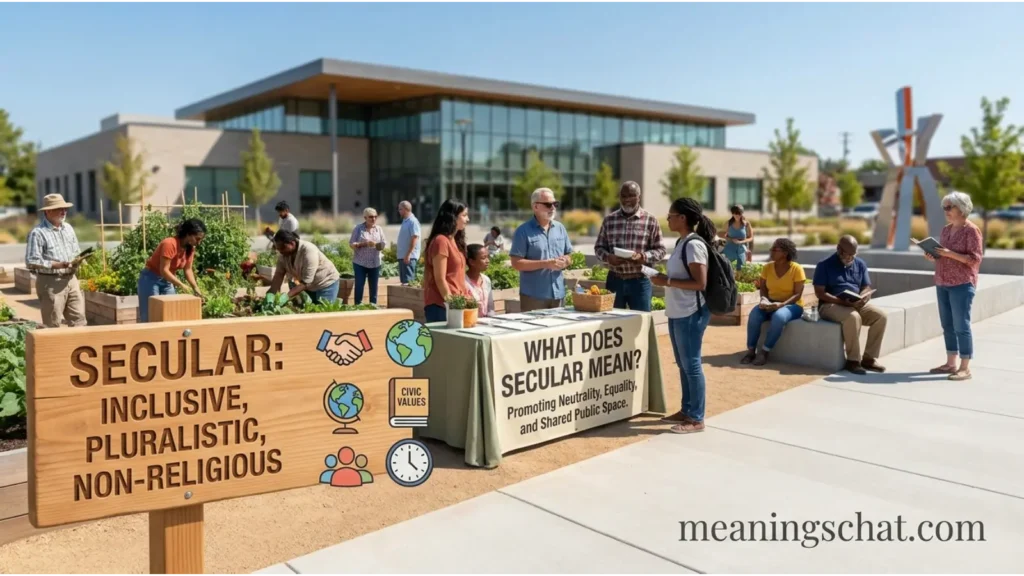
For example, imagine a community center that welcomes people from many different faiths and does not promote one religion. You could describe the center as secular.
The exact meaning depends on how someone uses the word.
Secular Meaning in Text
When someone uses “secular” in a text message, social media comment, or online conversation, they usually use the standard dictionary meaning rather than slang.
For example:
“The country has a secular government.”
This means the government operates independently of religious authority.
Another example:
“I prefer secular music.”
Here, the person means music that is not specifically religious.
So, unlike abbreviations such as “LOL” or “IDK,” secular does not have a special texting full form.
Secular Full Form
There is no secular full form because secular is a complete English word, not an abbreviation.
People sometimes search for “secular full form” because they expect it to represent a phrase or acronym. However, it does not.
The word secular comes from the Latin saecularis, which relates to the world or an age.
What Does Secular Stand For?
If you are asking “what does secular stand for?”, the answer is simple: it does not stand for a group of words.
Instead, secular describes something that is:
- Nonreligious
- Separate from religious authority
- Related to ordinary worldly life rather than religious practice
- Independent of a particular religion in certain contexts
The intended meaning depends on the situation.
Is Secular Rude or Offensive?
The word “secular” is generally neutral and not offensive.
It is a descriptive term used in everyday writing, academic discussions, journalism, politics, philosophy, and social conversations.
However, tone can change how people interpret it.
For example:
“The school follows a secular education system.”
This is a neutral statement.
But if someone says:
“You are too secular to understand religion.”
The word itself is still not necessarily offensive, but the overall sentence may sound judgmental.
So, context matters more than the word itself.
Where Is Secular Commonly Used?
You can find the word secular in many areas.
Education
Schools and universities may use “secular” when discussing education that does not promote a particular religion.
Example:
“The school provides a secular education.”
Government and Politics
The term frequently appears in discussions about government and public institutions.
Example:
“The constitution supports a secular system.”
Society
People may describe communities or social organizations as secular when religion does not control their activities.
Music and Art
The word can distinguish religious works from ordinary artistic works.
Example:
“The composer created both sacred and secular music.”
Philosophy
“Secular” can describe viewpoints that focus on worldly or nonreligious ideas.
Real-Life Examples of Secular
Here are some natural examples:
Example 1:
“The university offers a secular education.”
Meaning: The university does not base its education on a specific religious teaching.
Example 2:
“She prefers secular books.”
Meaning: She prefers books that are not primarily religious.
Example 3:
“The organization is secular and welcomes everyone.”
Meaning: The organization does not operate as a religious organization.
Example 4:
“They discussed secular politics.”
Meaning: They discussed politics that operates independently of religious authority.
Example 5:
“This is a secular celebration.”
Meaning: The celebration is not specifically religious.
Secular Meaning in Different Contexts
The meaning of secular can shift slightly depending on the topic.
Secular Government
A secular government generally separates government authority from religious authority.
This does not necessarily mean that religion is banned. It can mean that the government does not officially base its authority on one religion.
Secular Person
Calling someone secular can mean that the person does not strongly base their public or personal decisions on religious beliefs.
However, the label does not automatically tell you everything about that person’s personal beliefs.
Secular Society
A secular society generally gives greater space to nonreligious public institutions and allows people with different beliefs to participate equally.
Secular Education
Secular education focuses on subjects such as science, mathematics, history, literature, and other academic areas without making religious instruction the foundation of the curriculum.
Secular vs Religious
The easiest way to understand the term is to compare it with “religious.”
| Term | Meaning | Example |
|---|---|---|
| Secular | Not primarily connected with religion | Secular education |
| Religious | Connected with religion or faith | Religious ceremony |
| Sacred | Considered holy or religiously important | Sacred text |
| Nonreligious | Not religious | Nonreligious event |
“Secular” and “nonreligious” can overlap, but they are not always perfect synonyms.
For example, a government may be described as secular because it separates state authority from religion. That does not necessarily mean every person working in that government is nonreligious.
Secular vs Nonreligious
These two words often appear together, but they can have different uses.
Nonreligious generally describes a person, belief, activity, or object that is not religious.
Secular often emphasizes separation from religious authority or influence.
For example:
“He is nonreligious.”
This focuses on the person’s relationship with religion.
“The government is secular.”
This focuses on the relationship between government and religion.
Secular vs Atheist
“Secular” and “atheist” do not mean the same thing.
An atheist generally does not believe in the existence of gods.
A secular person or institution is associated with a separation between religious and nonreligious matters.
A person can support secular government while still being religious.
That is why it is incorrect to automatically assume that every secular person is atheist.
When Should You Avoid Using Secular?
There is usually no need to avoid the word, but you should use it accurately.
Avoid using “secular” when you actually mean:
- Atheist
- Anti-religious
- Nonreligious
- Spiritual
- Religious
These terms can describe different ideas.
For example, saying “secular means atheist” is inaccurate.
Instead, explain the specific idea you want to communicate.
Why Do People Use the Word Secular?
People use “secular” because it provides a concise way to describe the relationship between religion and another subject.
Instead of saying:
“This organization does not operate under religious authority.”
You can simply say:
“This is a secular organization.”
The word is especially useful in discussions about:
- Government
- Education
- Law
- Culture
- Politics
- Philosophy
- Art
- Society
Impact of Using Secular in Communication
Using “secular” can make communication more precise.
For example:
“The event is secular.”
This tells the reader that the event does not have a specifically religious character.
However, because religion can be a sensitive topic, you should avoid using the term as an insult or making assumptions about someone’s beliefs.
A respectful explanation works better than labeling someone without context.
Is Secular Safe for Social Media?
Yes. Secular is a normal, non-offensive English word and is generally safe to use on social media.
You might see it in posts about:
- Politics
- Education
- Religion
- Philosophy
- Culture
- Society
- Government
The word itself does not violate normal social media language standards.
Still, conversations about religion can become heated. Using neutral language and avoiding personal attacks can help keep discussions respectful.
Real-Life Examples of “Secular” in Different Tones
Friendly Example
“I enjoy both religious and secular music.”
This casually explains someone’s music preferences.
Casual Example
“The event is secular, so it isn’t connected to any particular religion.”
This gives a straightforward explanation.
Argumentative Example
“I think public institutions should remain secular.”
This expresses an opinion about the role of religion in public institutions.
Social Media Example
“A secular government can include citizens from many different religious backgrounds.”
This uses the word in a broader social discussion.
Academic Example
“The study examines the growth of secular institutions in modern society.”
Here, the word has a formal academic meaning.
Origin and Background of Secular
The history of secular goes back to Latin.
It comes from the Latin word saeculum, which referred to an age, generation, or the world of ordinary human life.
The Latin term saecularis developed from this idea and eventually influenced English.
Over time, “secular” became strongly associated with things that are separate from religious institutions or religious life.
Today, the word appears frequently in discussions about government, society, education, philosophy, culture, and everyday life.
Common Misunderstandings About Secular
Several misconceptions surround the word.
Secular Does Not Automatically Mean Anti-Religious
A secular institution can respect religion while keeping its official activities separate from religious authority.
Secular Does Not Automatically Mean Atheist
A religious person can support secular government or secular institutions.
Secular Does Not Mean Immoral
Some people mistakenly assume that something nonreligious must lack moral values. That conclusion does not follow from the word itself.
Secular Does Not Mean “Against Religion”
The word usually describes separation or lack of religious connection rather than hostility toward religion.
Polite Alternatives to Secular
If you want to make your meaning especially clear, you can sometimes use:
- Nonreligious
- Independent of religion
- Separate from religious authority
- Not specifically religious
- Religion-neutral
- Worldly
Choose the alternative that best matches your intended meaning.
For example, “not specifically religious” may sound clearer to a general audience than “secular.”
How to Use Secular Correctly
Here are some simple tips:
- Use “secular” when discussing something separate from religion.
- Do not use it as a synonym for atheist.
- Consider the context before labeling a person or institution.
- Use neutral language during sensitive discussions.
- Explain the term when writing for readers who may not know it.
Correct usage makes your writing clearer and prevents unnecessary misunderstandings.
Frequently Asked Questions
What is the secular meaning?
The secular meaning refers to something that is not religious or that operates separately from religious authority.
What is the secular full form?
Secular has no full form because it is not an abbreviation. It is a complete English word.
What does secular stand for?
“Secular” does not stand for a phrase. It describes something that is nonreligious or separate from religious authority, depending on the context.
Is secular the same as atheist?
No. Atheism concerns belief in gods, while secularism generally concerns the separation of religion from particular institutions or areas of public life.
Is secular a negative word?
No. “Secular” is generally a neutral and descriptive word. Its interpretation depends on the context and tone.
Can a religious person support secularism?
Yes. A person can have religious beliefs while supporting a secular government or secular public institutions.
Conclusion
The secular meaning is simple: it generally describes something that is not religious or operates separately from religious authority. You may encounter the word when reading about government, education, politics, society, culture, philosophy, or everyday life.
Remember that secular does not automatically mean atheist, anti-religious, or immoral. Context determines the precise meaning.
If you were searching for the secular meaning in text, you can usually understand it as “not specifically religious.” Use the word carefully, especially when discussing personal beliefs or sensitive social topics, and always consider the context surrounding it.