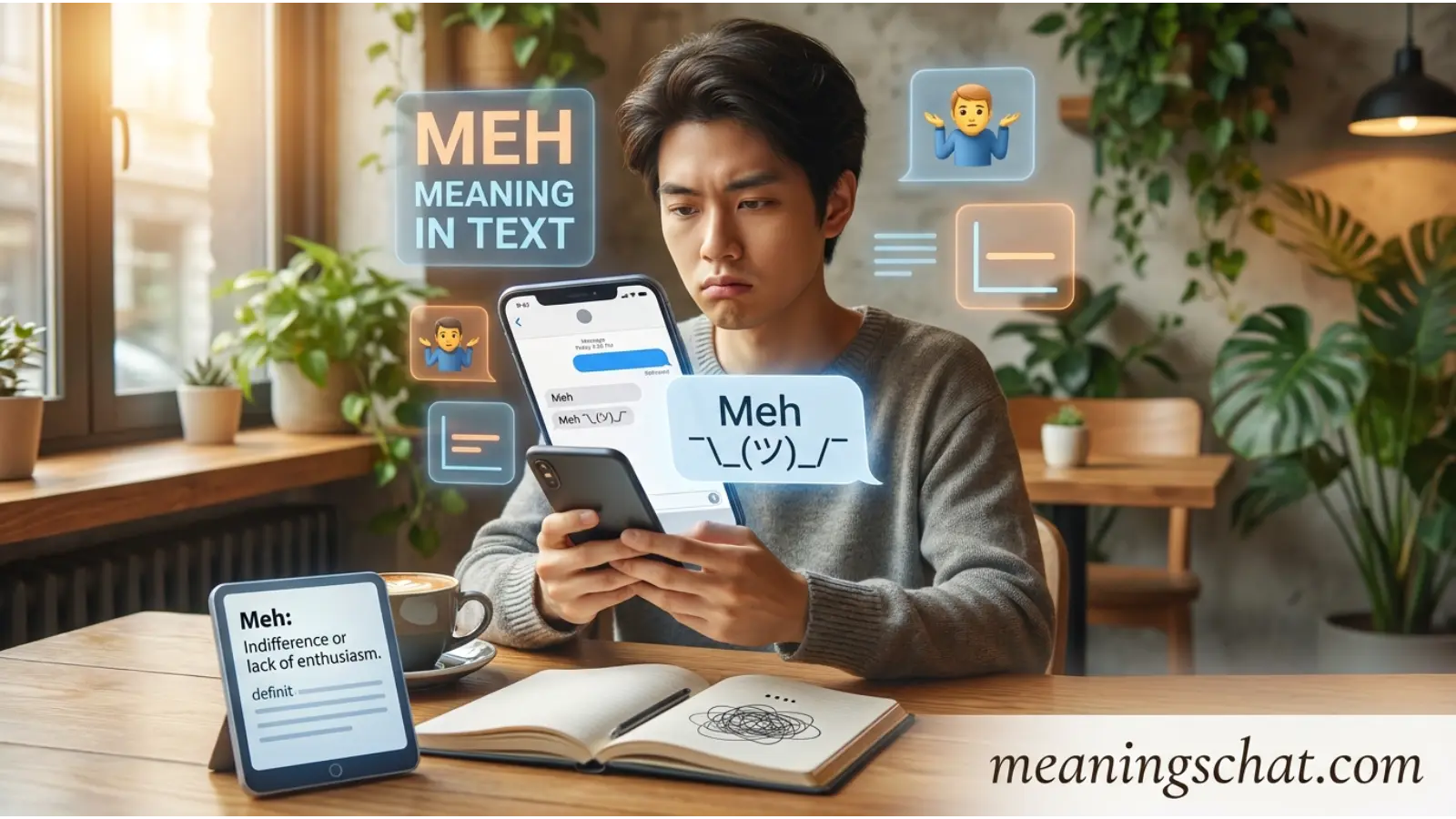
meh meaning in text usually refers to a casual way of showing indifference, boredom, or a lack of excitement. If someone sends you “meh” in a text, they often mean something like “I don’t really care,” “It’s okay,” or “I’m not impressed.” The exact meaning depends on the conversation and the person’s tone.
People often search for this slang because “meh” can feel confusing when it appears as a short, one-word reply. Unlike many texting abbreviations, it does not stand for a long phrase or formal expression. Instead, it works more like an informal reaction.
You might see it in texts, social media comments, chats, gaming conversations, and everyday online communication.
Quick Answer:
“Meh” means a feeling of indifference, mild disappointment, boredom, or a lack of enthusiasm. It can basically mean “I’m not impressed” or “I don’t really care.”
What Does Meh Mean in Text?
In text messages, meh expresses a weak or neutral reaction to something. It can show that a person does not feel strongly about a topic, event, idea, product, or situation.
For example:
“How was the movie?”
“Meh.”
Here, “meh” suggests that the person found the movie average or uninteresting. They did not necessarily hate it, but they did not enjoy it enough to recommend it enthusiastically.
The meaning can change slightly depending on the situation. It may communicate:
- Indifference
- Boredom
- Mild disappointment
- Lack of excitement
- Uncertainty
- A neutral opinion
- “It’s okay”
- “I don’t really care”
Because it is short and informal, the surrounding conversation usually provides the strongest clue.
Meh Full Form and Definition
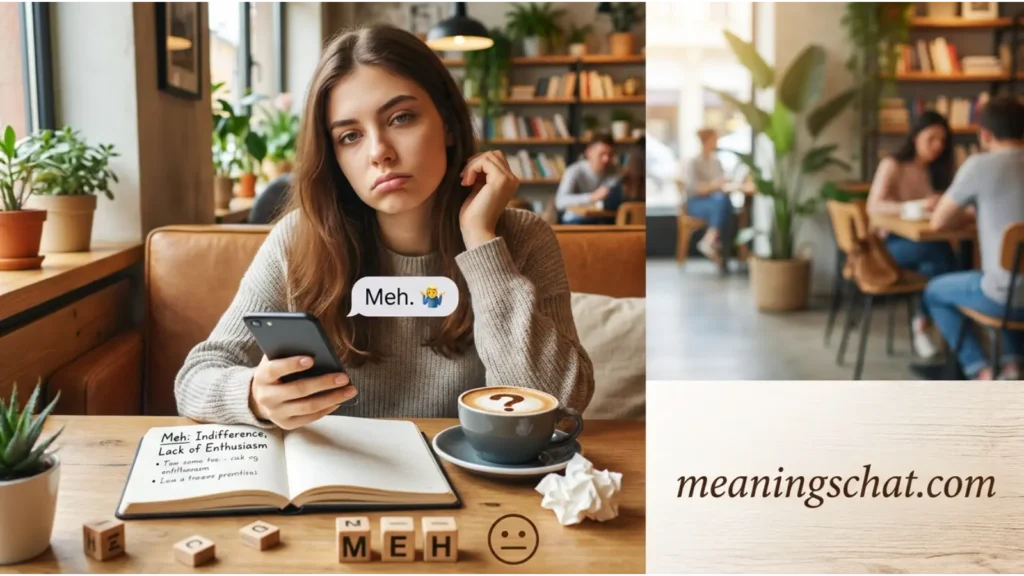
Many people search for the meh full form, but “meh” does not have a standard full form.
It is not an acronym like LOL, BRB, or IDK. Instead, “meh” functions as an interjection or informal expression.
The closest meanings include:
- “I don’t care.”
- “So-so.”
- “It’s nothing special.”
- “I’m not impressed.”
- “I feel indifferent.”
- “That does not excite me.”
So, if someone asks what does meh stand for, the simplest answer is that it does not stand for a specific phrase.
Meh Meaning Slang Explained
As slang, meh communicates a lack of strong emotion. It sits somewhere between positive and negative reactions.
Imagine someone asks:
“Do you want pizza tonight?”
You might reply:
“Meh, I’m fine with anything.”
In this case, you are not rejecting pizza. You simply do not have a strong preference.
Now consider another example:
“Did you like the new game?”
“Meh. It was pretty boring.”
Here, “meh” carries a slightly negative feeling.
This makes meh meaning slang highly dependent on context, punctuation, and the rest of the message.
Is Meh Rude, Offensive, or Neutral?
“Meh” is generally neutral and informal, but it can sometimes sound dismissive.
The word itself is not normally offensive or insulting. However, sending only “meh” in response to someone’s excitement may make them feel that you are ignoring or minimizing their feelings.
For example:
Friend: “I finally got tickets to the concert!”
You: “Meh.”
That response could sound cold because your friend expects excitement.
On the other hand:
Friend: “Did you like the restaurant?”
You: “Meh, it was okay.”
This sounds much more natural because you are simply giving an honest opinion.
Is Meh a Bad Word?
No. “Meh” is not generally considered a bad word or profanity.
Still, it may not fit professional communication. A workplace email, academic assignment, or formal message usually needs clearer language.
Where Is Meh Commonly Used?
People commonly use “meh” in informal digital communication.
You may find it in:
- Text messages
- Social media comments
- Group chats
- Online forums
- Gaming chats
- Memes
- Dating apps
- Casual conversations
- Product discussions
- Movie and TV reviews
It works especially well when people want to express an opinion quickly without writing a long explanation.
Real-Life Examples of Meh in Text
The following examples show how the meaning can change with context.
Friendly Example
Alex: “Want to watch that new comedy tonight?”
Sam: “Meh, sure. I have nothing else planned.”
Here, “meh” means Sam does not feel particularly excited but is willing to watch it.
Casual Example
A: “How was your weekend?”
B: “Meh. Pretty normal.”
Here, the person means the weekend was neither great nor terrible.
Disappointed Example
A: “Did the restaurant live up to the hype?”
B: “Meh. I expected better.”
Here, “meh” expresses mild disappointment.
Argumentative Example
A: “You should definitely buy this phone!”
B: “Meh. I don’t think it’s worth the money.”
In this context, “meh” dismisses the enthusiasm behind the recommendation.
Gaming Example
Player 1: “How’s the new update?”
Player 2: “Meh. The new map is okay, but the gameplay feels the same.”
Here, “meh” means the update is not impressive.
Social Media Example
Comment: “This is the best movie of the year!”
Reply: “Meh, I liked the older one more.”
The reply shows disagreement without directly attacking the other person’s opinion.
How to Use Meh in a Sentence
You can use “meh” by itself or combine it with additional words.
As a One-Word Reply
“Meh.”
This is the shortest form and often sounds indifferent.
With an Explanation
“Meh, it was okay.”
This makes your meaning clearer.
To Show Disappointment
“Meh, I expected more.”
This indicates that something failed to meet your expectations.
To Show No Preference
“Meh, you can choose.”
This means you do not strongly care about the decision.
Meh Meaning Depending on Tone
Tone plays a major role in understanding this slang.
| Message | Possible Meaning |
|---|---|
| “Meh.” | I don’t really care or feel excited. |
| “Meh, it’s okay.” | It’s average. |
| “Meh, whatever.” | I don’t want to argue about it. |
| “Mehhh 😅” | I’m unsure or mildly disappointed. |
| “Meh, I guess.” | I’m not enthusiastic, but I’ll accept it. |
| “That movie was meh.” | The movie was average or unimpressive. |
Extra letters, emojis, punctuation, and additional words can change the emotional feel.
Origin and Background of Meh
The exact history of “meh” is difficult to pin down because informal expressions often develop through everyday speech and popular culture.
The word became especially recognizable in modern American popular culture through The Simpsons, where characters used “meh” as an expression of indifference. The expression later became widespread across internet culture, social media, forums, and texting.
Today, people use “meh” far beyond television or meme culture. It has become a familiar informal English expression.
Its popularity comes partly from its simplicity. Instead of saying “I feel neither positive nor negative about this,” someone can simply type “meh.”
Meh vs. Similar Slang Terms
Several informal expressions can communicate a similar idea, but they do not always carry the same tone.
| Slang | Meaning | Typical Tone |
|---|---|---|
| Meh | Indifferent or unimpressed | Neutral |
| Whatever | I don’t care or don’t want to discuss it | Dismissive |
| IDK | I don’t know | Uncertain |
| Eh | Not impressive or uncertain | Neutral |
| So-so | Average or okay | Neutral |
| Fine | Acceptable | Neutral |
| Nah | No or rejection | Negative |
“Meh” usually focuses on a lack of enthusiasm, while “IDK” focuses on uncertainty or lack of knowledge.
For example:
“Did you like the movie?”
“IDK.”
This means the person is unsure or does not know how they feel.
But:
“Meh.”
This usually means the person has an opinion but does not find the movie particularly impressive.
When Should You Avoid Using Meh?
Although “meh” is harmless in most casual situations, some situations call for clearer or more respectful language.
Avoid using it when:
- Someone shares serious personal news.
- Someone is excited about an important achievement.
- You are responding to a sensitive topic.
- You are writing a professional email.
- You are answering a formal customer inquiry.
- The other person may interpret your short reply as disrespectful.
For example, if someone says:
“I worked really hard on this project.”
Replying with “meh” could sound unnecessarily rude.
A more thoughtful response would be:
“I see what you mean. I think it could use a few improvements.”
Polite Alternatives to Meh
If you want to express a similar idea without sounding dismissive, try these alternatives:
- “It was okay.”
- “I’m not sure how I feel about it.”
- “It was average.”
- “It wasn’t really my thing.”
- “I didn’t find it that exciting.”
- “I could take it or leave it.”
- “It was fine, but nothing special.”
These phrases provide more context and can sound friendlier.
Why Do People Use Meh?
People use “meh” because it saves time and communicates an emotion quickly.
Modern texting often favors short expressions. Instead of explaining an entire reaction, a person can type “meh” and let the context do the rest.
Common reasons people use it include:
To Show Indifference
“Where should we eat?”
“Meh, anywhere is fine.”
To Express Boredom
“How was the party?”
“Meh. Nothing interesting happened.”
To Give a Mildly Negative Opinion
“Did you like the new episode?”
“Meh, it wasn’t great.”
To Avoid a Long Explanation
Sometimes people simply do not want to spend time explaining their feelings. “Meh” gives them a quick way to respond.
The Impact of Using Meh in Communication
The biggest advantage of “meh” is its simplicity. It allows people to express a subtle emotional reaction without sounding extremely negative.
However, its shortness can also create confusion.
A message like:
“Meh.”
could mean:
- “I don’t care.”
- “I’m bored.”
- “It was average.”
- “I’m disappointed.”
- “I’m too tired to explain.”
- “I’m not interested.”
The recipient may not know which meaning you intend.
Adding a few words can prevent confusion:
“Meh, it was okay.”
That sentence gives the reader much more information.
Is Meh Safe for Social Media?
Yes, “meh” is generally safe for social media because it is not normally offensive, explicit, or profane.
You can use it in casual comments, captions, discussions, and replies.
Still, context matters. A sarcastic “meh” can annoy someone, especially during a serious conversation.
If you are discussing a sensitive subject, choose clearer and more respectful wording.
Common Mistakes When Using Meh
Some people misunderstand “meh” as meaning “bad.” That is not always correct.
“Meh” usually means something is average, unexciting, or not worth a strong reaction.
For example:
“The food was meh.”
This does not necessarily mean the food was terrible. It may simply mean the food was ordinary.
Another common mistake involves using “meh” in formal writing. Because it is informal slang, professional communication usually benefits from more precise wording.
Meh in Different Situations
The same word can communicate different feelings depending on the situation.
In Relationships
“How do you feel about going out tonight?”
“Meh, I’m kind of tired.”
This can show a lack of enthusiasm.
Among Friends
“Want to play basketball?”
“Meh, maybe later.”
This suggests the person is not particularly interested right now.
At Work
“What do you think about the new office layout?”
“Meh.”
This may sound too casual or dismissive for a professional setting.
A better workplace response would be:
“I think it is okay, but I prefer the previous layout.”
In Gaming
“Did you enjoy the new season?”
“Meh. The rewards aren’t that good.”
This expresses a mild negative opinion.
FAQs:
What does meh mean in text?
“Meh” means indifference, boredom, mild disappointment, or a lack of excitement. It can also mean something is simply average.
What is the meh full form?
“Meh” does not have a standard full form. It is an informal expression rather than an acronym.
What does meh mean from a girl?
If a girl texts “meh,” the meaning depends on the conversation. She may feel indifferent, unimpressed, bored, or simply unwilling to give a strong opinion.
Is meh rude?
“Meh” is not normally rude or offensive, but a one-word “meh” can sound dismissive in certain conversations.
Is meh a negative word?
“Meh” can have a mildly negative feeling, but it usually expresses indifference rather than strong dislike.
Can I use meh on social media?
Yes. “Meh” is commonly used on social media, messaging apps, forums, and other informal online spaces.
Conclusion
Understanding meh meaning in text becomes much easier when you look at the context. The slang usually expresses indifference, boredom, mild disappointment, or a lack of enthusiasm. It can mean “so-so,” “nothing special,” or “I don’t really care.”
The word does not have a traditional full form because it is not an acronym. Instead, meh meaning slang comes from its use as a quick emotional reaction.
Use “meh” freely in casual conversations, texts, gaming chats, and social media. However, think about the other person’s feelings before using it as a response to exciting or sensitive news. A simple “meh” can sound harmless in one conversation and dismissive in another.
When you want to make your meaning clear, add a few words after it. For example, “Meh, it was okay” communicates your opinion much better than simply saying “Meh.”