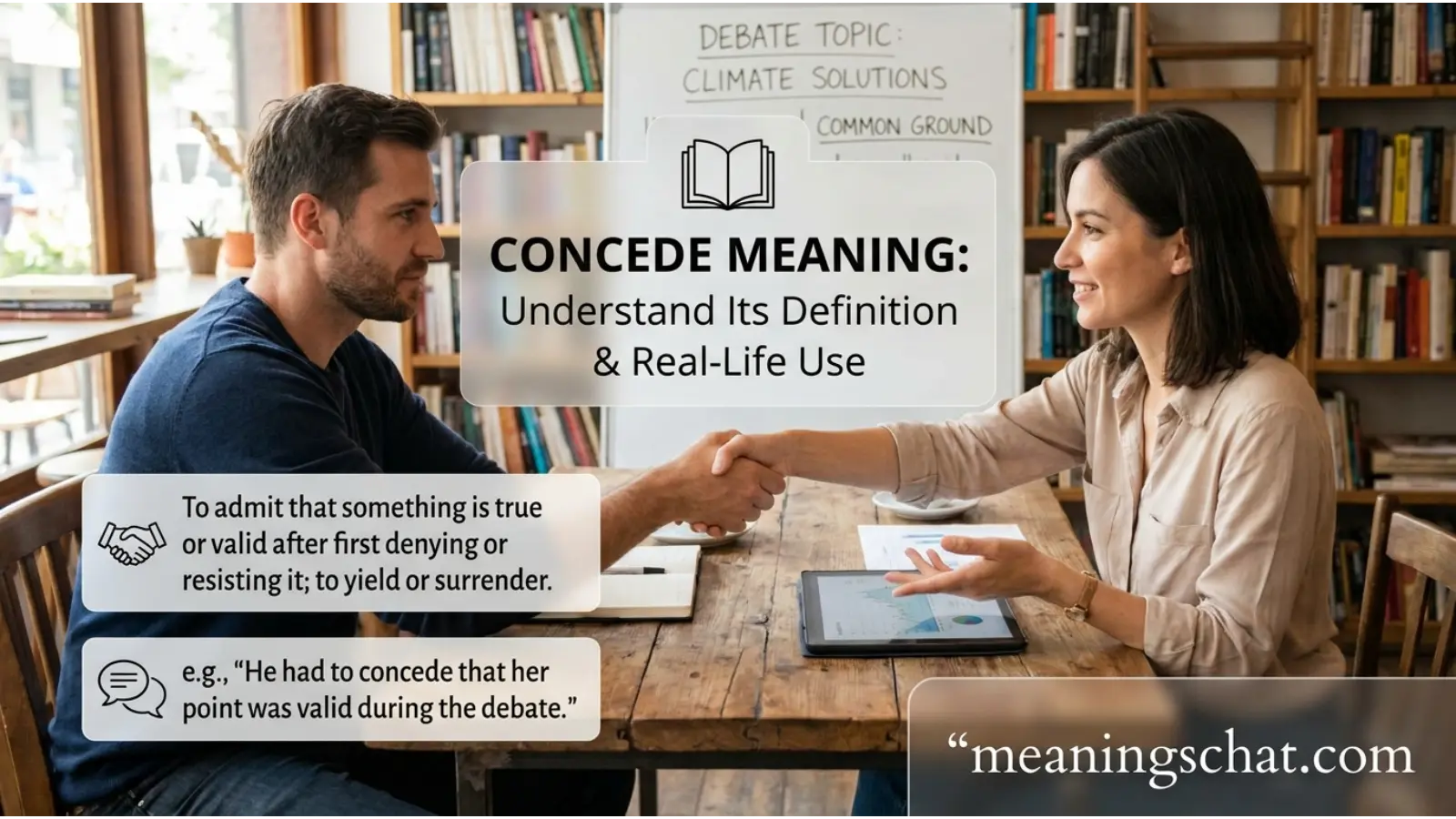
Concede meaning in text can be confusing when someone uses the word during an argument, discussion, game, or social media conversation. Unlike common texting terms such as “LOL” or “BTW,” concede is not an abbreviation. It is a regular English verb that people use in both everyday conversations and formal writing.
When someone says, “I concede,” they usually mean they accept that another person is right, admit a point, or acknowledge that they cannot win a particular argument or competition. The exact meaning depends on the context.
Understanding this word can help you read texts, comments, debates, and online conversations more accurately. It can also help you choose the right tone when you use it yourself.
Quick Answer:
To concede means to admit, accept, or acknowledge something, often after disagreeing or trying to win. In a text, “I concede” can mean “You’re right” or “I admit your point.”
What Does Concede Mean in Text?
The concede meaning in text is generally “to admit something is true” or “to accept that someone else has a valid point.”
For example:
“Okay, I concede. Your idea is better.”
Here, the person admits that the other person’s idea is better.
The word can also describe accepting defeat:
“We conceded the match.”
In this context, it means the team accepted that it had lost or allowed the opponent to score, depending on the sporting context.
In everyday texting, concede often appears during:
- Arguments
- Friendly debates
- Discussions
- Games
- Sports conversations
- Online disagreements
- Academic discussions
- Social media comments
The word usually signals acknowledgment rather than anger.
Concede Full Form and Definition
People sometimes search for the concede full form, but concede does not have a full form because it is not an acronym.
The word concede comes from English and functions as a verb.
Common dictionary meanings include:
- To admit that something is true
- To acknowledge another person’s point
- To accept something reluctantly
- To admit defeat
- To give something to someone
The meaning changes slightly depending on the sentence.
For example:
“I concede that you were right.”
This means:
“I admit that you were right.”
Another example is:
“The candidate conceded the election.”
This means the candidate accepted that they had lost.
What Does Concede Stand For?
If you searched for what does concede stand for, the simple answer is that it does not stand for anything.
It is a complete English word rather than a texting acronym.
People may mistake it for slang because it sometimes appears in short online conversations. However, its meaning remains the same basic English meaning: to admit, accept, or acknowledge something.
So, unlike “IDK,” which stands for “I don’t know,” there is no expanded phrase behind “concede.”
Is Concede Rude, Offensive, or Neutral?
Concede is generally neutral. The word itself is not rude or offensive.
However, the tone can depend on how someone uses it.
For example:
“I concede. You made a good point.”
This sounds respectful.
But:
“Fine, I concede. Happy now?”
This may sound annoyed or sarcastic.
The surrounding words, punctuation, and conversation can change the emotional tone.
Using “concede” does not automatically make a message formal or unfriendly. It simply communicates acknowledgment.
Concede Meaning Slang: Is It Actually Slang?
The phrase concede meaning slang can be misleading because concede is not normally classified as slang.
It is a standard vocabulary word.
Some people may use it casually in texting, especially when discussing an argument or playful disagreement. That casual use does not turn the word into slang.
For instance:
“Okay, I concede 😂 You win.”
This is a casual text, but concede itself is still a standard English word.
The emoji and surrounding language create the casual tone.
Where Is Concede Commonly Used?
You can find concede in many different situations.
In Text Messages
Friends may use it during playful disagreements:
“Okay, I concede. Pineapple pizza is actually pretty good.”
In Arguments
Someone may acknowledge another person’s stronger point:
“I concede that you had more evidence.”
In Sports
Sports commentators frequently use the word when discussing defeat or points.
“The team conceded two goals.”
Here, the meaning is different from simply admitting someone is right.
In Politics
The word can describe accepting an election result:
“The candidate conceded after the results were announced.”
On Social Media
People sometimes use it to acknowledge a strong argument:
“I concede. That was a solid response.”
In Academic Writing
The word can introduce an opposing point:
“The author concedes that the method has limitations.”
This use is more formal.
Real Life Examples of Concede in Text
Here are several examples that show how people might use the word naturally.
Friendly Example
Friend: “You said the movie would be boring, but you laughed the whole time.”
You: “Okay, I concede 😂 You were right.”
The speaker playfully admits the friend was correct.
Casual Example
Participant A: “Your explanation actually makes sense.”
Person B: “So you concede my point?”
PerformerC: “Yeah, I concede.”
Here, concede means “I admit your point is valid.”
Argumentative Example
Person A: “You said the store was closed at 8, but their website says 9.”
Person B: “I checked again. I concede that I was wrong.”
The speaker directly admits their mistake.
Gaming Example
Player A: “You have the better strategy this round.”
Performer B: “Are you conceding?”
Participant C: “Yep. I concede. GG!”
Here, concede means accepting defeat.
Social Media Example
Comment: “Your first argument was weak, but your second point changed my mind.”
Reply: “I concede. You made a fair point.”
This shows respectful disagreement.
Playful Example
“I concede. You clearly know more about coffee than I do ☕.”
The word creates a humorous way to admit defeat in a friendly discussion.
Origin and Background of Concede
The word concede has a long history in the English language. It comes from Latin roots associated with the idea of giving way or yielding.
Over time, English developed several related meanings. The word can describe giving something up, accepting a point, or acknowledging defeat.
This explains why concede can appear in very different contexts.
Someone can concede an argument, concede a point, concede an election, or concede a match. Although these situations differ, they share the basic idea of accepting or giving way.
Concede vs Admit
Concede and admit are closely related, but they do not always sound exactly the same.
| Word | General Meaning | Common Tone |
|---|---|---|
| Concede | Accept or acknowledge a point, often after resistance | Neutral or formal |
| Admit | Say that something is true, especially something you previously denied | Neutral |
| Acknowledge | Recognize or accept something | Neutral or formal |
| Accept | Agree to receive or recognize something | Neutral |
| Give in | Stop resisting or arguing | Casual |
For example:
“I admit you were right.”
This directly states that the person was right.
“I concede that you were right.”
This can suggest that the speaker originally disagreed but now accepts the point.
Concede vs Give In
The phrase give in is more casual than concede.
You might text a friend:
“Fine, I give in. You win.”
Or:
“Fine, I concede. You win.”
Both can communicate a similar idea, but give in sounds more conversational.
Concede can sound slightly more polished or deliberate.
When Should You Avoid Using Concede?
There are few situations where the word is inappropriate, but context still matters.
Avoid using it if your audience may not understand the word and a simpler expression would be clearer.
For example, instead of:
“I concede your argument.”
You could say:
“I agree with your point.”
For a casual text, “You’re right” may sound more natural.
You may also want to avoid “concede” if you do not actually mean that you accept the other person’s point. The word communicates acknowledgment, so using it sarcastically can create confusion.
Polite Alternatives to Concede
If you want a softer or more conversational expression, try these alternatives:
- “You’re right.”
- “I agree.”
- “Fair point.”
- “I see what you mean.”
- “That’s a good point.”
- “I’ll give you that.”
- “I admit you’re right.”
- “You have a point.”
- “I can accept that.”
- “Okay, you win.”
The best choice depends on your relationship with the other person and the tone of the conversation.
Why Do People Use Concede?
People use concede because it communicates acknowledgment clearly.
During a disagreement, saying “I concede” can show that you are willing to recognize another person’s stronger argument.
It can also help end an unnecessary argument.
For example:
“We could keep debating this, but I concede that your evidence is stronger.”
This tells the other person that you recognize their point without creating more conflict.
In friendly conversations, the word can even make a disagreement humorous:
“I concede. Your burger recommendation was better than mine.”
The Impact of Using Concede in Communication
Words can influence how a message feels, and concede is no exception.
Using it can make you sound:
- Thoughtful
- Open-minded
- Reasonable
- Respectful
- Slightly formal
- Willing to accept another viewpoint
However, tone still matters.
“I concede your point” may sound serious in a casual chat.
“I concede 😂 You win” feels much lighter.
This is why context plays an important role when interpreting the word in texts.
Is Concede Safe for Social Media?
Yes. Concede is generally safe for social media.
It does not contain offensive language, profanity, or inappropriate meaning.
You can use it in:
- Facebook comments
- Instagram captions
- TikTok comments
- Reddit discussions
- YouTube comments
- Gaming chats
- Online debates
- Professional social platforms
The main consideration is tone. If you use the word sarcastically, some readers may interpret your message differently than you intended.
Concede Meaning in Different Contexts
The meaning becomes easier to understand when you look at different situations.
During an Argument
“I concede your point.”
Meaning: “I accept that your argument is valid.”
During a Debate
“I concede that this solution has advantages.”
Meaning: “I acknowledge that this solution has some benefits.”
During a Competition
“I concede. You win.”
Meaning: “I accept that I have lost.”
In Sports
“They conceded three goals.”
Meaning: “They allowed the opposing team to score three goals.”
In Politics
“The candidate conceded the election.”
Meaning: “The candidate accepted that they lost the election.”
These examples show why context matters so much.
Common Mistakes With Concede
One common mistake is assuming concede always means “lose.”
That is not completely accurate.
You can concede a point without losing an entire argument.
For example:
“I concede that the plan costs more, but I still think it is better.”
The speaker accepts one fact but continues to disagree with the overall conclusion.
Another mistake is treating concede like an acronym.
Remember:
Concede is a standard English verb, not a texting abbreviation.
FAQs:
What does concede mean in a text message?
In a text message, concede usually means to admit that someone else is right, accept a point, or acknowledge defeat.
Is concede a slang word?
No. Concede is a standard English word rather than slang. People can use it casually in texts, but the word itself is not slang.
What does “I concede” mean?
“I concede” usually means “I admit your point,” “I accept that you are right,” or “I accept that I have lost,” depending on the context.
Is concede rude?
No. Concede is generally neutral and can even sound respectful. The surrounding words and tone can make it sound sarcastic or annoyed.
What is the simplest synonym for concede?
Depending on the context, simple alternatives include “admit,” “agree,” “accept,” “give in,” or “acknowledge.”
What does concede mean in an argument?
In an argument, concede means to accept that the other person has a valid point or that you were wrong about something.
Conclusion
The concede meaning in text is simple once you understand the context. The word generally means to admit, acknowledge, accept, or give way, especially after disagreement or competition.
It is important to remember that concede is not slang and does not have a full form. It is a standard English verb that works in casual conversations, formal writing, debates, sports, politics, gaming, and social media.
When someone texts, “I concede,” they may simply be saying, “You’re right,” “I accept your point,” or “You win.” The exact meaning depends on what came before it.
Use the word when you want to acknowledge a point clearly and respectfully. For casual conversations, simpler alternatives such as “Fair point,” “You’re right,” or “I’ll give you that” may sound more natural.