Opaque meaning can seem confusing when you come across the word in a text, message, article, or everyday conversation. Unlike many modern slang terms, opaque is a standard English word that describes something difficult to see through, understand, or interpret clearly. Its meaning can change slightly depending on the context.
People often search for the opaque meaning because the word can describe both physical objects and abstract ideas. For example, an opaque window blocks light from passing through, while an opaque explanation may be difficult to understand.
Understanding this word helps you read messages, articles, academic writing, and everyday conversations with greater confidence. In this guide, you will learn the opaque definition, examples, synonyms, common uses, and the difference between literal and figurative meanings.
Quick Answer:
Opaque means something that cannot be seen through or something that is difficult to understand clearly. In text, it usually describes unclear, confusing, hidden, or non-transparent information.
What Does Opaque Mean in Text?
The opaque meaning in text usually refers to something that is unclear, difficult to understand, or not easy to interpret.
The word has two major meanings:
- Physical meaning: Something that does not allow light to pass through.
- Figurative meaning: Something that is unclear, confusing, mysterious, or difficult to understand.
For example:
“The glass is opaque.”
Here, opaque describes the physical appearance of the glass. You cannot see clearly through it.
Now consider:
“His explanation was opaque.”
In this sentence, opaque describes the explanation. It means the explanation was difficult to understand.
So, when someone uses opaque meaning slang in a text discussion, remember that opaque itself is generally not slang. It is a normal English adjective that people use in formal and informal communication.
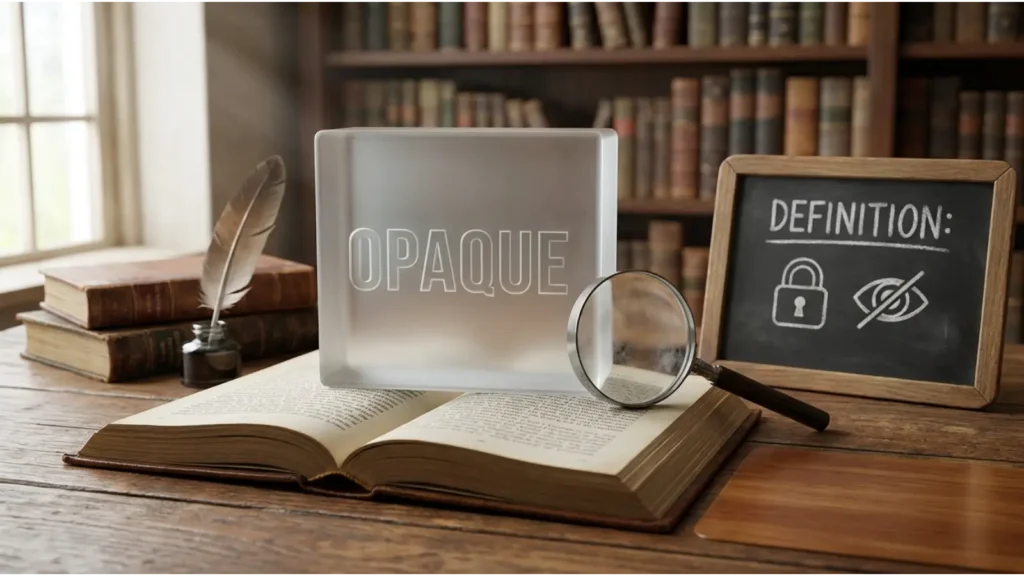
Opaque Full Form and Definition
People sometimes search for the opaque full form, but opaque is not an abbreviation. It does not have a full form like internet slang such as LOL or BRB.
The word opaque comes from a traditional English vocabulary background and functions as an adjective.
Its basic dictionary meaning is:
Opaque: Not allowing light to pass through, or difficult to understand and interpret.
Simple Definition of Opaque
In very simple English, opaque means:
“Not clear or easy to see through or understand.”
The exact meaning depends on the sentence.
Physical Example
“The bathroom window has opaque glass.”
This means the glass prevents people from seeing clearly through it.
Figurative Example
“The company’s pricing policy is opaque.”
This means the pricing policy is confusing or not transparent.
What Does Opaque Stand For?
If you are wondering what does opaque stand for, the answer is simple: it does not stand for a phrase or abbreviation.
Opaque is a complete English word.
It can describe:
- Objects that block light
- Information that lacks clarity
- Rules that are difficult to understand
- Explanations that seem confusing
- Decisions that are not transparent
- Communication that hides important details
Is Opaque Rude, Offensive, or Neutral?
The word opaque is generally neutral and is not offensive.
However, the tone can become negative depending on how you use it.
For example:
“The glass is opaque.”
This is completely neutral.
But:
“The manager gave an opaque explanation.”
This may sound critical because you are saying the explanation was unclear.
Calling someone’s communication “opaque” can suggest that the person is being unclear, secretive, or unnecessarily complicated.
Still, the word itself is not rude or insulting.
Where Is Opaque Commonly Used?
You can find opaque in many areas of communication.
Everyday Conversation
People may use opaque to describe glass, windows, curtains, or materials.
Example:
“We need opaque curtains for the bedroom.”
Business Communication
Professionals often use opaque to discuss unclear processes or policies.
Example:
“The company’s decision-making process seems opaque.”
Academic Writing
Students and researchers may use opaque when discussing complicated concepts.
Example:
“The author’s argument becomes opaque in the final section.”
Technology
Opaque can describe systems that users cannot easily understand.
Example:
“The software uses an opaque algorithm.”
Social Media
People may use opaque in posts and comments to criticize unclear statements.
Example:
“That response was pretty opaque. I still don’t know what they meant.”
Real-Life Examples of Opaque Meaning
Context makes the meaning much easier to understand.
Friendly Example
“This glass is opaque, so you won’t have to worry about privacy.”
Here, opaque refers to the physical glass.
Casual Example
“Your explanation is a little opaque. Can you explain it more simply?”
Here, opaque means unclear.
Professional Example
“The company needs to make its policies less opaque.”
This means the policies should become clearer and more transparent.
Argumentative Example
“You’re being opaque about what actually happened.”
Here, the speaker suggests that someone is avoiding clarity or withholding information.
Social Media Example
“That post was so opaque. I couldn’t figure out the point.”
The writer means the post was confusing or unclear.
Academic Example
“The terminology makes the article opaque for beginners.”
This means the terminology makes the article difficult to understand.
Opaque Meaning in Different Contexts
The word can carry slightly different meanings depending on where you see it.
| Context | Meaning of Opaque | Example |
|---|---|---|
| Glass | Cannot be seen through | Opaque glass blocks the view. |
| Writing | Difficult to understand | The paragraph is opaque. |
| Business | Not transparent | The company’s policy is opaque. |
| Technology | Difficult to understand or inspect | The system is opaque to users. |
| Communication | Unclear or vague | His answer was opaque. |
| Art | Not allowing light through | The paint creates an opaque layer. |
Origin and Background of Opaque
The word opaque has a long history in English and comes through French from the Latin word opacus, which refers to something shaded, dark, or lacking brightness.
Over time, English speakers developed both literal and figurative uses.
The literal sense focuses on light. An opaque material prevents light from passing through.
The figurative sense developed around the idea of something being difficult to see or understand. If you cannot “see through” an explanation, idea, or system, it can be described as opaque.
This connection makes the word easier to remember:
Transparent means something allows light through or communicates information openly and clearly.
For example:
“The window is opaque.”
You cannot see through it clearly.
“The company’s policies are transparent.”
The company communicates its policies openly and clearly.
The figurative difference is also useful:
- Opaque communication = unclear communication
- Transparent communication = clear and open communication
Obscure usually describes something that is unknown, difficult to see, difficult to understand, or not well known.
Example:
“The instructions are opaque.”
The instructions are difficult to understand.
“The author is obscure.”
The author is not widely known.
The right choice depends on the context.
Opaque vs Vague
Vague means something lacks specific details or clear information.
Opaque can mean something is difficult to understand because the meaning or information is not accessible.
For example:
“His answer was vague.”
The answer did not provide enough specific information.
“His answer was opaque.”
The answer was difficult to interpret or understand.
A vague statement may be incomplete, while an opaque statement may be complicated, hidden, or unclear.
When Should You Avoid Using Opaque?
Opaque is a useful word, but it may sound formal in very casual conversations.
If you are chatting with a friend, simpler words can make your meaning clearer.
Instead of:
“Your message is opaque.”
You could say:
“I don’t understand your message.”
Instead of:
“That explanation is opaque.”
You could say:
“That explanation is confusing.”
Use opaque when you want a precise or slightly more formal description of something unclear.
Polite Alternatives to Opaque
If you want to describe unclear communication without sounding overly critical, try these alternatives:
- Unclear
- Confusing
- Hard to understand
- Complicated
- Uncertain
- Vague
- Difficult to interpret
- Not very clear
- Not transparent
- Hard to follow
For example, instead of saying:
“Your explanation is opaque.”
You could politely say:
“Could you explain that in a simpler way?”
This focuses on improving communication instead of criticizing the person.
Why Do People Use the Word Opaque?
People use opaque because it communicates a specific idea in one word.
Instead of saying:
“This information is difficult to understand and doesn’t give us enough clarity.”
Someone can simply say:
“The information is opaque.”
The word is especially useful in professional, academic, technical, and analytical writing.
It also works well when discussing systems or organizations that do not clearly explain how decisions are made.
Impact of Using Opaque in Communication
Using precise vocabulary can make communication more effective.
When you use opaque correctly, readers can quickly understand that something lacks clarity or transparency.
However, using overly formal vocabulary in casual conversations can sometimes make your message sound distant.
Consider your audience before using it.
For a professional report, opaque may be an excellent choice.
For a quick text to a friend, confusing or unclear may sound more natural.
Good communication is not only about choosing sophisticated words. It is about choosing words your audience understands.
Is Opaque Safe for Social Media?
Yes. Opaque is generally safe for social media.
It is not a profanity, slur, or offensive abbreviation. You can use it in posts, comments, captions, discussions, and professional networking content.
For example:
“The instructions are opaque, so I’m going to look for a clearer guide.”
This is completely appropriate.
The only consideration is tone. Calling someone’s statement opaque may sound like criticism because it suggests their message is unclear or difficult to understand.
Real-Life Text Examples by Tone
Friendly
“Did you understand the instructions?”
“Not really. They were kind of opaque. 😅”
The speaker uses opaque casually to say the instructions were difficult to understand.
Casual
Friend: “What did he mean by that?”
You: “Honestly, his message was pretty opaque.”
Here, opaque means unclear.
Argumentative
“Why didn’t you tell me what happened?”
“I did.”
“Your explanation was opaque, and I still don’t know what happened.”
Here, the word expresses frustration.
Gaming Context
“The new ranking system is so opaque. I have no idea how points are calculated.”
Here, opaque means the system is difficult for players to understand.
Social Media Context
“That announcement was completely opaque. They should have explained the changes.”
The speaker criticizes a lack of clear communication.
Workplace Context
“The promotion process feels opaque.”
This means employees may not understand how promotion decisions are made.
Is Opaque Slang?
No, opaque is not normally considered slang.
It is a standard English adjective used in everyday, professional, academic, scientific, and technical communication.
You may encounter it in text messages, but that does not make it slang.
This distinction is important because many people search for a word’s “meaning in text” when they actually want to know how it works in messaging.
With opaque, the meaning remains essentially the same. The context determines whether it refers to a physical object or an abstract idea.
Common Mistakes When Using Opaque
A common mistake is treating opaque as a synonym for “bad.”
Opaque does not automatically mean something is bad.
For example:
“The bottle is opaque.”
This is simply a description of the bottle.
Another mistake is assuming opaque always means “secret.”
An opaque policy may be difficult to understand, but that does not necessarily mean someone intentionally hides information.
Remember the central idea:
Opaque means difficult to see through, understand, or interpret clearly.
FAQs:
What is the simple meaning of opaque?
Opaque means something that cannot be seen through clearly or something that is difficult to understand.
What is the opaque full form?
Opaque has no full form because it is a regular English word, not an abbreviation.
What does opaque mean in a text message?
In a text message, opaque usually means unclear, confusing, difficult to interpret, or lacking transparency.
Is opaque a slang word?
No. Opaque is a standard English word rather than internet slang.
Is opaque a negative word?
Opaque is neutral by itself, but it can sound critical when used to describe unclear communication, confusing instructions, or a non-transparent process.
What is the opposite of opaque?
The most common opposite is transparent. Transparent can mean allowing light through physically or being clear and open figuratively.
Conclusion
The opaque meaning in text is usually connected to something that is unclear, difficult to understand, or not transparent. In its literal sense, opaque describes an object that does not allow light to pass through. In its figurative sense, it can describe confusing writing, unclear explanations, complicated systems, or information that lacks transparency.
Opaque is not slang and does not have a full form. It is a standard English adjective that works in casual, professional, academic, and social media communication.
Remember the easiest definition: opaque means not clear or easy to see through or understand.
Use the word according to the context and tone. For casual conversations, words such as “unclear” or “confusing” may sound more natural. For professional or analytical writing, opaque can provide a concise and precise description.