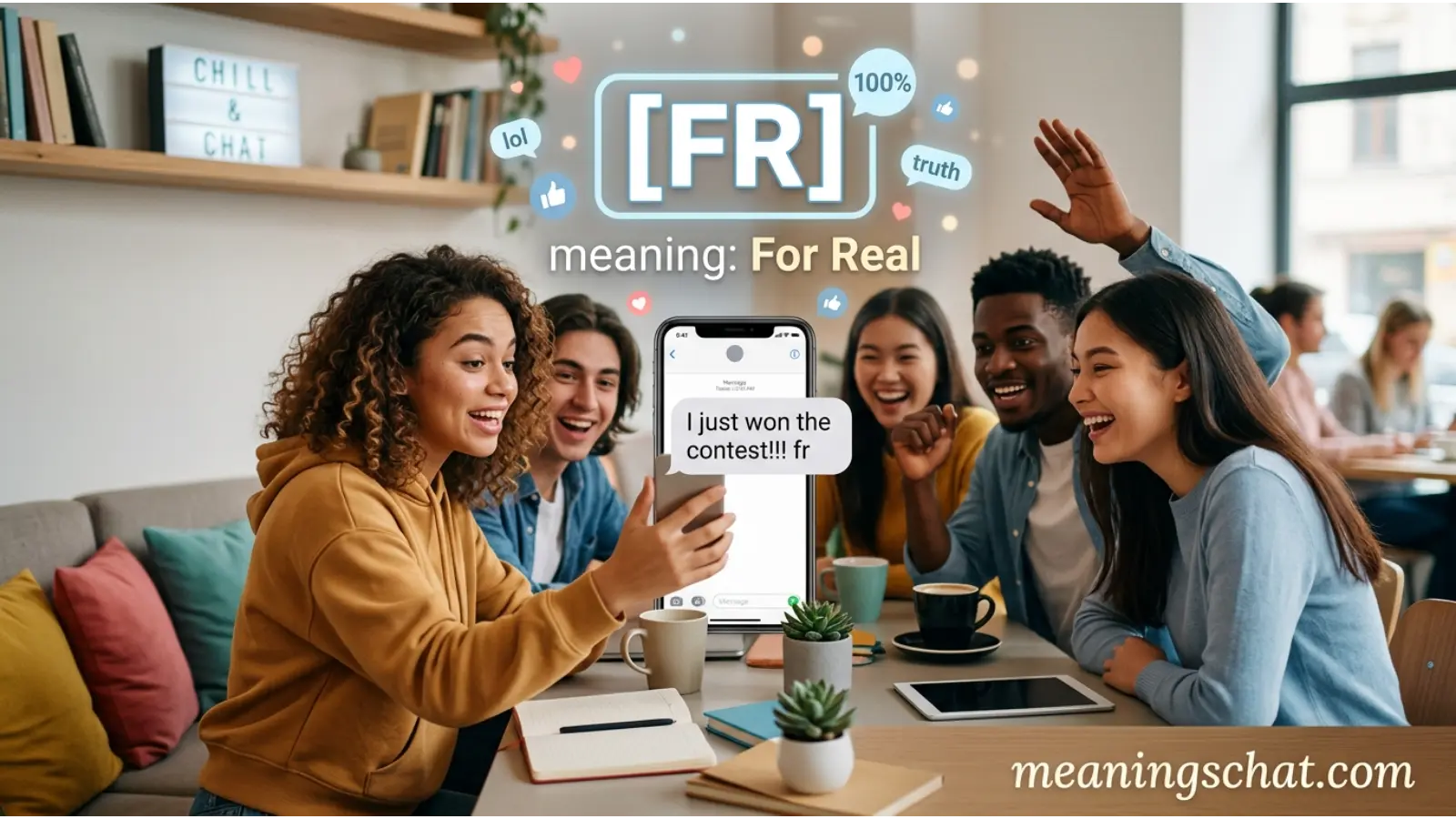
FR meaning in text usually refers to “for real.” People use this short slang term in text messages, social media comments, gaming chats, and everyday online conversations to show that they are serious, agree with someone, or strongly relate to what was said.
You may see someone write “FR?” after hearing something surprising, or simply say “FR” to agree with a statement. For example, if your friend says, “This movie was amazing,” you might reply, “FR!” to mean “For real!” or “I completely agree.”
Because texting slang can have different meanings depending on the conversation, understanding the context matters. FR can also represent phrases such as “friend request” or “French” in certain situations.
Quick Answer
FR meaning in text is most commonly “for real.” It shows agreement, seriousness, or genuine feelings. In some contexts, FR can have other meanings, so always check the surrounding conversation.
What Does FR Mean in Text?
The most common FR meaning slang is “for real.”
People use FR when they want to emphasize that something is true, serious, genuine, or relatable. It can work as a complete response or appear within a longer sentence.
For example:
- “FR, that was the best concert ever.”
- “You’re moving next month? FR?”
- “FR though, I need a vacation.”
- “That game was difficult FR.”
In casual online conversations, FR often replaces phrases such as “seriously,” “honestly,” “I agree,” or “I really mean it.”
The exact meaning depends on how someone uses it. A short “FR?” can express surprise or ask for confirmation, while “FR!” can show strong agreement.
FR Full Form
The most common FR full form in texting is:
FR = For Real
The phrase “for real” has been used in everyday English for a long time. Online communication shortened it to FR because people often prefer quick and convenient expressions.
Here are some common interpretations:
| FR | Meaning | Common Context |
|---|---|---|
| FR | For real | Texting, social media, gaming |
| FR? | For real? | Surprise or confirmation |
| FR! | For real! | Strong agreement |
| FR | Friend request | Social platforms |
| FR | French | Language or country-related context |
When someone uses FR in a casual conversation, “for real” is usually the safest interpretation unless the context suggests otherwise.
What Does FR Stand For?
If you are wondering “what does FR stand for?”, the answer in most texting situations is “for real.”
It can express several related ideas:
- “Seriously”
- “Honestly”
- “I agree”
- “That is true”
- “I genuinely mean it”
- “Are you serious?”
For example, imagine a friend says:
“I could sleep for 12 hours today.”
You could reply:
“FR.”
Here, FR means that you completely understand and agree with them.
On the other hand, someone might say:
“FR? You actually quit your job?”
In this example, FR works more like “Seriously?” or “Are you for real?”
Is FR Rude, Offensive, or Neutral?
FR is generally neutral and not offensive.
It is common in casual conversations between friends, classmates, coworkers who communicate informally, and social media users.
However, tone can change depending on the message.
For example:
Friendly:
“FR! That was hilarious 😂”
Serious:
“FR, we need to talk about this.”
Surprised:
“FR? You met her?”
The abbreviation itself is not rude. Still, using too much slang in a professional conversation may make your message seem overly casual.
For formal emails, applications, business messages, or academic writing, it is better to write “for real” only when the phrase fits naturally—or choose a more professional expression such as “seriously” or “indeed.”
Where Is FR Commonly Used?
FR appears across many online platforms and digital conversations.
You may encounter it in:
- Text messages
- Instagram comments
- TikTok comments
- Snapchat chats
- Discord servers
- Gaming conversations
- Facebook messages
- X posts and replies
- Group chats
- Online forums
You may also see variations such as “fr,” “FR,” “frfr,” or “fr fr.”
The lowercase version often feels more casual, while uppercase FR can add emphasis.
For example:
“fr, I need coffee.”
Compared with:
“FR! You are absolutely right.”
Both communicate a similar idea, but the second feels more emphatic.
Real-Life Examples of FR in Text
Seeing FR in different situations can make its meaning easier to understand.
Friendly Example
Alex: “I love hanging out with you guys.”
Sam: “FR! We always have fun.”
Here, FR means “for real” and shows genuine agreement.
Casual Example
Mia: “This weekend went way too fast.”
Jake: “FR 😭”
Jake agrees that the weekend passed quickly.
Surprised Example
Alex: “I finally bought that car.”
Sam: “FR?”
Here, FR means “Really?” or “Are you serious?”
Argumentative Example
Person 1: “You never listen to what I say.”
Person 2: “FR, I’ve explained this three times.”
In this case, FR adds seriousness and emphasizes the speaker’s frustration.
Gaming Example
Player 1: “That boss fight was impossible.”
Player 2: “FR! I lost five times.”
Here, FR means “For real” and shows agreement with another player’s experience.
Social Media Example
Comment: “This song never gets old.”
Reply: “FR 🔥”
The reply expresses strong agreement.
FR Meaning in Social Media
On social media, FR often appears as a quick reaction.
Someone might post:
“Mondays should be illegal.”
A user could comment:
“FR.”
The commenter is basically saying, “For real. I completely agree.”
FR works particularly well in comments because it communicates agreement without requiring a long response.
You may also see FRFR, which means “for real, for real.” It gives the phrase extra emphasis.
For example:
“That was the best pizza I’ve ever had.”
“FRFR.”
This means the person strongly agrees.
FR vs. FRFR
FR and FRFR have almost the same basic meaning, but their intensity differs.
| Slang | Meaning | Tone |
|---|---|---|
| FR | For real | Casual agreement |
| FRFR | For real, for real | Stronger agreement |
| Seriously | Genuinely/seriously | Casual to neutral |
| Honestly | Speaking truthfully | Casual to neutral |
| Really? | Is that true? | Curious or surprised |
If someone writes FRFR, they usually want to emphasize that they strongly mean what they are saying.
FR vs. Similar Text Slang
Several slang terms can communicate agreement or seriousness.
FR vs. TBH
TBH means “to be honest.”
Example:
“TBH, I didn’t like the movie.”
TBH introduces an honest opinion, while FR usually confirms or emphasizes something.
FR vs. ISTG
ISTG means “I swear to God.”
It can express strong frustration, seriousness, or emphasis.
Example:
“ISTG, my phone keeps freezing.”
FR is generally softer and more casual.
FR vs. NGL
NGL means “not gonna lie.”
Example:
“NGL, that song is catchy.”
NGL introduces a candid opinion. FR more commonly expresses agreement or emphasizes truth.
FR vs. IMO
IMO means “in my opinion.”
Example:
“IMO, the second season was better.”
IMO signals a personal viewpoint, while FR does not necessarily express an opinion.
When Should You Avoid Using FR?
FR is perfectly normal in casual online communication, but it does not fit every situation.
Avoid using FR when you need a formal or professional tone.
For example, instead of writing:
“FR, I agree with your proposal.”
You could write:
“I completely agree with your proposal.”
Professional settings where formal language works better include:
- Job applications
- Business emails
- Academic assignments
- Official letters
- Formal reports
- Customer service messages
- Professional presentations
The goal is not to avoid slang completely. Instead, match your language to your audience and situation.
Polite Alternatives to FR
If you want to express the same idea without slang, you can use:
- “Seriously.”
- “I completely agree.”
- “That’s true.”
- “Absolutely.”
- “I agree.”
- “Honestly.”
- “Exactly.”
- “I really mean it.”
- “You’re right.”
For casual conversations, FR sounds natural. For professional communication, “I agree,” “absolutely,” or “that’s true” usually works better.
Why Do People Use FR?
People use FR because it makes digital conversations faster and more expressive.
Texting often encourages short responses. Instead of typing “I completely agree with you,” someone can simply type “FR.”
There are several reasons people like this abbreviation:
It Saves Time
Typing two letters is faster than writing an entire phrase.
It Shows Agreement
FR can instantly show that you share someone’s opinion or experience.
It Adds Emphasis
The phrase can make a statement sound more serious or genuine.
It Fits Online Culture
Short abbreviations are common across social media, gaming, and messaging platforms.
It Creates a Casual Tone
FR can make a conversation feel relaxed and friendly.
How Tone Changes the Meaning of FR
Context plays an important role in understanding FR.
Consider these examples:
“FR!”
This usually expresses strong agreement.
“FR?”
This may mean “Really?” or “Are you serious?”
“FR, I’m tired.”
This emphasizes the speaker’s genuine feeling.
“You did that FR?”
Depending on the conversation, this could express surprise, disbelief, or a request for confirmation.
Therefore, punctuation and surrounding words can change how readers interpret FR.
Is FR Safe for Social Media?
Yes. FR is generally safe and harmless for social media.
It does not normally contain offensive language. People commonly use it in comments, captions, replies, and private messages.
However, context still matters. A phrase that sounds friendly in one conversation could sound dismissive or sarcastic in another.
For example:
“You think I should apologize?”
“FR.”
Depending on the conversation, this could mean “For real, yes,” or it could come across as a short, slightly dismissive response.
If you want to avoid misunderstanding, add a few words to clarify your meaning.
Instead of:
“FR.”
You could write:
“FR, I completely agree with you.”
Other Meanings of FR
Although “for real” is the dominant texting meaning, FR can mean something else in specific contexts.
Friend Request
On social media, FR can sometimes mean friend request.
Example:
“Did you get my FR?”
Here, the person may be referring to a friend request rather than “for real.”
French
In language-related contexts, FR can be used as an abbreviation for French.
For example, a website, app, or document may use FR as a language code or label.
France
In some contexts, FR can refer to France, particularly in abbreviations, addresses, or location-related information.
This is why context matters. If someone says:
“FR, that’s so true!”
They almost certainly mean “for real.”
If a website lists:
“Language: EN | FR”
FR is probably referring to French.
Common Mistakes When Using FR
Although FR is easy to understand, beginners sometimes use it incorrectly.
Mistake 1: Using FR in Formal Writing
FR belongs mainly to casual communication. Avoid it in academic or professional writing.
Mistake 2: Ignoring Context
Do not automatically assume FR means “for real.” Check the surrounding words.
Mistake 3: Overusing It
Repeating FR in every message can make your writing feel repetitive.
Mistake 4: Confusing FR With FRFR
FR means “for real,” while FRFR means “for real, for real.” The latter adds stronger emphasis.
FAQs:
What does FR mean in text?
FR most commonly means “for real.” People use it to show agreement, seriousness, or genuine feelings.
What is the FR full form in texting?
The most common FR full form is “for real.” It is widely used in text messages, social media, gaming, and online conversations.
What does FR mean on Instagram?
On Instagram, FR usually means “for real.” Users often post it as a short reply to show agreement with a comment or post.
What does FR mean in Snapchat?
On Snapchat, FR generally means “for real.” Depending on the context, it can express agreement, seriousness, or surprise.
What does FRFR mean?
FRFR means “for real, for real.” It gives extra emphasis to the idea that someone genuinely agrees or means what they say.
Is FR rude?
No. FR is generally neutral and casual. It is not normally offensive, although the tone can depend on the conversation and how the person uses it.
Conclusion
The most common FR meaning in text is “for real.” People use this abbreviation to show agreement, emphasize a statement, express genuine feelings, or ask if something is actually true.
For example, “FR!” can mean “I completely agree,” while “FR?” can mean “Really?” or “Are you serious?”
FR is especially common in text messages, social media, gaming chats, and online communities. It is casual rather than formal, so it works best when talking with friends or communicating in relaxed online spaces.
Remember that context matters. FR can occasionally mean friend request, French, or France, depending on where you see it. When you understand the surrounding conversation, you can quickly identify the intended meaning and use the slang naturally.