No contest meaning can be confusing because the phrase does not always refer to texting slang. In everyday messages, social media posts, sports conversations, debates, and even legal discussions, “no contest” can carry different meanings depending on the context. People often search for the phrase because they have seen it in a text, comment, caption, game, or conversation and want to understand what the sender really means.
Unlike many internet abbreviations, no contest is usually written in full. It commonly means that one side is clearly better, a competition is not worth debating, or someone does not want to argue about the result. In legal language, however, “no contest” has a specific meaning that is different from casual conversation.
Quick Answer:
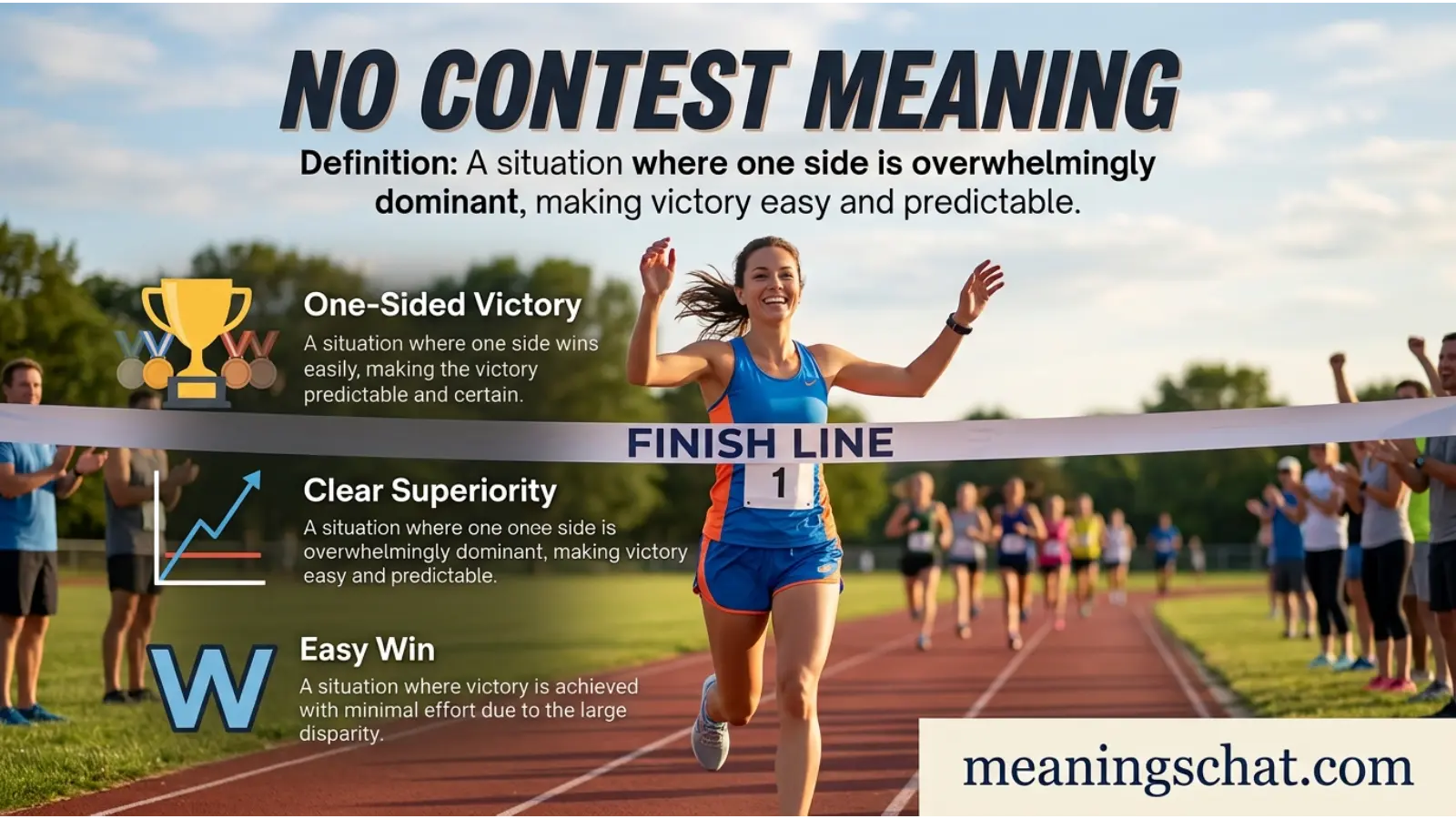
In text and casual conversation, no contest usually means there is an obvious winner or that something is clearly better than another option. Its exact meaning depends on the situation and tone.
What Does No Contest Mean in Text?
The no contest meaning in text is generally simple: there is no real competition because one choice, person, or thing is clearly superior.
For example, if someone asks:
“Pizza or burgers?”
You might reply:
“Pizza. No contest.”
Here, you are saying pizza wins easily and you do not think the comparison is close.
The phrase can also mean that someone accepts a result without arguing. For example:
“You definitely won that argument. No contest.”
This means the speaker believes the other person clearly won.
So, when you see “no contest” in a message, look at what the person is comparing. The phrase often emphasizes certainty rather than simply saying “I agree.”
No Contest Full Form and Definition
There is no special no contest full form because “no contest” is not an abbreviation or acronym.
The phrase consists of two ordinary English words:
- No means none or not any.
- Contest means a competition, challenge, or struggle between people or things.
Together, no contest literally suggests that there is no meaningful competition.
In casual communication, people use it to say that the winner or better choice is obvious.
For example:
“Who is the better singer? Maya, no contest.”
The speaker strongly believes Maya is better and does not see the comparison as close.
No Contest Meaning Slang
The no contest meaning slang usage is informal rather than traditional texting slang.
People may use it in:
- Text messages
- Instagram comments
- TikTok discussions
- YouTube comments
- Sports conversations
- Gaming chats
- Online debates
- Friendly arguments
- Everyday conversations
It can add emphasis to an opinion.
For example:
“That was the best movie of the year. No contest.”
The person is not simply saying they liked the movie. They are strongly suggesting that nothing else comes close.
Because the phrase is already short and familiar, people usually do not shorten it further.
What Does No Contest Stand For?
If you are wondering what does no contest stand for, it does not stand for a longer phrase.
It is a standard expression rather than an abbreviation.
In casual English, it usually communicates one of these ideas:
- One option is clearly better.
- One person clearly won.
- The competition is extremely one-sided.
- There is no reason to debate the result.
- Someone accepts the outcome without challenging it.
The surrounding conversation determines which meaning fits best.
Is No Contest Rude, Offensive, or Neutral?
In most everyday conversations, no contest is neutral.
It is not inherently rude or offensive. However, the phrase can sound dismissive when you use it during a serious disagreement.
For example:
“Your idea versus mine? No contest.”
This could sound arrogant because the speaker is dismissing the other person’s idea.
With friends, the same phrase can sound playful:
“Your homemade cookies versus mine? No contest. Yours win!”
Here, the phrase shows admiration rather than disrespect.
Tone Matters
The phrase can communicate different feelings depending on context:
- Friendly: “Your team won, no contest!”
- Confident: “This phone is better, no contest.”
- Playful: “Chocolate cake beats everything, no contest.”
- Dismissive: “Your argument makes no sense. No contest.”
- Competitive: “We dominated them. No contest.”
The words remain the same, but the emotional meaning changes.
Where Is No Contest Commonly Used?
The phrase appears in many types of communication.
Sports
Sports fans frequently use “no contest” when a match is heavily one-sided.
Example:
“The final score was 6–0. No contest.”
The speaker means one team completely dominated the other.
Gaming
Gamers may use it after an easy victory.
Example:
“That boss fight was no contest.”
This means the player defeated the boss without much difficulty.
Social Media
People often use the phrase when comparing celebrities, movies, foods, brands, or opinions.
Example:
“Summer is better than winter. No contest.”
Text Messages
Friends can use it during casual conversations.
Example:
“Which restaurant should we pick?”
“The Italian place. No contest.”
Debates
Someone may use “no contest” to express strong confidence in an argument.
Example:
“Her presentation was clearly the best. No contest.”
Real-Life Examples of No Contest
Understanding examples makes the phrase easier to recognize.
Friendly Example
Alex: “Who makes better coffee, you or me?”
Sam: “You, no contest 😂”
Here, the phrase is friendly and complimentary.
Casual Example
Friend: “Beach vacation or mountain trip?”
You: “Beach vacation, no contest.”
The speaker strongly prefers the beach.
Argumentative Example
Person A: “I think Team A played better.”
Person B: “Team B scored four goals. No contest.”
The phrase sounds more forceful because the speakers disagree.
Gaming Example
Player 1: “Was that level difficult?”
Player 2: “Not at all. No contest.”
The player found the level very easy.
Social Media Example
Comment: “Which movie has the better ending?”
Reply: “Movie B. No contest.”
The commenter believes the answer is obvious.
Sports Example
“That championship game was no contest.”
This means one side dominated the game.
Food Example
“Pizza versus tacos? No contest. Give me tacos!”
This expresses a strong personal preference in a playful way.
No Contest in Legal Language
The phrase has a separate and important meaning in the legal system.
A no contest plea, also called a nolo contendere plea in some legal systems, generally means that a defendant does not contest the criminal charge. It is not exactly the same as pleading guilty, and the legal consequences can vary by jurisdiction.
For this reason, do not assume that a legal use of “no contest” has the same meaning as a casual text message.
For example:
“The defendant entered a no contest plea.”
This is a legal statement, not slang.
If you encounter “no contest” in a legal document or court-related situation, rely on the applicable law or qualified legal advice rather than the casual texting definition.
Origin and Background of No Contest
The expression comes from the ordinary concept of a contest or competition.
A contest involves competing sides. When someone says “no contest,” they suggest that the competition is either nonexistent or so one-sided that comparing the two sides feels pointless.
The phrase became common in everyday English because it provides a quick way to express a strong judgment.
Over time, people began using it beyond physical competitions. Today, you might see it used for:
- Movies
- Music
- Food
- Sports
- Technology
- Fashion
- Gaming
- Personal preferences
- Arguments
- Online discussions
This flexibility makes “no contest” useful in casual communication.
No Contest vs. No Competition
These expressions are similar, but they can carry slightly different tones.
| Phrase | Common Meaning | Example |
|---|---|---|
| No contest | One option clearly wins | “Pizza wins, no contest.” |
| No competition | Something is clearly superior | “This restaurant has no competition.” |
| Easy win | Winning is very easy | “That was an easy win.” |
| Clear winner | The best choice is obvious | “She was the clear winner.” |
| Hands down | Strong confidence in a choice | “He is the best, hands down.” |
| Not even close | The difference is very large | “It wasn’t even close.” |
No contest often sounds punchy and conversational, making it popular in texts and online comments.
No Contest vs. Hands Down
“Hands down” is another phrase people use to express strong certainty.
For example:
“She is the best singer, hands down.”
This means the speaker has very little doubt.
You could also say:
“She is the best singer. No contest.”
Both expressions communicate strong confidence, but “no contest” focuses more directly on the comparison.
When Should You Avoid Using No Contest?
Although the phrase is harmless in most situations, you should think about your audience.
Avoid using it when:
- You are discussing a sensitive disagreement.
- You are speaking to someone who may feel personally criticized.
- You need to sound formal or diplomatic.
- You are discussing a serious professional decision.
- The comparison is genuinely complicated.
- You want to encourage a balanced discussion.
For example, telling a coworker:
“My proposal is better. No contest.”
could sound unnecessarily dismissive.
A more professional approach would be:
“I think my proposal may be stronger because it addresses the main concern more directly.”
Polite Alternatives to No Contest
If you want to express a strong opinion without sounding too blunt, try these alternatives:
- “I definitely prefer this one.”
- “This is my clear favorite.”
- “I think this one wins.”
- “For me, this is the better choice.”
- “I would choose this one without hesitation.”
- “This one stands out to me.”
- “I think this is clearly the stronger option.”
These alternatives work especially well in professional conversations.
Why Do People Use No Contest?
People use “no contest” because it is short, expressive, and easy to understand.
Instead of writing:
“I strongly believe that there is a significant difference between these two options and that the first option is much better.”
Someone can simply write:
“The first one. No contest.”
The phrase saves time while adding personality.
It can also make a conversation more energetic. Online users often prefer compact expressions that communicate an opinion quickly.
Impact of Using No Contest in Communication
The phrase can make communication more direct and confident.
Positive Effects
It can:
- Show strong confidence.
- Make a message more engaging.
- Add humor or personality.
- Emphasize a clear preference.
- Keep casual conversations short.
Possible Negative Effects
It can also:
- Sound arrogant.
- Dismiss another person’s opinion.
- Make a debate feel more hostile.
- Create the impression that discussion is pointless.
The key is to match the phrase with the situation.
Is No Contest Safe for Social Media?
Yes, no contest is generally safe for social media because it is an ordinary expression and is not inherently offensive.
However, social media conversations can become heated quickly. A phrase that sounds playful to one person may sound dismissive to another.
For example:
“My favorite team wins, no contest!”
usually sounds like harmless fan talk.
But:
“Your opinion is terrible. No contest.”
sounds confrontational.
If you want to avoid unnecessary arguments online, use the phrase in lighthearted comparisons rather than personal attacks.
No Contest in Different Tones
The meaning can shift slightly based on tone.
Friendly
“Your brownies are better than mine, no contest!”
This sounds like a compliment.
Casual
“Coffee or tea?”
“Coffee, no contest.”
This simply expresses a strong preference.
Funny
“Sleep or waking up early? No contest. I’m choosing sleep.”
This uses exaggeration for humor.
Argumentative
“Look at the statistics. Their team was better, no contest.”
This sounds more forceful.
Competitive
“We beat them 10–1. No contest!”
This emphasizes a dominant victory.
Common Mistakes When Using No Contest
A common mistake is assuming that “no contest” always refers to a literal competition.
It does not.
You can use it for opinions and comparisons too.
For example:
“Which dessert should we order?”
“Cheesecake, no contest.”
There is no actual contest happening. The speaker simply considers cheesecake the obvious choice.
Another mistake is assuming that “no contest” is always polite. The phrase itself is neutral, but using it to dismiss someone’s opinion can make it sound rude.
FAQs About No Contest Meaning
What does no contest mean in text?
In text, “no contest” usually means one person, option, or thing is clearly better or has clearly won. It can also mean there is little reason to debate the result.
Is no contest slang?
“No contest” is an informal expression, but it is not really an acronym or modern texting abbreviation. People commonly use it in casual speech, texts, gaming, sports, and social media.
What is the no contest full form?
There is no no contest full form because the phrase is not an abbreviation. It is simply the expression “no contest.”
What does no contest stand for?
Nothing. No contest does not stand for a longer phrase. Its meaning comes from the ordinary words “no” and “contest.”
Is no contest rude?
Usually, no. It is generally neutral or playful. However, it can sound dismissive if you use it to shut down someone’s opinion during an argument.
Can I use no contest on social media?
Yes. “No contest” is generally safe for social media and works well in casual comparisons, sports discussions, gaming posts, and friendly debates.
Conclusion
The no contest meaning in text is usually straightforward: one option, person, or side is considered clearly better or has obviously won. People use the phrase to show confidence, express strong preferences, celebrate a victory, or emphasize that a comparison is not close.
There is no special no contest full form, since the expression is not an abbreviation. In casual conversations, it can sound confident, funny, or friendly, while in an argument it may sound dismissive. Context and tone therefore matter.
Remember that “no contest” also has a specific legal meaning, so always consider where you encounter the phrase. For texts, social media, gaming, sports, and everyday conversations, you can usually understand it as “there is no real competition; this one clearly wins.”