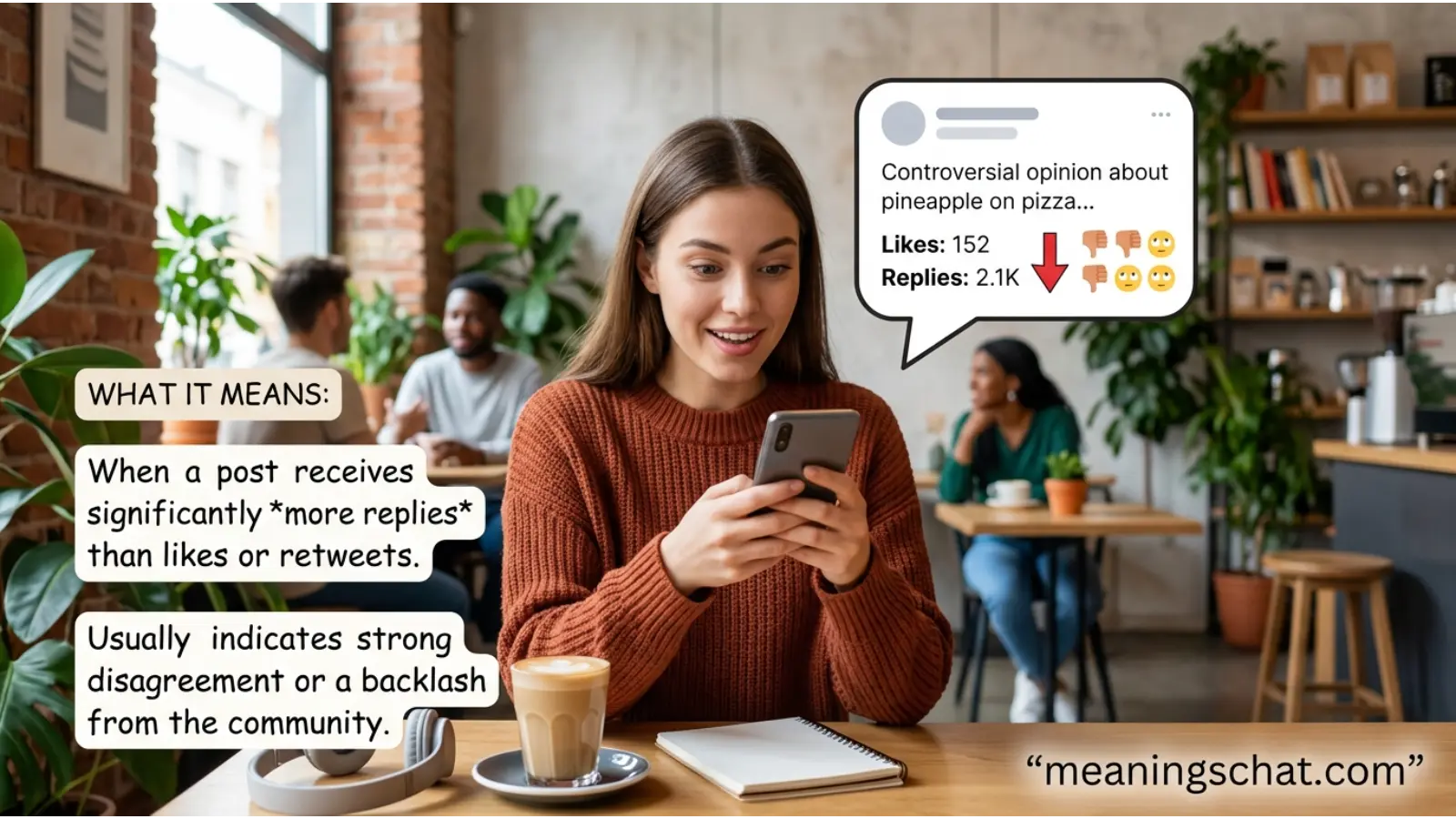
Ratio meaning slang can be confusing if you see it in a social media comment and assume it refers to mathematics. Online, “ratio” has developed a popular slang meaning connected to likes, replies, reposts, and public reactions. You may see someone simply comment “ratio,” or you might see phrases like “you got ratioed” under a post.
People often search for the ratio meaning in text because the word can change meaning depending on the conversation. In everyday English, a ratio compares two quantities. On social media, however, it can describe a situation where a reply receives more attention or approval than the original post.
Quick Answer:
In slang, “ratio” usually means that a reply, comment, or opposing opinion gets more positive engagement than the original post. “Ratioed” means someone has received a much stronger public reaction against their post or comment.
What Does Ratio Mean in Text?
The ratio meaning slang has a strong connection to social media engagement.
When someone writes “ratio” under a post, they are often predicting or pointing out that a reply will receive more likes, reposts, or support than the original post.
For example:
Person A: “This is the worst movie of the year.”
Person B: “You clearly haven’t watched enough movies.”
Someone else: “Ratio.”
The person saying “ratio” may be suggesting that Person B’s reply will get more support than Person A’s original statement.
The term became especially popular on platforms where users can publicly interact with posts through likes, replies, reposts, and other engagement features.
Ratio Full Form and Definition
Many people search for the ratio full form, but “ratio” does not have a special slang full form.
It is an ordinary English word that developed an additional internet slang meaning.
In traditional English, a ratio shows the relationship between two amounts.
For example:
2:1 means two parts compared with one part.
In internet slang, “ratio” refers to the comparison between the amount of attention or approval received by different posts or comments.
So, the word does not stand for a longer phrase like many texting abbreviations do.
What Does Ratio Stand For?
If you’re asking what does ratio stand for in social media slang, the answer is simple:
Ratio does not stand for another phrase. It is a slang use of the word “ratio” to describe an engagement comparison or a negative public reaction.
What Does “Ratioed” Mean?
“Ratioed” is the past-tense form commonly used online.
Someone may say:
“He got ratioed.”
This generally means the person’s post received a weaker response than a reply or opposing comment.
The reply may receive significantly more likes or support, making the original poster look unpopular or incorrect in the eyes of the online audience.
For example:
“She posted an unpopular opinion, and the top reply got 10,000 likes while her post got 500. She got ratioed.”
The word can be playful, teasing, or openly insulting depending on the situation.
Is Ratio Rude, Offensive, or Neutral?
The word ratio itself is not offensive.
However, using “ratio” toward another person can feel rude because it often means:
“People agree with the other person more than they agree with you.”
That can embarrass someone, especially during an argument.
Its tone depends heavily on context.
Friendly Use
Friends may use “ratio” as a joke after someone makes a silly statement.
Casual Use
People often use it casually in comments when they think another opinion deserves more support.
Argumentative Use
During an online argument, “ratio” can become a way of mocking someone’s opinion.
Harsh Use
Repeatedly trying to ratio someone can contribute to online harassment or pile-ons.
So, the word itself is neutral, but the intention behind it can make the message friendly or hostile.
Where Is “Ratio” Commonly Used?
The slang meaning appears mainly in online communities and social media conversations.
You may encounter it in:
- Social media comments
- Public posts
- Reply sections
- Online arguments
- Gaming communities
- Meme communities
- Sports discussions
- Entertainment conversations
- Political discussions
- Group chats
- Community forums
The term works best in conversations where people can see public engagement numbers or reactions.
Real Life Examples of Ratio Slang
Here are some examples showing how people actually use the term.
Friendly Example
Alex: “I make the best homemade pizza.”
Sam: “Your pizza literally has pineapple and chocolate on it.”
Alex: “Don’t expose me 😂”
Jordan: “Ratio.”
Here, “ratio” is being used humorously.
Casual Example
Post: “This album has no good songs.”
Reply: “The entire album charted for months.”
Comment: “Ratio.”
The commenter believes the reply makes a stronger point.
Argumentative Example
Post: “Nobody watches basketball anymore.”
Reply: “The stadiums are sold out every week.”
Comment: “Ratio.”
The word suggests that the reply has stronger evidence or public support.
Gaming Example
Player 1: “That team is terrible.”
2: “They literally won the tournament yesterday.”
3: “Ratio 💀”
The slang adds humor to the disagreement.
Social Media Example
User A: “This is the best movie ever made.”
B: “The reviews strongly disagree.”
B gets thousands of likes.
Someone comments:
“Bro got ratioed.”
This means User A’s opinion received much less support than the response.
How Is Ratio Used as a Verb?
Internet users sometimes turn “ratio” into a verb.
You might see:
- “I ratioed him.”
- “They ratioed that post.”
- “She got ratioed.”
- “We’re about to ratio this take.”
- “That comment is getting ratioed.”
This informal grammar is common in online slang.
The meaning remains connected to receiving more engagement or support than another person.
Origin and Background of Ratio Slang
The modern slang use of “ratio” grew from social media culture, particularly platforms where users could publicly compare engagement on posts and replies.
The basic idea is simple: people began treating online engagement as a visible popularity contest.
If a reply received substantially more likes or attention than the original post, users could describe the situation as a “ratio.”
Over time, the word became more than a description of numbers. It became a quick way to signal:
“The audience supports this response more than the original opinion.”
The term became especially recognizable through social media discussions, memes, debates, and viral posts.
Ratio Meaning Slang vs. Traditional Ratio
The two meanings are connected by the idea of comparison, but they are used differently.
| Term | Meaning | Common Use |
|---|---|---|
| Ratio | Comparison between quantities | Mathematics |
| Ratio | Comparison of online engagement | Social media slang |
| Ratioed | Received less support than a reply | Social media |
| Ratio someone | Outperform their post in engagement | Internet slang |
| Ratio + reply | Predicting stronger engagement for a reply | Social media |
The traditional meaning is mathematical, while the slang meaning focuses on online reactions.
Similar Slang Terms to Ratio
Several internet expressions have meanings that overlap with “ratio.”
Ratioed
“Ratioed” means someone received less favorable engagement compared with another person or post.
Example:
“His comment got ratioed within minutes.”
Ratio
Ratio” is a more aggressive internet phrase.
commonly represents “loss,” while “ratio” refers to the stronger public reaction against someone’s statement.
Together, the phrase mocks someone’s opinion or suggests they lost an online argument.
W
“W” commonly means “win” or something viewed positively.
Someone may reply with “W” to show approval.
L
“L” commonly means “loss” and can signal that someone failed, lost an argument, or made a bad decision.
These terms often appear together in fast-moving online conversations.
When Should You Avoid Using “Ratio”?
Although “ratio” is common slang, it does not fit every situation.
Avoid using it when:
- You’re speaking in a formal workplace setting.
- You’re writing an academic assignment.
- You’re communicating with someone unfamiliar with internet slang.
- The conversation involves a serious personal issue.
- You want to show empathy during a sensitive discussion.
- The other person may interpret it as harassment.
- You’re responding to someone who is already being targeted online.
A simple and respectful response often works better than internet slang.
Polite Alternatives to Ratio
If you want to express disagreement without sounding aggressive, try:
- “I think the second point is stronger.”
- “I agree with the reply above.”
- “That argument makes more sense to me.”
- “I see this differently.”
- “The response raises a good point.”
- “I don’t think the original post is accurate.”
- “A lot of people seem to disagree with this.”
These alternatives communicate your opinion without turning the conversation into a popularity contest.
Why Do People Use Ratio Slang?
People use “ratio” because it is short, recognizable, and humorous.
Online conversations move quickly, so users often prefer a single word instead of explaining an entire idea.
The word can communicate several things at once:
- Disagreement
- Approval of another comment
- Humor
- Mockery
- Confidence
- Group support
- Recognition of a viral response
It also fits naturally into meme culture.
Someone can type “ratio” in seconds and let the engagement numbers tell the rest of the story.
The Impact of Ratio Slang on Communication
Internet slang can make conversations faster and more entertaining.
A single word such as “ratio” can communicate an entire social reaction.
However, it can also reduce meaningful discussion.
Instead of explaining why an opinion is wrong, someone may simply write “ratio.” That tells the other person that the audience disagrees but does not necessarily explain the reasoning.
This creates an important difference between winning engagement and having a strong argument.
A post can receive thousands of likes without necessarily being factually correct.
For healthy online communication, it helps to focus on evidence and respectful discussion rather than engagement alone.
Is Ratio Safe to Use on Social Media?
Yes, “ratio” is generally safe to use as ordinary internet slang.
The word itself is not a profanity or inherently offensive term.
Still, context matters.
Using “ratio” playfully among friends is very different from repeatedly targeting an individual to encourage thousands of people to attack them.
Keep your use respectful, especially in heated discussions.
A Good Rule to Follow
Use “ratio” as playful internet language, but avoid using it to encourage harassment, humiliation, or coordinated attacks.
Ratio Meaning in Text: Different Tones
The same word can communicate different emotions.
Playful Tone
“Ratio 😂”
This can be a lighthearted joke between friends.
Confident Tone
“Easy ratio.”
This suggests the person expects their reply to receive more support.
Mocking Tone
“You really thought that was a good take? Ratio.”
This sounds more insulting.
Excited Tone
“WE RATIOED IT!”
This can show excitement after a reply receives significant engagement.
Sarcastic Tone
“Ratio, I guess?”
This can mock the idea of treating social media engagement as a victory.
How to Understand Ratio in a Text Message
If someone sends “ratio” in a private message, the meaning can be slightly different.
Since private messages do not always provide visible engagement numbers, the sender may be using the term as an internet joke.
For example:
Friend: “I told everyone you’re obsessed with coffee.”
You: “Why would you expose me?”
Friend: “Ratio.”
Here, the word may simply mean that the friend thinks their joke won the conversation.
Always look at the surrounding messages before deciding what the person means.
Common Mistakes When Using Ratio
New internet slang users sometimes misunderstand how “ratio” works.
Mistake 1: Thinking It Has a Full Form
“Ratio” does not have a special slang expansion.
Mistake 2: Assuming It Always Means an Insult
The word can be playful or neutral depending on context.
Mistake 3: Using It in Formal Writing
Internet slang usually does not belong in professional or academic communication.
Mistake 4: Thinking More Likes Always Mean Someone Is Correct
Engagement shows audience reaction, not necessarily factual accuracy.
Mistake 5: Ignoring Context
A friend saying “ratio” may be joking, while a stranger using it during an argument may be mocking you.
FAQs:
What is the ratio meaning in text?
In text and social media slang, “ratio” usually means that a reply or opposing opinion receives more public support or engagement than the original post.
What is the ratio full form?
There is no special full form for “ratio.” It is a regular English word that gained an additional slang meaning online.
What does ratio stand for on social media?
“Ratio” does not stand for a phrase. On social media, it describes a comparison in engagement or a situation where another response receives stronger public support.
Is “ratio” a bad word?
No. “Ratio” is not inherently a bad word or profanity. However, using it to mock or embarrass someone can make the message feel rude.
What does “you got ratioed” mean?
“You got ratioed” means that someone’s post or comment received less favorable engagement than a reply or opposing response.
What does “L + ratio” mean?
“L + ratio” is internet slang used to mock someone by suggesting they took an “L,” or loss, and received weaker public support in the discussion.
Conclusion
The ratio meaning slang is mainly connected to social media engagement. When someone says “ratio,” they often suggest that a reply, comment, or opposing viewpoint will receive more support than the original post. “Ratioed” describes the situation after someone receives a noticeably weaker response.
The word has no special ratio full form, and its meaning depends heavily on context and tone. It can sound funny among friends, casual in a comment section, or mocking during an argument.
Understanding what does ratio stand for helps you follow modern online conversations more easily. Just remember that popularity does not always equal correctness. Use the slang casually, understand the audience, and choose respectful language when a conversation becomes serious.