Lowkey meaning slang can be confusing when you see it in a text, comment, caption, or social media post. You might notice someone say, “I lowkey love this song,” or “I’m lowkey tired,” and wonder what they really mean. Is the person hiding something, speaking casually, or trying to make a secret confession?
The word lowkey has become a popular part of modern internet slang. People use it to express feelings, opinions, preferences, or reactions in a subtle and relaxed way. Its meaning can change slightly depending on the sentence and tone. Understanding the context makes the slang much easier to recognize and use naturally.
If you have seen lowkey in TikTok comments, Instagram captions, Snapchat messages, gaming chats, or everyday conversations, this guide will explain exactly what it means.
Quick Answer:
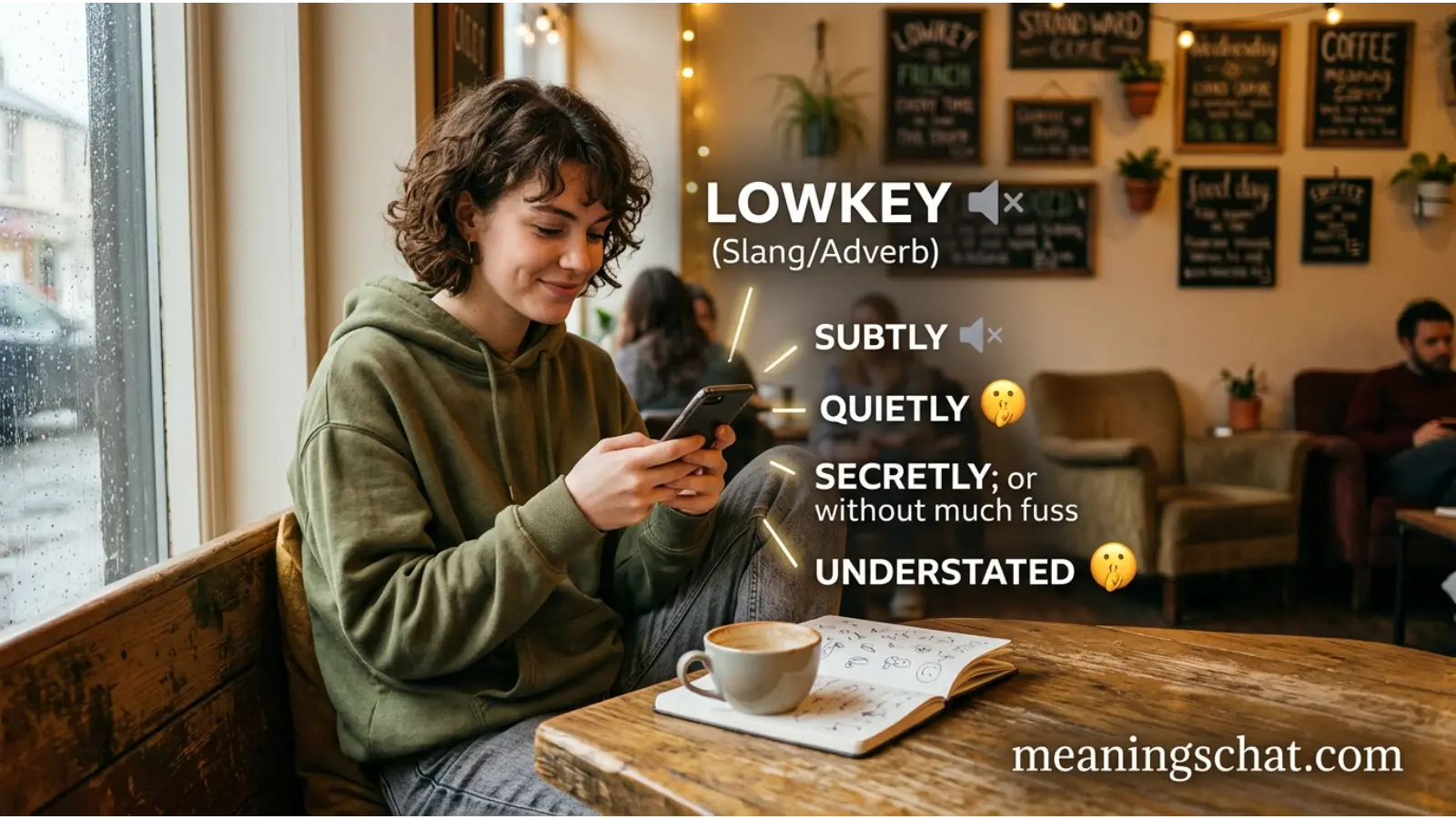
In slang, lowkey usually means somewhat, secretly, quietly, or without making a big deal about something. For example, “I lowkey like this” means “I secretly or quietly like this.”
What Does Lowkey Mean in Text?
In texting and online conversations, lowkey usually describes something a person feels, thinks, likes, or wants without strongly announcing it.
For example:
“I lowkey want pizza.”
This means the person kind of wants pizza or has a quiet desire for pizza. They are not making a huge statement about it.
Another example is:
“I lowkey miss those days.”
Here, the person is admitting that they miss the past, but they are expressing the feeling in a casual or slightly understated way.
The lowkey meaning slang often depends on context. It can communicate ideas such as:
- Secretly
- Quietly
- Kind of
- Somewhat
- Honestly
- Without making a big deal
- Privately
- Surprisingly
The word does not always mean that something is literally a secret. In many modern conversations, people use it simply to soften what they are saying.
Lowkey Full Form and Definition
Many people search for the lowkey full form, but lowkey is not an abbreviation like LOL or BRB. It is a regular English expression that developed into popular slang.
The standard word low-key traditionally means something quiet, restrained, subtle, or not attracting much attention.
In modern slang, people commonly write it as lowkey without the hyphen.
For example:
- “I lowkey enjoyed the movie.”
- “She is lowkey funny.”
- “That game is lowkey difficult.”
- “I’m lowkey nervous.”
In these examples, lowkey makes the statement sound less intense or more casual.
Lowkey Meaning Slang in Different Contexts
The meaning of lowkey can shift based on how someone uses it.
Lowkey Means “Secretly”
Sometimes lowkey suggests that someone has a feeling they have not openly shared.
Example:
“I lowkey have a crush on him.”
The speaker is admitting that they secretly or quietly like him.
Lowkey Means “Kind of”
People also use lowkey to mean “kind of” or “somewhat.”
Example:
“This movie is lowkey scary.”
The speaker thinks the movie is somewhat scary, but they are not describing it as extremely frightening.
Lowkey Means “Without Attention”
Lowkey can also describe doing something quietly or without attracting attention.
Example:
“Let’s keep the party lowkey.”
This means the speaker wants a relaxed gathering without making it a huge event.
Lowkey Means “Honestly”
In casual online speech, lowkey can introduce an honest opinion.
Example:
“Lowkey, that was the best performance.”
The speaker is emphasizing a genuine opinion while keeping the statement casual.
Is Lowkey Rude, Offensive, or Neutral?
Lowkey is generally neutral and not offensive. It is a casual slang expression used in everyday digital communication.
You can see it in conversations among:
- Friends
- Teenagers
- Young adults
- Gaming communities
- Social media users
- Online creators
The word itself is not insulting or vulgar.
However, the sentence around it can still sound rude. For example:
“I lowkey think your idea is terrible.”
The word lowkey is harmless, but the overall statement may hurt someone’s feelings.
For professional emails, business documents, academic writing, and formal communication, standard language usually works better.
Where Is Lowkey Commonly Used?
Lowkey appears frequently in modern digital communication. It has become especially common in informal online spaces.
You may find it in:
- Text messages
- TikTok comments
- Instagram captions
- Snapchat chats
- X posts
- YouTube comments
- Discord conversations
- Gaming chats
- Memes
- Casual conversations
For example, someone might comment:
“This song is lowkey amazing.”
Another person might write:
“I lowkey need a vacation.”
The expression works naturally because these platforms encourage short, informal communication.
Real-Life Examples of Lowkey in Text
Here are several examples showing how people can use lowkey naturally.
Friendly Example
Friend 1: “Want to grab coffee later?”
Friend 2: “Yeah, I lowkey need coffee today.”
Here, lowkey adds a relaxed tone and suggests that the person really wants coffee.
Casual Example
Text: “I lowkey forgot we had homework.”
This means the speaker casually admits that they forgot.
Romantic Example
Text: “I lowkey get excited whenever she texts me.”
The speaker is subtly admitting romantic interest.
Funny Example
Text: “I lowkey ate the entire cake.”
This can be humorous because the speaker admits something they probably should not have done.
Argumentative Example
Person 1: “You never listen to me.”
Person 2: “I lowkey do listen. You just don’t notice.”
Here, lowkey softens the response slightly while still making a defensive point.
Gaming Example
Player: “This boss is lowkey impossible.”
The player means the boss feels extremely difficult, although the statement remains casual.
Social Media Example
Caption: “Lowkey obsessed with this outfit.”
This means the person really likes the outfit and wants to express strong enthusiasm in a trendy, informal way.
Origin and Background of Lowkey
The expression low-key existed in English long before it became internet slang. Traditionally, it described something restrained, subtle, quiet, or not attracting much public attention.
Over time, younger speakers and online communities adapted the expression into a more flexible slang term. Social media helped spread the modern use of lowkey because short, conversational expressions fit naturally into captions, comments, memes, and messages.
Today, people can use lowkey as an adverb to modify an emotion, opinion, action, or reaction.
For example:
“I lowkey love this.”
The modern use is much more flexible than the older expression. It can now suggest secrecy, understatement, moderation, or casual honesty depending on the context.
What Does Lowkey Stand For?
A common question is “what does lowkey stand for?”
Technically, lowkey does not stand for a longer phrase. It is not an acronym or abbreviation.
Instead, it is a slang expression derived from the traditional phrase low-key.
In casual texting, lowkey often communicates:
“I feel this, but I am not making a huge deal about it.”
That simple idea explains many of its modern uses.
Lowkey vs Highkey
One of the most useful comparisons is lowkey vs highkey.
Lowkey usually suggests something subtle, private, understated, or somewhat true.
Highkey usually emphasizes something openly, strongly, or obviously true.
| Slang | Common Meaning | Example |
|---|---|---|
| Lowkey | Secretly, somewhat, quietly | “I lowkey like this song.” |
| Highkey | Openly, strongly, definitely | “I highkey love this song.” |
| Kinda | Somewhat | “I kinda like it.” |
| Secretly | Without openly admitting it | “I secretly like him.” |
| Honestly | Speaking frankly | “Honestly, I like it.” |
The difference between lowkey and highkey is mainly the level of emphasis.
Lowkey: “I quietly like it.”
Highkey: “I openly and strongly like it.”
Lowkey vs Kinda
Lowkey and kinda can sometimes appear interchangeable, but they do not always communicate exactly the same feeling.
“Kinda” mainly means somewhat.
“I kinda like this.”
Lowkey can mean somewhat, but it can also suggest that the speaker is quietly admitting a feeling.
“I lowkey like this.”
The second sentence can sound more like a subtle confession.
Lowkey vs Secretly
These words can overlap, but secretly is more direct.
“I secretly like him.”
This clearly suggests the speaker is hiding the feeling.
“I lowkey like him.”
This sounds softer and more casual. It can mean the speaker quietly likes him without necessarily implying that the feeling is completely hidden.
When Should You Avoid Using Lowkey?
Although lowkey is harmless slang, it does not fit every situation.
Avoid using it in highly formal communication such as:
- Job applications
- Professional reports
- Academic essays
- Business proposals
- Official letters
- Legal documents
- Formal presentations
For example, instead of writing:
“I lowkey think this strategy will work.”
A professional version would be:
“I believe this strategy will work.”
The formal version communicates the idea more clearly and professionally.
Polite Alternatives to Lowkey
Since lowkey is not offensive, you do not need to replace it for politeness. You may still want alternatives when writing formally.
Useful alternatives include:
- Somewhat
- Slightly
- Quietly
- Privately
- Subtly
- To some extent
- Honestly
- In a way
- I believe
- I somewhat agree
For example:
Casual: “I lowkey agree.”
Professional: “I somewhat agree.”
Casual: “I lowkey want to leave.”
Neutral: “I quietly want to leave.”
Professional: “I would prefer to leave.”
Why Do People Use Lowkey?
People use lowkey because it makes communication sound relaxed and natural.
It can help speakers express an opinion without sounding too serious or dramatic.
For example:
“I love this.”
sounds direct and confident.
“I lowkey love this.”
sounds more casual and understated.
The second version can also create a sense of humor or personality. That makes lowkey especially popular in social media posts and text messages.
People may also use it to make a confession feel less embarrassing.
“I lowkey have a crush on you.”
This can feel easier to say than:
“I have a crush on you.”
The slang creates a softer emotional cushion.
Impact of Lowkey in Communication
Slang can make conversations feel more personal and natural. Lowkey is a good example because it can add subtle emotion to a simple statement.
It can make a message sound:
- Relaxed
- Friendly
- Playful
- Honest
- Understated
- Modern
- Conversational
At the same time, slang can create confusion when the reader does not understand its meaning.
For example, someone unfamiliar with internet slang might interpret:
“I lowkey like you.”
as unclear or contradictory.
That is why context matters.
Is Lowkey Safe for Social Media?
Yes. Lowkey is generally safe to use on social media. It is a common, non-offensive slang expression.
You can use it in:
- Captions
- Comments
- Replies
- Direct messages
- Memes
- Gaming posts
- Casual videos
For example:
“Lowkey one of my favorite places.”
or
“This recipe is lowkey incredible.”
There is no harmful meaning attached to the word itself. Still, always consider the overall message and audience before posting.
Lowkey Meaning in Social Media Captions
Social media users often use lowkey to create a relaxed or humorous tone.
Examples include:
“Lowkey living my best life.”
“Lowkey obsessed with this view.”
“Lowkey need a vacation.”
“This is lowkey the funniest thing ever.”
These captions sound less formal and more conversational than traditional wording.
Common Mistakes When Using Lowkey
People sometimes misunderstand the purpose of lowkey.
Mistake 1: Treating It Like an Acronym
Lowkey is not an acronym, so there is no official phrase represented by individual letters.
Mistake 2: Assuming It Always Means Secretly
Lowkey can mean secretly, but it can also mean somewhat, subtly, or casually.
Mistake 3: Using It in Formal Writing
Lowkey works best in informal communication. Professional writing usually needs clearer and more standard vocabulary.
Mistake 4: Ignoring Context
The exact meaning can depend on the sentence.
“I lowkey like it” and “Keep the event lowkey” use the expression differently.
FAQs:
What does lowkey mean in slang?
Lowkey usually means secretly, quietly, somewhat, or without making a big deal about something. The exact meaning depends on the context.
What does lowkey mean in text messages?
In text messages, lowkey usually softens an opinion or feeling. “I lowkey love it” can mean “I secretly or quietly love it.”
What does lowkey stand for?
Lowkey does not stand for a longer phrase. It is a slang expression derived from the traditional term “low-key.”
Is lowkey a bad word?
No. Lowkey is generally neutral and harmless slang. It is widely used in casual conversations and social media.
What is the difference between lowkey and highkey?
Lowkey suggests something subtle, quiet, or understated. Highkey suggests something obvious, strong, or openly expressed.
Can I use lowkey in professional writing?
It is best to avoid lowkey in formal or professional writing. Use words such as “somewhat,” “quietly,” “subtly,” or “I believe” instead.
Conclusion
Understanding the lowkey meaning slang is easy once you look at the context. In modern texting and social media, lowkey usually means secretly, quietly, somewhat, or without making a big deal about something. It can soften an opinion, make a confession feel more casual, or simply add personality to a message.
The expression is generally neutral and safe for casual conversations, captions, comments, gaming chats, and messages. However, formal communication calls for more standard language.
So, when someone says, “I lowkey love this,” they are usually saying that they really like it but are expressing that feeling in a relaxed or understated way. Understanding that subtle tone can help you read online conversations more naturally and use the slang confidently yourself.