You’re scrolling through a chat and suddenly see someone type “jsyk…” in a message. At first glance, it looks confusing—maybe even like a typo. You pause for a second, wondering if it’s some secret code or a new internet trend you missed. A friend might say, “JSYK, the meeting is moved to 5,” and you’re still stuck trying to decode it.
Don’t worry—you’re not alone. Internet slang evolves fast, and abbreviations like this can feel overwhelming. The good news is that “jsyk” is actually simple, friendly, and widely used in casual online conversations. Once you understand it, you’ll start noticing it everywhere in texts, social media posts, and group chats.
In this guide, we’ll break down exactly what “jsyk” means, where it’s used, how to use it correctly, and when you should avoid it. Let’s make it easy.
What Does jsyk Mean in Text?
The abbreviation “jsyk” stands for “Just So You Know.”
It is commonly used in texting and online communication to share helpful or additional information with someone. It’s like giving a quick heads-up without sounding too serious or formal.
Simple meaning:
“jsyk” = “I want to inform you about something quickly.”
It is often used when someone is:
- Sharing useful information
- Giving a reminder
- Clarifying something
- Adding extra context to a message
Example of meaning in a sentence:
- “JSYK, the store closes early today.”
This means: “Just so you know, the store closes early today.”
Is it always the same meaning?
Yes, most of the time “jsyk” only means “Just So You Know.” Unlike some slang terms, it doesn’t usually have multiple meanings, which makes it easy to understand and use.

Where Is jsyk Used?
The slang “jsyk” is widely used in casual digital communication. You will mostly see it in places where people talk quickly and informally.
Common platforms include:
- WhatsApp chats
- Instagram DMs
- Snapchat messages
- TikTok comments or replies
- Discord chats (especially among gamers)
- General SMS texting
Who uses it most?
- Teenagers and young adults
- Social media users
- Gamers in group chats
- People who prefer quick texting shortcuts
Why is it popular?
People use “jsyk” because:
- It saves time
- It feels casual and friendly
- It keeps conversations short
- It adds a conversational tone instead of sounding formal
In short, it fits perfectly into the fast-paced world of online chatting.

Examples of jsyk in Conversation
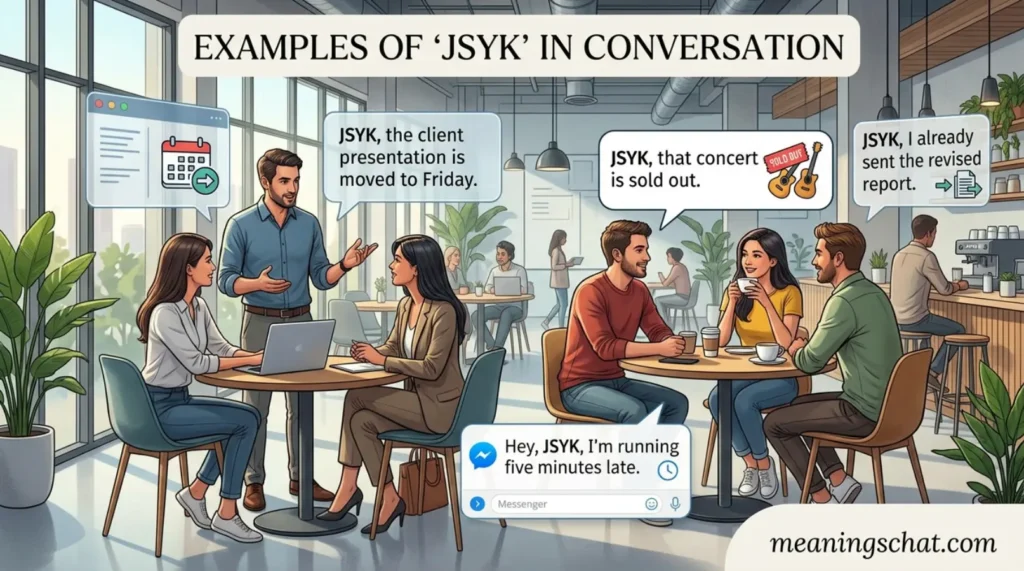
Understanding slang becomes much easier when you see it in real conversations. Here are some natural examples of how “jsyk” is used:
- Friendly update:
- A: “Are we still meeting tonight?”
- B: “JSYK, it got postponed to tomorrow.”
- Helpful reminder:
- “JSYK, your assignment is due by 6 PM today.”
- Casual info sharing:
- “JSYK, I won’t be online much this weekend.”
- Funny tone:
- “JSYK, I ate the last slice of pizza 😅”
- Flirty message:
- “JSYK, I think you looked really good today 😉”
- Group chat update:
- “JSYK, the group call is starting in 10 minutes.”
- Warning or heads-up:
- “JSYK, the road near your house is closed.”
These examples show how flexible and easy-going the slang is. It can be used in serious updates or lighthearted chats depending on the situation.
When to Use and When Not to Use jsyk
Even though “jsyk” is simple and useful, it’s important to know when it fits and when it doesn’t.
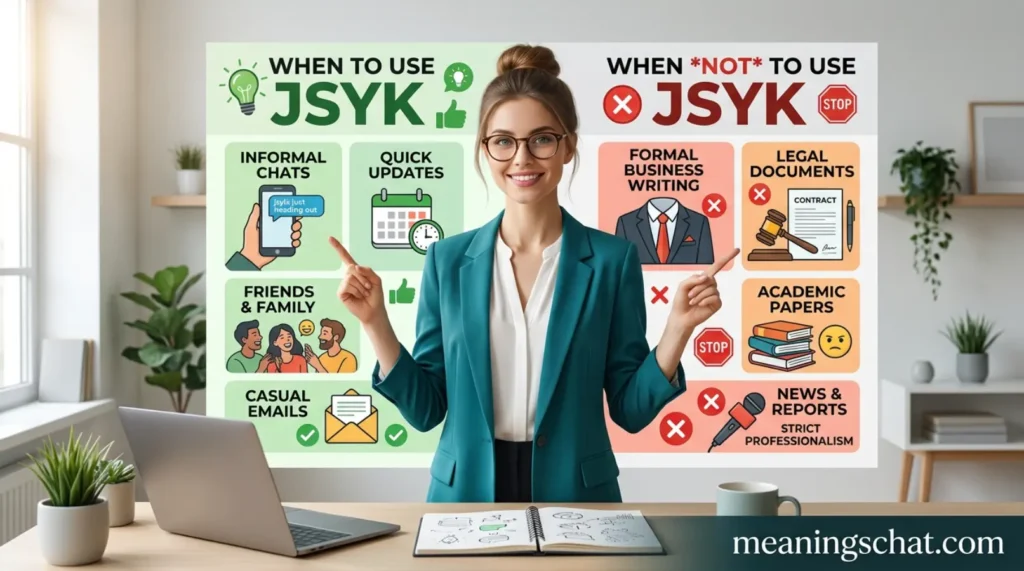
When to use jsyk:
- Casual conversations with friends
- Informal group chats
- Social media posts or comments
- Quick updates or reminders
- Light or friendly communication
It works best when the tone is relaxed and conversational.
When NOT to use jsyk:
- Professional emails
- Work-related messages (formal communication)
- Academic essays or assignments
- Official announcements
- Serious or sensitive situations
Why avoid it in formal settings?
Because “jsyk” is slang, it can feel unprofessional or unclear to people who are not familiar with internet abbreviations. In workplaces or formal writing, it’s better to write the full phrase “Just so you know.”
Tone check:
- Friendly: ✔ Yes
- Casual: ✔ Yes
- Professional: ✖ No
- Formal: ✖ No
Knowing this balance helps you avoid misunderstandings.
Similar Slang Words or Alternatives
“jsyk” belongs to a family of short texting abbreviations used to make communication faster. Here are some similar slang terms:
1. FYI (For Your Information)
Used to share useful information, similar to “jsyk,” but slightly more formal.
2. BTW (By The Way)
Used when adding extra information casually in a conversation.
3. ICYMI (In Case You Missed It)
Used to highlight something someone may have missed.
4. TBH (To Be Honest)
Used when someone is giving a frank opinion.
5. NGL (Not Gonna Lie)
Used when someone is being honest or blunt.
These alternatives often overlap in usage, but “jsyk” specifically focuses on giving a quick informational heads-up.
FAQs
What does jsyk mean from a girl?
It has the same meaning—“Just So You Know.” It doesn’t change based on gender. However, the tone may feel flirty or friendly depending on the context of the message.
Is jsyk slang rude?
No, “jsyk” is not rude. It is neutral and simply used to share information. However, tone depends on how it’s used in a sentence.
Can I use jsyk in professional chats?
It’s better not to use “jsyk” in professional or formal communication. Instead, write “Just so you know” for clarity and professionalism.
Does jsyk have any flirty meaning?
Not by default. However, in casual or flirty conversations, it can feel playful depending on what follows the phrase.
Is jsyk still popular in 2025?
Yes, “jsyk” is still used in texting and social media, although it is less common than more universal terms like “FYI.”
Conclusion
“jsyk” is a simple and useful internet abbreviation that stands for “Just So You Know.” It’s commonly used in casual texting and social media to share quick updates, reminders, or helpful information. While it’s perfect for friendly conversations, it should be avoided in formal or professional settings.
If you remember one thing, it’s this: use “jsyk” when you want to sound casual, quick, and conversational—but switch to full wording when clarity and professionalism matter.

William Jones is a dedicated writer at Meaningschat who specializes in explaining text slang, abbreviations, and online language trends. He enjoys creating simple, engaging, and reader-friendly content that helps people understand modern digital communication with ease. His writing style is clear, conversational, and informative, making complex internet terms easy for everyone to follow. In his free time, William loves exploring social media trends, reading about digital culture, and discovering how online language continues to evolve.