Have you ever been scrolling through a chat or social media post and suddenly seen someone write “GMT”, leaving you confused for a moment? You’re not alone. Many people first assume it’s something technical or related to time zones, and in some cases, it actually is. But in texting and online slang, abbreviations like this can have different meanings depending on the context.
The term “GMT” often appears in messages, group chats, gaming lobbies, and even social media comments. If you’ve been wondering what it means, how people use it, and whether you should use it too, this guide will break it all down in a simple and friendly way so you never feel lost again.
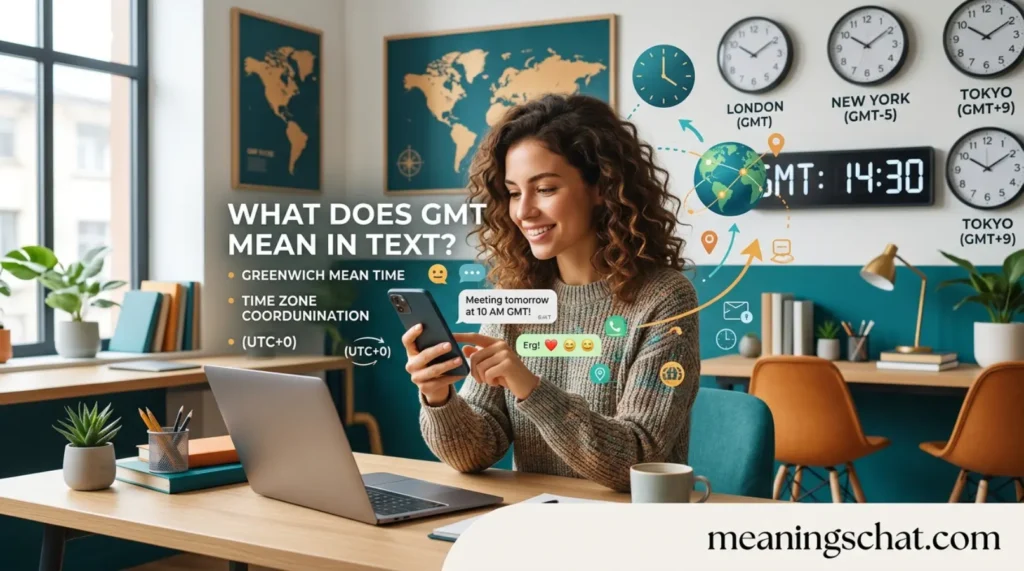
What Does GMT Mean in Text?
In texting and online communication, GMT can have a few different meanings depending on context:
1. Greenwich Mean Time (Most Common Meaning)
The most standard and widely known meaning of GMT is Greenwich Mean Time, which is a global time standard used to calculate time zones around the world.
In chats, people sometimes use it when referring to timing, schedules, or international communication.
Example:
- “Let’s meet at 3 PM GMT.”
2. “Good Morning/Good Night Text” (Rare Slang Use)
In some informal or creative texting circles, people may loosely use GMT as shorthand in playful ways, but this is not widely standardized. It is very rare and not commonly understood.
3. Gaming or Group Chat Context (Time Reference)
Gamers or online communities sometimes use GMT casually to coordinate events across time zones.
Example:
- “Raid starts at 8 PM GMT, don’t miss it.”
Key Takeaway:
In 99% of cases, GMT = Greenwich Mean Time, not slang. So when you see it in text, think “time zone” first.
Where Is GMT Used?
The abbreviation GMT is not typical slang like “LOL” or “BRB.” Instead, it is mostly used in structured or global communication.
1. Social Media Platforms
On platforms like Instagram, Twitter (X), TikTok, or Facebook, GMT is used when people talk about posting schedules or live events.
Example:
- “Going live at 6 PM GMT tonight!”
2. Messaging Apps
On WhatsApp, Telegram, or Messenger, GMT appears in group planning chats, especially when people are in different countries.
3. Gaming Communities
Gamers often use GMT to coordinate matches, tournaments, or events across regions.
4. Professional or International Communication
Freelancers, remote workers, and businesses use GMT to avoid confusion across time zones.
5. Educational or Technical Discussions
It is also used in academic, aviation, and scientific contexts.
Who Uses It Most?
- International users
- Gamers
- Content creators
- Remote workers
- Students learning time zones

Examples of GMT in Conversation
Here are some realistic chat-style examples to help you understand how GMT appears in daily messages:
- Planning a meeting:
- Alex: “What time is the meeting?”
- Sam: “10 AM GMT.”
- Gaming session:
- Player1: “When does the event start?”
- Player2: “It’s live at 7 PM GMT.”
- Social media post:
- “New video drops at 5 PM GMT 🔥 Don’t miss it!”
- Friend chat across countries:
- Emma: “It’s 9 PM here.”
- John: “That’s 2 PM GMT for me.”
- Work coordination:
- Manager: “Deadline is midnight GMT.”
- Streaming schedule:
- “Live stream starts at 4 PM GMT sharp!”
- Travel/time confusion:
- “Wait, is that GMT or local time?”
These examples show that GMT is mainly used for clarity in timing rather than emotional or slang meaning.

When to Use and When Not To Use GMT
Understanding when to use GMT is important so you don’t confuse people.
When to Use GMT
✔ When talking about international time differences
✔ When scheduling meetings across countries
✔ When posting content for global audiences
✔ In gaming or online events
✔ When clarity in timing is important
Example:
- “Webinar starts at 3 PM GMT for all participants.”
When NOT to Use GMT
❌ Casual local conversations (people may not understand it)
❌ Emotional or informal texting
❌ When talking to someone who doesn’t know time zone terms
❌ In jokes or memes (unless context is clear)
Example of confusion:
- “Let’s meet at 5 PM GMT” (to someone local, this may be unnecessary)
Tone of GMT Usage
- Neutral and professional in most cases
- Not emotional, not flirty
- Not casual slang like “lol” or “wyd”
So, GMT is best used when clarity matters, not emotion.

Similar Slang Words or Alternatives
Here are some related abbreviations and time-related terms you might see:
1. UTC (Coordinated Universal Time)
A global time standard similar to GMT, often used in technology and aviation.
2. EST (Eastern Standard Time)
Used in North America for time zone reference.
3. PST (Pacific Standard Time)
Another U.S. time zone abbreviation.
4. IST (Indian Standard Time)
Used in India for local time reference.
5. Zulu Time (Z)
A military and aviation term equivalent to GMT/UTC.
These are not slang but time zone abbreviations used globally.
FAQs
What does GMT mean from a girl?
It doesn’t have a special meaning from a girl or boy. GMT simply refers to Greenwich Mean Time, unless used in a very specific joking context, which is rare.
Is GMT slang rude?
No, GMT is not rude. It is a neutral and professional time reference used globally.
Can I use GMT in professional chats?
Yes, absolutely. GMT is commonly used in business, remote work, and international communication.
Does GMT have any flirty meaning?
No, GMT does not have a flirty meaning in standard texting. It is purely related to time zones.
Is GMT still popular in 2025?
Yes. GMT is still widely used in 2025, especially in global communication, gaming, and online scheduling.
Conclusion
To sum it up, GMT in text mostly means Greenwich Mean Time, a global time standard used to coordinate schedules across different time zones. While it may look like slang at first, it is actually more technical and practical than casual.
The key to using GMT correctly is understanding context. If you’re talking about timing, meetings, or international communication, it fits perfectly. But in casual everyday chats, it’s often unnecessary.
So next time you see GMT in a message, you’ll know exactly what it means—and you can even use it confidently when talking to people across the world.

William Jones is a dedicated writer at Meaningschat who specializes in explaining text slang, abbreviations, and online language trends. He enjoys creating simple, engaging, and reader-friendly content that helps people understand modern digital communication with ease. His writing style is clear, conversational, and informative, making complex internet terms easy for everyone to follow. In his free time, William loves exploring social media trends, reading about digital culture, and discovering how online language continues to evolve.