
Composite number meaning is an important basic concept in mathematics. If you have ever wondered why some numbers can be divided evenly by more than just 1 and themselves, you have already encountered composite numbers. Students often search for this term because understanding composite numbers makes topics like factors, prime numbers, divisibility, and number classification much easier.
The good news is that the idea is simple once you know what to look for. A composite number has more than two positive factors. For example, 6 can be divided evenly by 1, 2, 3, and 6, so it is composite. In everyday math, identifying these numbers helps you solve problems faster and understand how numbers are built.
Quick Answer:
A composite number is a whole number greater than 1 that has more than two positive factors. For example, 4, 6, 8, 9, and 10 are composite numbers.
What Does Composite Number Mean?
A composite number is a positive whole number greater than 1 that has more than two positive factors.
A factor is a whole number that divides another number evenly without leaving a remainder. Since a composite number has factors besides 1 and itself, it can be divided into smaller whole-number groups.
For example:
- 4 has factors 1, 2, and 4.
- 6 has factors 1, 2, 3, and 6.
- 8 has factors 1, 2, 4, and 8.
- 9 has factors 1, 3, and 9.
- 10 has factors 1, 2, 5, and 10.
Each of these numbers has more than two factors, so each one is composite.
A simple way to remember the definition is:
More than two factors = composite number.
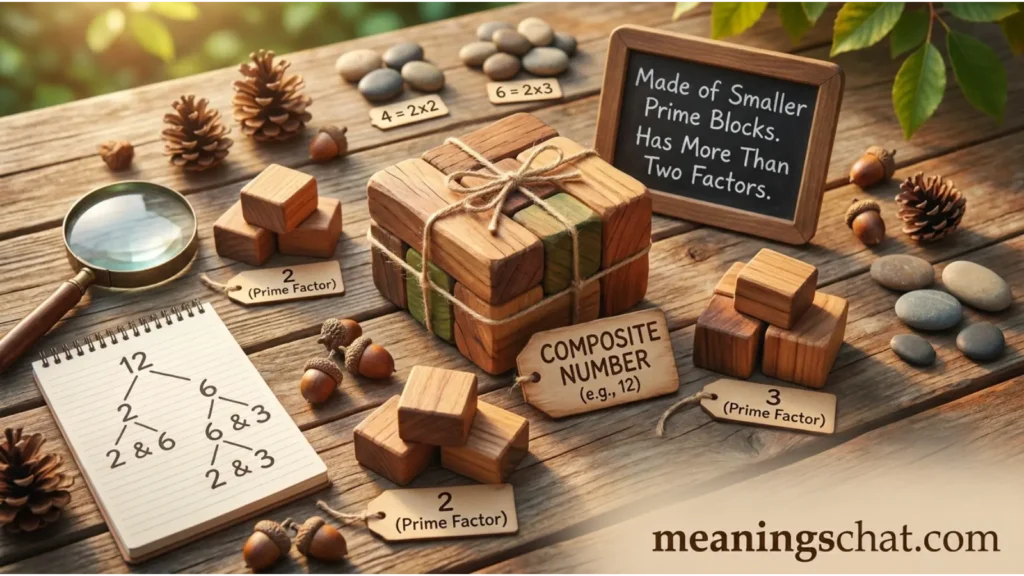
Composite Number Definition in Simple Words
The formal definition can sound complicated at first, but you can simplify it.
A composite number is a number that can be made by multiplying two smaller whole numbers greater than 1.
For example:
6 = 2 × 3
Because 6 can be created by multiplying 2 and 3, it is composite.
Another example is:
12 = 3 × 4
Therefore, 12 is also composite.
This multiplication approach provides a quick way to recognize composite numbers.
What Is the Composite Number Full Meaning?
People sometimes search for composite number full form, but “composite” is not an abbreviation. It does not have a full form like an acronym.
In mathematics, the word composite describes something made from multiple parts. A composite number has multiple factors that work together to produce the number.
For example:
15 = 3 × 5
The number 15 is built from 3 and 5, so it is composite.
The term does not stand for a phrase. Instead, it describes the structure of the number.
How Do You Identify a Composite Number?
You can identify a composite number by checking how many positive factors it has.
Follow these simple steps:
- Choose a whole number greater than 1.
- Try dividing it by numbers other than 1 and itself.
- If another whole number divides it evenly, the number is composite.
- If no other whole number divides it evenly, the number is prime.
For example, consider 14.
14 can be divided by:
- 1
- 2
- 7
- 14
Since 14 has more than two factors, it is composite.
Now consider 13.
13 can only be divided evenly by:
- 1
- 13
Therefore, 13 is prime, not composite.
Composite Numbers vs. Prime Numbers
Composite numbers and prime numbers are closely related, but they are not the same.
A prime number has exactly two positive factors: 1 and itself.
A composite number has more than two positive factors.
Here are some examples:
| Number | Factors | Type |
|---|---|---|
| 2 | 1, 2 | Prime |
| 3 | 1, 3 | Prime |
| 4 | 1, 2, 4 | Composite |
| 5 | 1, 5 | Prime |
| 6 | 1, 2, 3, 6 | Composite |
| 7 | 1, 7 | Prime |
| 8 | 1, 2, 4, 8 | Composite |
| 9 | 1, 3, 9 | Composite |
| 10 | 1, 2, 5, 10 | Composite |
A quick rule is:
Exactly two factors = prime.
More than two factors = composite.
Is 1 a Composite Number?
No. 1 is neither prime nor composite.
This is one of the most common points of confusion for students.
The number 1 has only one positive factor: itself.
Remember that a composite number must have more than two positive factors. Since 1 has only one factor, it does not qualify.
Likewise, 1 cannot be prime because a prime number must have exactly two positive factors.
So:
1 = neither prime nor composite.
Is 0 a Composite Number?
No. Zero is not classified as a composite number.
Composite numbers are positive integers greater than 1. Zero does not meet this basic requirement.
The same idea applies to negative numbers. Standard elementary number classification generally discusses prime and composite numbers among positive integers greater than 1.
So the easiest rule is:
Composite numbers start at 4.
Is 2 a Composite Number?
No. 2 is a prime number.
In fact, 2 is the smallest prime number and the only even prime number.
Its only positive factors are:
1 and 2
Because it has exactly two factors, it is prime.
The next even number, 4, is composite because it has three factors:
1, 2, and 4
Is Every Even Number Composite?
Almost every even whole number greater than 2 is composite.
The reason is simple: every even number can be divided evenly by 2.
For example:
- 4 ÷ 2 = 2
- 6 ÷ 2 = 3
- 8 ÷ 2 = 4
- 10 ÷ 2 = 5
- 12 ÷ 2 = 6
Each number has at least one factor besides 1 and itself.
However, 2 is the exception because it has only two factors.
Therefore:
Every even number greater than 2 is composite.
Examples of Composite Numbers
Here are some common composite numbers:
4, 6, 8, 9, 10, 12, 14, 15, 16, 18, 20, 21, 22, 24, 25, 26, 27, 28, 30
Let’s examine a few closely.
4
Factors:
1, 2, 4
Since 4 has three factors, it is composite.
9
Factors:
1, 3, 9
Because 9 has more than two factors, it is composite.
15
Factors:
1, 3, 5, 15
It has four positive factors, making it composite.
25
Factors:
1, 5, 25
Therefore, 25 is composite.
27
Factors:
1, 3, 9, 27
So 27 is also composite.
Composite Number Examples in Multiplication
Another easy way to understand composite numbers is through multiplication.
If a number can be written as a product of two whole numbers greater than 1, it is composite.
Examples include:
- 4 = 2 × 2
- 6 = 2 × 3
- 8 = 2 × 4
- 9 = 3 × 3
- 10 = 2 × 5
- 12 = 3 × 4
- 14 = 2 × 7
- 15 = 3 × 5
- 16 = 4 × 4
- 18 = 3 × 6
This method is especially useful when you need to identify composite numbers quickly during a math exercise.
How Composite Numbers Are Used in Real Life
Composite numbers may seem like a classroom-only concept, but factors and multiplication appear throughout everyday life.
For example, imagine you have 12 apples and want to arrange them into equal rows.
You could make:
- 2 rows of 6
- 3 rows of 4
- 4 rows of 3
- 6 rows of 2
These different arrangements exist because 12 has several factors.
Another example is a classroom with 20 students. You can arrange the students into equal groups in several ways because 20 has multiple factors.
Understanding composite numbers helps you recognize these patterns.
Why Are Composite Numbers Important?
Composite numbers are important because they help build a foundation for more advanced mathematics.
They connect to:
- Factors
- Multiplication
- Division
- Prime numbers
- Prime factorization
- Greatest common factors
- Least common multiples
- Fractions
- Number theory
When students understand how composite numbers work, they can approach many other math concepts with greater confidence.
Composite Numbers and Prime Factorization
Composite numbers can be broken down into prime factors. This process is called prime factorization.
Consider the number 12.
You can write:
12 = 2 × 6
Then break 6 down further:
6 = 2 × 3
So:
12 = 2 × 2 × 3
All the numbers on the right are prime.
This process helps mathematicians and students work with numbers in a structured way.
Another example is 18:
18 = 2 × 9
Then:
9 = 3 × 3
Therefore:
18 = 2 × 3 × 3
Composite Number Meaning Compared With Related Terms
Several mathematical terms can seem similar, especially when you are learning number classifications.
| Term | Meaning | Example |
|---|---|---|
| Prime number | Has exactly two positive factors | 7 |
| Composite number | Has more than two positive factors | 12 |
| Factor | A number that divides another number evenly | 3 is a factor of 12 |
| Multiple | Result of multiplying a number by an integer | 24 is a multiple of 6 |
| Integer | A whole number that can be positive, negative, or zero | -3, 0, 5 |
Knowing the difference between these terms makes mathematical explanations much easier to follow.
Common Mistakes About Composite Numbers
Students often make a few predictable mistakes when learning this topic.
Mistake 1: Thinking Every Number Is Prime or Composite
The number 1 is neither prime nor composite.
Mistake 2: Calling 2 Composite
Although 2 is even, it is prime because it has exactly two factors.
Mistake 3: Forgetting the Number Itself
When listing factors, remember to include the number itself.
For 10, the factors are:
1, 2, 5, 10
Mistake 4: Confusing Factors With Multiples
A factor divides a number evenly.
A multiple results from multiplying a number by an integer.
For example, 3 is a factor of 12, while 12 is a multiple of 3.
Quick Practice: Is the Number Composite?
Try identifying these numbers:
5, 8, 11, 15, 17, 21, 23, 24
The composite numbers are:
8, 15, 21, and 24
Why?
- 8 = 2 × 4
- 15 = 3 × 5
- 21 = 3 × 7
- 24 = 4 × 6
The other numbers in the list are prime.
Why People Search for Composite Number Meaning
Students, parents, teachers, and anyone reviewing basic mathematics may search for composite number meaning when they encounter the term in homework, textbooks, quizzes, or online lessons.
A simple definition often works better than a complicated mathematical explanation.
The key idea is easy to remember:
A composite number has more than two positive factors.
Once you understand that rule, you can identify many composite numbers without memorizing a long list.
FAQs:
What is a composite number in simple words?
A composite number is a whole number greater than 1 that has more than two positive factors. For example, 6 is composite because its factors are 1, 2, 3, and 6.
What does composite number stand for?
“Composite number” does not stand for an abbreviation. The word composite describes a number that has multiple factors.
What is the smallest composite number?
The smallest composite number is 4. Its positive factors are 1, 2, and 4.
Is 1 a composite number?
No. 1 is neither prime nor composite because it has only one positive factor.
Is 9 a composite number?
Yes. 9 is composite because it has three positive factors: 1, 3, and 9.
What is the difference between a prime and composite number?
A prime number has exactly two positive factors, while a composite number has more than two positive factors.
Conclusion
Understanding composite number meaning becomes easy when you focus on factors. A composite number is a whole number greater than 1 that has more than two positive factors. Numbers such as 4, 6, 8, 9, 10, and 12 are common examples.
Remember the three important rules: prime numbers have exactly two positive factors, composite numbers have more than two, and 1 is neither prime nor composite. You can also identify many composite numbers by finding a multiplication combination using numbers greater than 1.
Once you learn this simple pattern, topics such as prime factorization, factors, multiples, fractions, and number theory become much easier to understand.