
Composite meaning usually refers to something that is made by combining two or more separate parts, ideas, materials, or elements into one complete thing. People often search for the composite meaning because the word appears in schoolwork, science, mathematics, technology, art, construction, and everyday conversations. Its meaning can change slightly depending on the subject, so understanding the context makes the word much easier to use correctly.
You may see “composite” describing a material made from different substances, a number formed by multiplying smaller numbers, or an image created from several pictures. It can sound technical at first, but the central idea stays simple: different parts come together to form a whole.
Quick Answer
Composite meaning describes something formed by combining two or more separate parts into one whole. The word “composite” generally means “made up of several parts or elements.”
What Does Composite Mean in Text?
The word composite is not usually internet slang or a text abbreviation. Instead, it is a standard English word that people use in both formal and casual communication.
In text messages, chats, emails, social media posts, and online discussions, “composite” generally keeps its normal dictionary meaning. It describes something that combines multiple components.
For example:
“The character is a composite of several historical figures.”
This means the character combines traits or features from multiple people.
Another example is:
“The report gives a composite picture of customer opinions.”
Here, “composite” means the picture or summary combines information from several sources.
So, when someone searches for composite meaning slang, it is important to know that composite does not normally function as slang. It is a regular vocabulary word with several specialized uses.
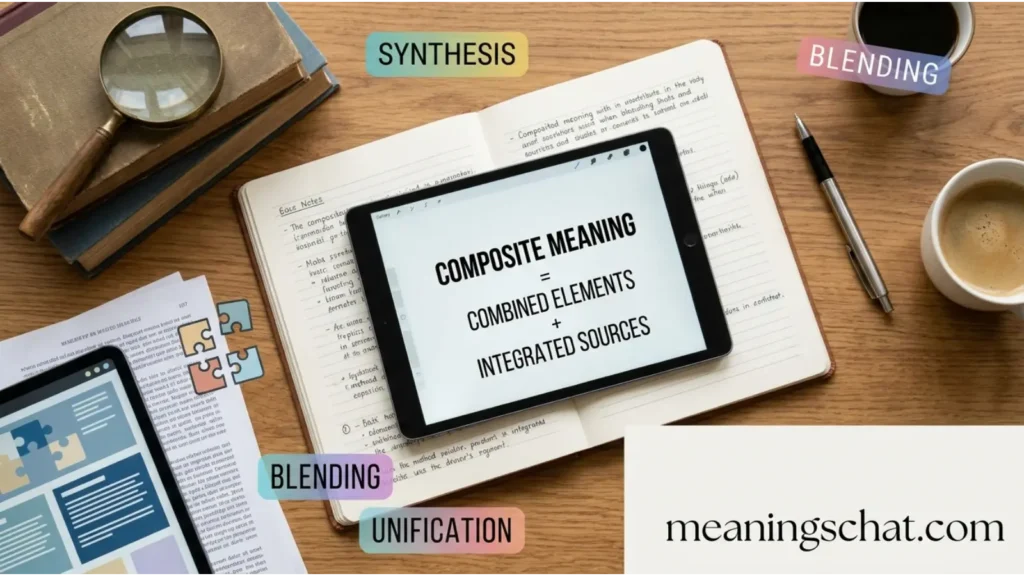
Composite Full Form and Definition
People sometimes search for a composite full form, but “composite” does not have a standard full form because it is not an acronym.
The word comes from the idea of combining separate parts.
Simple Definition
Composite: Something created by combining multiple parts, elements, materials, or ideas.
In Simple English
You can think of “composite” as:
Many parts + one complete result = composite
For instance, a collage is a composite image because it combines several visual elements into one picture.
A composite material combines different materials to create a product with useful properties.
A composite number combines the mathematical idea of having more than two positive factors.
What Does Composite Stand For?
If you are asking what does composite stand for, the answer is that it does not stand for a phrase like an abbreviation does.
Instead, “composite” describes the combination of different parts into a single whole.
The exact interpretation depends on the context:
- In general English, it means made from several parts.
- In mathematics, it describes a number with more than two positive factors.
- In materials science, it describes a material made from two or more distinct components.
- In photography, it can describe an image created by combining multiple images.
- In writing, it can describe something based on characteristics from multiple sources.
- In technology, it can describe a system or object made from several components.
Composite Meaning in Different Contexts
One of the easiest ways to understand this word is to see how its meaning works in different subjects.
Composite Meaning in General English
In everyday English, composite means something formed by combining different parts.
Example:
“The final design is a composite of several ideas.”
The sentence means that the final design combines several ideas into one.
Composite Meaning in Mathematics
In mathematics, composite has a very specific meaning.
A composite number is a positive whole number greater than 1 that has more than two positive factors.
For example:
12 is composite because its positive factors include:
1, 2, 3, 4, 6, and 12
By comparison, 7 is a prime number because its only positive factors are 1 and 7.
Other composite numbers include:
- 4
- 6
- 8
- 9
- 10
- 12
- 14
- 15
- 16
- 18
This is one of the most common meanings students encounter when searching for composite meaning.
Composite Meaning in Science
In science and engineering, a composite is often a material made by combining two or more different materials.
A common example is fiberglass. It combines glass fibers with a resin material to create a product with useful strength and durability.
The goal is usually to combine desirable properties from different components.
Composite Meaning in Photography
In photography and digital design, a composite image combines elements from multiple photographs or visual sources.
For example, a designer might place a person from one photograph into a different background.
The final picture becomes a composite because several visual elements create one finished image.
Composite Meaning in Writing
A writer can use “composite” to describe something created from multiple sources.
For example:
“The fictional character is a composite based on several real people.”
This means the character does not represent only one person. Instead, the writer combined characteristics from different people.
Is Composite Rude, Offensive, or Neutral?
Composite is a neutral word.
It is not normally rude, insulting, vulgar, or offensive. You can use it in professional, educational, academic, and casual conversations.
For example:
“We created a composite image for the presentation.”
This sounds professional and neutral.
Another example:
“The character is a composite of several personalities.”
Again, the word itself carries no offensive meaning.
The surrounding sentence can affect the overall tone, but composite itself is generally safe to use.
Where Is Composite Commonly Used?
You can encounter “composite” in many areas.
Common examples include:
- Mathematics
- Science
- Engineering
- Construction
- Photography
- Graphic design
- Education
- Research
- Business
- Technology
- Sports analysis
- Journalism
- Everyday writing
It appears more often in written and educational communication than in casual texting.
For example, a student might write:
“A composite number has more than two positive factors.”
A designer might say:
“This is a composite photograph.”
An engineer might discuss:
“Composite materials used in aircraft.”
The context tells you which meaning applies.
Real Life Examples of Composite
Here are some natural examples that show how people use the word.
Friendly Example
“Your artwork looks like a composite of all your favorite styles.”
This is a friendly way to say that the artwork combines several styles.
Casual Example
“That picture is actually a composite. They combined three photos.”
This sounds natural in an everyday conversation.
Academic Example
“The teacher asked us to identify the composite numbers.”
Here, the word has its mathematical meaning.
Professional Example
“The company selected composite materials for the new product.”
This uses the word in a technical setting.
Social Media Example
“This image is a composite, not a single photograph.”
This clarifies that several visual elements were combined.
Creative Example
“The movie character feels like a composite of several classic heroes.”
Here, composite means the character contains traits inspired by multiple characters.
Composite Meaning in Text Messages
When someone uses “composite” in a text message, you should normally interpret it according to the surrounding conversation.
For example:
Friend: “Is that one photo?”
You: “No, it’s a composite.”
Here, composite probably means the picture combines multiple images.
Another conversation could be:
Student: “Is 21 prime?”
Friend: “No, it’s composite.”
Here, the mathematical meaning applies.
This shows why context matters. The word itself stays the same, but its specific meaning can change depending on the topic.
Is Composite Slang?
No. Composite is not commonly considered slang.
Some people searching for composite meaning slang may assume that every unusual word they encounter online must be slang. That is not the case.
Composite is a standard English vocabulary word.
It can appear in informal texts, but using a word in a text message does not automatically make it slang.
For example:
“The final design is composite.”
This is simply standard English used in a casual digital conversation.
Comparison With Similar Words
Several words have meanings close to “composite,” but they are not always interchangeable.
| Word | Meaning | Example |
|---|---|---|
| Composite | Made by combining several parts | The image is composite. |
| Combined | Joined together | We combined the two lists. |
| Mixture | Different substances or things mixed together | The mixture contains several ingredients. |
| Compound | Made by combining elements or parts | Water is a compound. |
| Collective | Formed from or representing a group | The team made a collective decision. |
| Hybrid | Created by combining different types | The car uses a hybrid system. |
| Aggregate | A total formed from several parts | The report shows aggregate results. |
Composite vs. Combined
“Combined” is more general.
“We combined the files.”
“Composite” emphasizes the final thing being formed from multiple components.
“The final image is composite.”
Composite vs. Compound
These words can overlap, especially in technical subjects, but they have different uses.
A compound can refer to a substance formed when elements chemically combine.
A composite generally refers to distinct components brought together to create a material or whole.
Composite vs. Mixture
A mixture usually involves substances placed together without necessarily creating a new material.
Composite often emphasizes a designed or structured combination of different components.
When Should You Avoid Using Composite?
There is no major safety concern with the word, but you should avoid using it when a simpler word would make your meaning clearer.
For example, instead of:
“We generated a composite arrangement of the documents.”
You could simply say:
“We combined the documents.”
In casual conversations, “combined,” “mixed,” or “made from several parts” may sound more natural.
Use “composite” when you want to communicate the idea accurately or when the context is technical.
Polite and Simple Alternatives to Composite
Since composite is neutral, you do not need a polite replacement. However, you can use simpler alternatives depending on your audience.
Consider:
- Combined
- Made from several parts
- Made up of different elements
- Blended
- Mixed
- Joined
- Integrated
- Combined together
- Formed from multiple components
For a general audience, “made from several parts” is often easier to understand.
For a technical audience, “composite” may be the more precise choice.
Why Do People Use the Word Composite?
People use “composite” because it efficiently communicates a specific idea: something contains or combines multiple components.
Instead of explaining the entire process, one word can communicate the concept.
For example:
“It is a composite image.”
This is shorter than saying:
“The image contains elements taken from several different pictures and combined into one.”
The word also helps people communicate accurately in technical and academic subjects.
Impact of Composite in Communication
Using “composite” can make communication more precise, especially in education, business, science, and technology.
However, technical vocabulary can sometimes confuse readers who are unfamiliar with it.
For example:
“The research team developed a composite model.”
An expert may understand this immediately, while a beginner may wonder what “composite” means.
A clearer version could be:
“The research team developed a model that combines several different factors.”
Good communication depends on your audience. Use the precise word when your readers understand it, and explain it when they may not.
Is Composite Safe for Social Media?
Yes. The word composite is generally safe and neutral for social media.
You can use it in posts about:
- Photography
- Mathematics
- Science
- Education
- Design
- Engineering
- Art
- Technology
- Research
For example:
“Created this composite image using several photographs.”
There is nothing offensive or inappropriate about the term.
If you are discussing edited images, however, it can be helpful to explain that the image is composite so viewers understand that it combines multiple visual elements.
Real Life Composite Examples by Tone
Friendly Tone
“I love this picture! It looks like a beautiful composite of all your travel photos.”
Casual Tone
“Yep, it’s a composite. I put a few pictures together.”
Argumentative Tone
“That isn’t an original photo. It’s a composite made from several images.”
The word remains neutral even when the surrounding conversation becomes argumentative.
Gaming Context
“Our strategy is a composite of several different builds.”
Here, the word suggests that the strategy combines multiple approaches.
Social Media Context
“Before you ask, this is a composite image. I combined several shots.”
School Context
“Twenty-five is composite because it has factors other than 1 and itself.”
Business Context
“The presentation includes a composite view of customer feedback.”
How to Remember Composite Meaning
A simple memory trick can make the word easier to remember.
Think:
Composite = components combined
Both words begin with com and relate to bringing things together.
You can remember it as:
Several parts come together → composite
For mathematics:
More than two positive factors → composite number
For photography:
Several images or elements → composite image
For materials:
Different materials joined together → composite material
This simple connection makes the word easier to recognize in different contexts.
Common Mistakes With Composite
Mistake 1: Treating It as an Acronym
Composite does not have a standard full form.
It is a normal English word, not an abbreviation.
Mistake 2: Assuming It Is Slang
Composite is not generally slang.
If you see it in a text, look at the surrounding words to determine its intended meaning.
Mistake 3: Using It as a Synonym for “Mixed” Every Time
Although “mixed” can sometimes work, composite often suggests a structured combination of distinct parts.
Mistake 4: Ignoring the Context
A composite number and a composite photograph have very different meanings.
Always check the subject of the conversation.
FAQs:
What is the simple meaning of composite?
Composite means made by combining two or more separate parts, elements, materials, or ideas into one whole.
What does composite mean in math?
In mathematics, a composite number is a positive whole number greater than 1 that has more than two positive factors.
Is composite a slang word?
No. Composite is a standard English word rather than common slang or texting shorthand.
What does composite mean in photography?
A composite photograph combines elements from two or more images to create one final image.
Is the word composite positive or negative?
Composite is neutral. Its tone depends on the sentence and context in which you use it.
What is another word for composite?
Depending on the context, alternatives include combined, blended, integrated, mixture, aggregate, hybrid, or made from several parts.
Conclusion
The composite meaning is simple once you understand the central idea: something composite is formed by combining multiple parts into one whole. The word is not normally slang, and it does not have a special texting full form.
The best way to understand composite meaning slang searches is to remember that composite is standard vocabulary rather than internet slang. Pay attention to context, choose simpler alternatives when appropriate, and explain the term when your audience may not know it.
Once you connect composite with the idea of “components combined,” its meaning becomes much easier to recognize and use correctly.