
PO meaning medical is one of the most common abbreviations you will see on prescriptions, medication labels, and hospital charts. If you’ve ever wondered what “Take 1 tablet PO twice daily” means, you’re not alone. Many patients search for this term because it appears in medical instructions without any explanation.
Healthcare professionals use abbreviations to save time and communicate quickly. However, these short forms can confuse patients who are unfamiliar with medical terminology. Understanding what PO means helps you follow medication instructions correctly and safely.
Knowing the meaning of PO can also prevent mistakes when taking medicine. It tells you exactly how the medication should enter your body, making it an important part of your prescription.
Quick Answer:
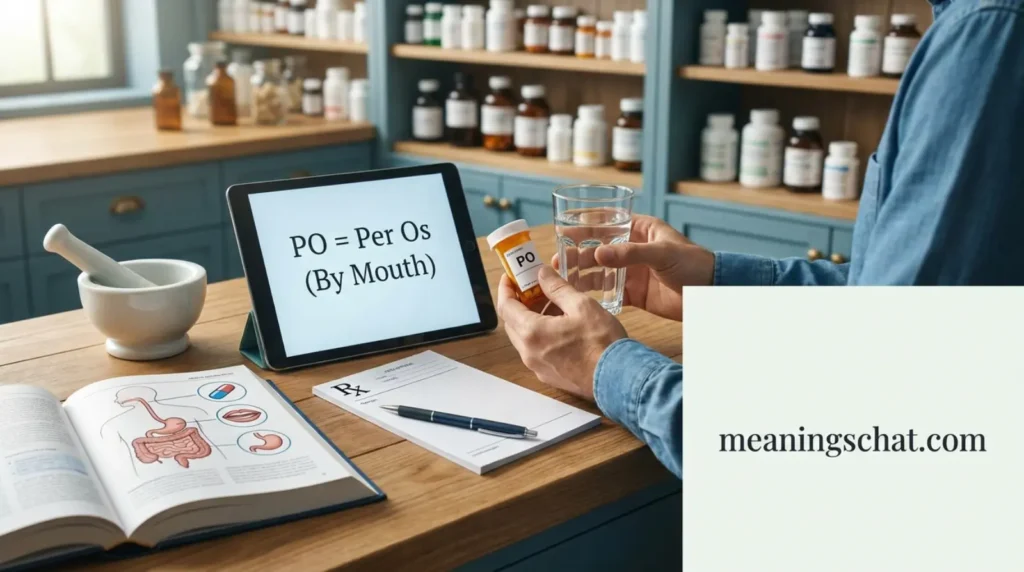
PO is a medical abbreviation that stands for “per os,” a Latin phrase meaning “by mouth” or “orally.” It tells patients to take a medication through the mouth.
What Does PO Mean in Medical?
In medicine, PO means “by mouth.” Doctors, nurses, and pharmacists use this abbreviation to indicate that a medication should be swallowed rather than injected, inhaled, or applied to the skin.
For example:
- Take one tablet PO every morning.
- Give the patient 500 mg PO twice daily.
- Continue antibiotics PO for seven days.
In each case, PO simply means the medicine should be taken orally.
PO Full Form in Medical
The PO full form is:
Per Os
This Latin phrase translates directly to:
- By mouth
- Through the mouth
- Orally
Many medical abbreviations come from Latin because it has been the traditional language of medicine for centuries.
How Do You Pronounce PO?
PO is usually pronounced by saying each letter separately:
P-O (pee-oh)
Healthcare workers rarely say “per os” during everyday conversations. Instead, they simply read it as “P-O.”
Why Do Doctors Use PO?
Doctors use PO because it is:
- Short and easy to write
- Universally recognized in healthcare
- Helpful for reducing writing time
- Standard in medical documentation
Although many hospitals now encourage writing “oral” instead of PO to reduce confusion, the abbreviation is still widely used in prescriptions and patient records.
Where Is PO Commonly Used?
You may see PO in many healthcare settings.
On Prescriptions
Example:
Amoxicillin 500 mg PO three times daily
This means you should swallow the medicine by mouth three times every day.
Hospital Charts
Nurses record medication routes using abbreviations like PO, IV, IM, and SC.
Pharmacy Labels
Some medication labels include PO to remind patients how to take the medicine.
Medical Records
Electronic health records often list PO as the route of administration.
Examples of PO in Medical Instructions
Here are some common prescription examples.
| Medical Instruction | Meaning |
|---|---|
| Take 1 tablet PO daily | Swallow one tablet every day |
| Acetaminophen 500 mg PO every 6 hours | Take the medicine by mouth every six hours |
| Vitamin D PO once daily | Take Vitamin D orally every day |
| Antibiotic PO for 10 days | Swallow the antibiotic for ten days |
Real-Life Examples of PO Usage
Friendly Example
“My doctor told me to take this vitamin PO every morning.”
Casual Example
“The label says PO, so just swallow the pill with water.”
Hospital Example
“The nurse administered the medication PO after breakfast.”
Pharmacy Example
“Please remember to take this antibiotic PO after meals.”
Is PO a Slang Term?
No.
PO is not slang. It is a professional medical abbreviation used by healthcare providers around the world.
Unlike internet abbreviations such as LOL or BRB, PO has a specific clinical meaning.
Is PO Rude, Offensive, or Neutral?
PO is completely neutral.
It is:
- Not offensive
- Not rude
- Not informal
- Appropriate in medical communication
Patients and healthcare professionals can safely use it when discussing medications.
Why Is PO Important?
Understanding PO helps patients:
- Take medicine correctly
- Avoid medication mistakes
- Follow doctor’s instructions accurately
- Improve treatment effectiveness
- Reduce the risk of incorrect medication use
A misunderstanding of medication instructions can lead to missed doses or improper treatment.
Difference Between PO and Other Medical Routes
Healthcare providers use many abbreviations for medication routes.
| Abbreviation | Full Form | Meaning |
|---|---|---|
| PO | Per Os | By mouth |
| IV | Intravenous | Into a vein |
| IM | Intramuscular | Into a muscle |
| SC | Subcutaneous | Under the skin |
| SL | Sublingual | Under the tongue |
| PR | Per Rectum | Through the rectum |
| Topical | — | Applied to the skin |
Each route affects how quickly medicine works and how it enters the body.
PO vs Oral
Many people ask if PO and oral mean the same thing.
The answer is yes.
| PO | Oral |
|---|---|
| Medical abbreviation | Plain English term |
| Used in prescriptions | Used in patient instructions |
| Means by mouth | Means by mouth |
Today, many healthcare organizations encourage writing “oral” instead of PO because it is easier for patients to understand.
Origin of PO
PO comes from the Latin phrase Per Os.
For hundreds of years, Latin was the standard language used in medicine. Many abbreviations still come from Latin today, including:
- PO (Per Os)
- PRN (Pro Re Nata)
- BID (Bis In Die)
- TID (Ter In Die)
These abbreviations remain common even though many healthcare providers now prefer plain English.
Why Do People Search for “PO Meaning Medical”?
People often encounter PO when:
- Reading a prescription
- Looking at hospital discharge papers
- Receiving medicine from a pharmacy
- Reviewing medical records
- Helping a family member understand medication instructions
Since the abbreviation is unfamiliar to many patients, they search online for a simple explanation.
Can PO Be Confused With Other Meanings?
Yes.
Outside medicine, PO can have different meanings.
| Context | Meaning |
|---|---|
| Medical | By mouth |
| Business | Purchase Order |
| Shipping | Post Office |
| Gaming | Player-Owned |
| Finance | Purchase Order |
Always look at the context to determine the correct meaning.
Is PO Safe to Use on Social Media?
Yes, if you are discussing healthcare.
Examples include:
- “Doctor changed my medicine from IV to PO today.”
- “Finally switched to PO antibiotics.”
However, many people outside healthcare may not understand the abbreviation. Writing “oral medication” may be clearer for a general audience.
When Should You Avoid Using PO?
Avoid using PO when talking to people unfamiliar with medical abbreviations.
Instead of saying:
“Take this PO.”
Say:
“Take this medicine by mouth.”
Using clear language reduces confusion and improves patient understanding.
Better Alternatives to PO
If your audience is not medically trained, consider using:
- By mouth
- Orally
- Swallow with water
- Take orally
- Oral medication
These phrases are easier for patients to understand.
Why Healthcare Professionals Still Use PO
Medical professionals continue using PO because it:
- Saves writing time
- Fits standard prescription formats
- Is recognized internationally
- Works well in electronic medical records
- Is familiar to doctors, nurses, and pharmacists
Even so, patient-friendly language is becoming more common.
Impact of Understanding Medical Abbreviations
Learning abbreviations like PO can improve communication between patients and healthcare providers.
Benefits include:
- Better medication safety
- Greater confidence when reading prescriptions
- Fewer misunderstandings
- Improved treatment adherence
- Easier communication during medical appointments
Common Prescription Example
Imagine your doctor writes:
Ibuprofen 400 mg PO every 8 hours after meals
This means:
- Take 400 mg of ibuprofen.
- Swallow it by mouth.
- Take it every eight hours.
- Take it after eating.
Understanding PO makes the entire prescription easier to follow.
Comparison Table of Similar Medical Abbreviations
| Abbreviation | Full Form | Meaning | Route |
|---|---|---|---|
| PO | Per Os | By mouth | Oral |
| IV | Intravenous | Into a vein | Injection |
| IM | Intramuscular | Into a muscle | Injection |
| SC | Subcutaneous | Under the skin | Injection |
| SL | Sublingual | Under the tongue | Oral absorption |
| PR | Per Rectum | Through the rectum | Rectal |
FAQs:
What does PO mean in medical terms?
PO stands for Per Os, which means by mouth or orally.
What is the PO full form in medicine?
The full form is Per Os, a Latin phrase meaning “through the mouth.”
Is PO the same as oral?
Yes. Both terms mean that the medicine should be taken by mouth.
Why do prescriptions say PO?
Doctors use PO to indicate the route of medication administration. It tells patients to swallow the medicine rather than receive it another way.
Is PO still used today?
Yes. Although many healthcare providers now prefer writing “oral,” PO remains common in prescriptions and medical records.
Can patients use the term PO?
Yes. Patients can use it when discussing medications with healthcare professionals, though saying “by mouth” may be clearer in everyday conversations.
Conclusion
PO meaning medical refers to Per Os, which means by mouth or orally. It is one of the most common abbreviations used in healthcare to tell patients how to take medication. You will often find PO on prescriptions, pharmacy labels, and hospital records.
Understanding this abbreviation makes it easier to follow medication instructions correctly and communicate confidently with healthcare providers. Although many medical organizations now encourage using plain language such as “oral” or “by mouth,” PO remains a widely recognized and important medical term.