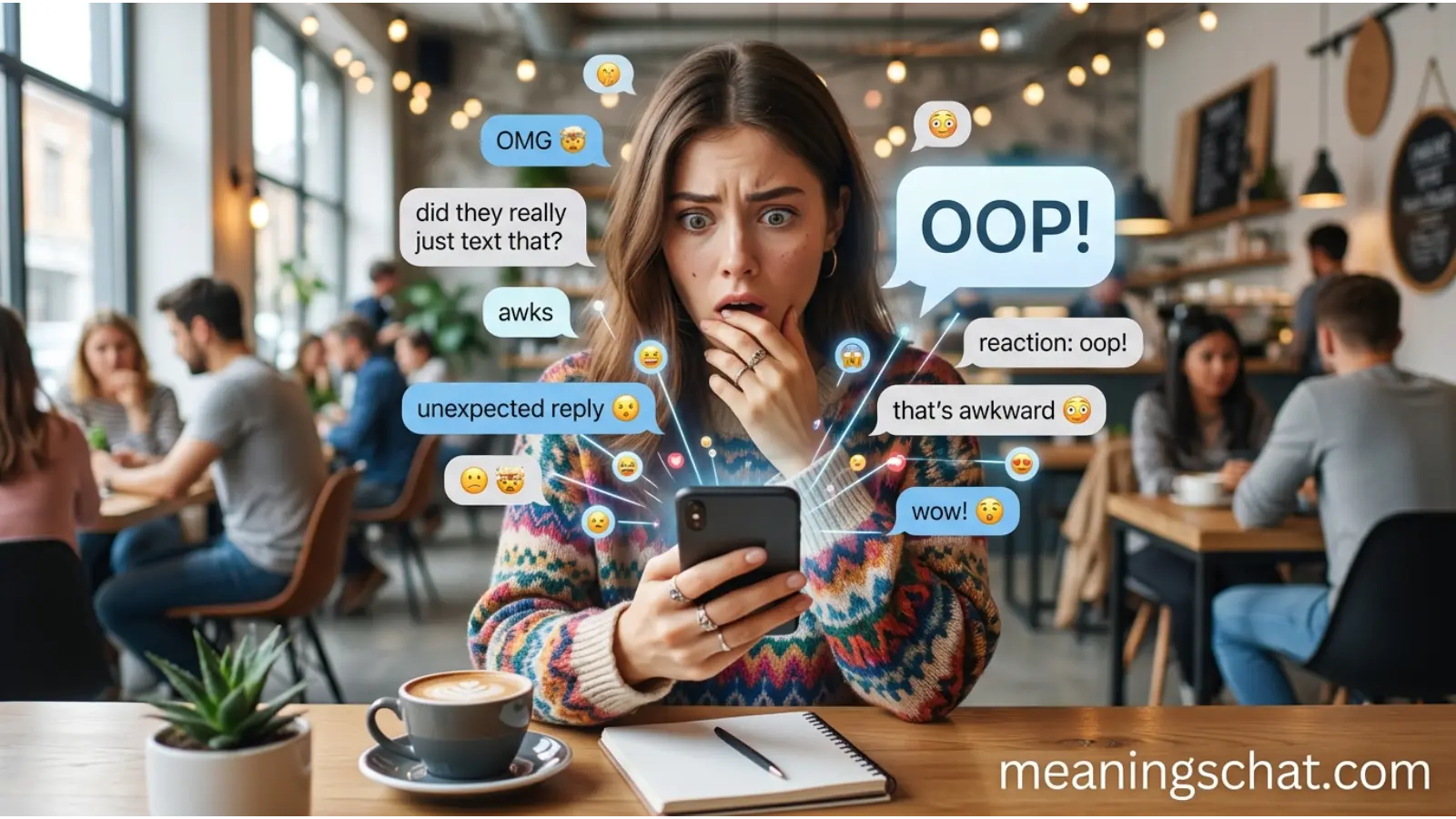
If you have seen someone type “oop” in a text, comment, or social media post, you may have wondered what they meant. At first glance, it can look like a shortened version of “oops,” but online users often give it a playful tone of its own. The oop meaning in text usually expresses surprise, awkwardness, embarrassment, sudden realization, or a reaction to something unexpected. It can also add humor when someone gets caught off guard or notices a small mistake.
You may see “oop” in group chats, TikTok comments, Instagram messages, Snapchat conversations, and other casual online spaces. The exact feeling depends on the situation and the words around it.
Quick Answer:
In texting, OOP usually means “oops” or shows a quick reaction to something surprising, awkward, funny, or unexpected. It is casual internet slang rather than a fixed acronym.
What Does OOP Mean in Text?
The oop meaning in text is usually a short reaction to something unexpected. It can communicate a feeling that would normally take a few words to explain.
Depending on the context, “oop” can mean:
- “Oops!”
- “Oh!”
- “Uh-oh!”
- “That was unexpected.”
- “I just realized that.”
- “That’s awkward.”
- “Well, that happened.”
For example:
“Oop, I sent that message to the wrong person.”
Here, “oop” works like “oops” and signals that the person has noticed a mistake.
In another conversation, someone might say:
“OOP 👀 She actually told everyone.”
In this case, the word expresses surprise and interest rather than an actual mistake.
That flexibility makes “oop” popular in casual digital communication.
OOP Meaning Slang: Is It an Abbreviation?
Unlike terms such as LOL, BRB, or IDK, oop does not have one official full form when used as internet slang.
In everyday texting, “oop” works more like an expressive sound than a traditional abbreviation. It is closely connected to “oops,” but online users have developed their own spelling and style.
So, if someone asks “what does OOP stand for?”, the answer depends on the context.
In casual texting:
OOP = “Oops” or a reaction to something unexpected.
In technology:
OOP = Object-Oriented Programming.
On Reddit and some online communities, OOP can also refer to “Original Poster” in certain contexts, although Reddit commonly uses “OP” for that meaning.
This is why you should always consider the conversation before deciding what OOP means.
Is OOP Rude, Offensive, or Neutral?
Generally, oop is neutral and harmless slang. It is not normally offensive, vulgar, or inappropriate.
People commonly use it in a playful way when something awkward or unexpected happens.
For example:
“Oop 😂 I forgot we had a test today.”
The word simply adds humor to the situation.
However, tone can change the way it feels. If someone shares serious personal news and you respond only with “oop,” they may think you are being dismissive or insensitive.
For serious conversations, use a clearer response instead of relying on slang.
Where Is OOP Commonly Used?
You can find “oop” across many casual online conversations. It works especially well in short-form communication where people want to react quickly.
Text Messages
Friends may use “oop” when someone makes a mistake, reveals unexpected information, or says something embarrassing.
Example:
“Oop, I forgot to reply yesterday 😭.”
TikTok
TikTok users often use “oop” in comments when a video contains a surprising moment, awkward situation, or unexpected twist.
Example:
“OOP, that ending 😭.”
On Instagram, “oop” can appear in comments, DMs, Stories, and reactions.
Example:
“Oop 👀 things are getting interesting.”
Snapchat
Friends may send “oop” when reacting to a photo, message, or unexpected update.
Group Chats
Group chats are another common place for this expression because it works as a quick emotional reaction.
Origin and Background of OOP
The casual use of “oop” is closely connected to the older expression “oops,” which people traditionally use after making a small mistake or encountering something unexpected.
Internet culture gave the expression a shorter and more playful form. The phrase “and I oop” became particularly recognizable through viral online culture and memes, helping make “oop” a familiar reaction across social media.
Today, people do not necessarily use “oop” to reference the original meme. Many simply use it as a natural reaction to something surprising, awkward, funny, or unexpected.
The spelling can also vary:
- oop
- OOP
- oop-
- oop 😭
- OOP 👀
- and I oop
The capitalization and emojis can change the emotional emphasis without changing the basic idea.
What Does OOP Mean on Social Media?
On social media, OOP often signals a sudden reaction.
Someone might use it when:
- A person accidentally reveals a secret.
- Someone gets caught doing something.
- A conversation suddenly becomes dramatic.
- A funny mistake happens.
- Someone realizes they misunderstood something.
- A post contains an unexpected twist.
For example:
“She said she wasn’t dating anyone, then posted a couple photo. OOP 👀”
Here, “oop” means something like “Oh, interesting!” or “Well, that changes things.”
The word can also make a comment feel more playful and less serious.
OOP Meaning in Different Tones
The same word can communicate different emotions depending on the surrounding conversation.
Friendly Tone
“Oop, you forgot your coffee again 😂.”
This sounds teasing and friendly.
Casual Tone
“Oop, I just saw your message.”
Here, it simply acknowledges something.
Surprised Tone
“OOP! He actually won!”
The capitalization adds stronger excitement.
Embarrassed Tone
“Oop 😭 I thought that was my account.”
This suggests the person has realized a mistake.
Dramatic Tone
“OOP 👀 She just exposed the whole story.”
This creates a playful reaction to drama.
Real-Life Examples of OOP in Text
Here are several examples showing how people may naturally use the expression.
Friendly Example
Friend 1: “You left your phone at my house.”
Friend 2: “Oop 😂 I was wondering where it went.”
Here, “oop” means “Oops, I just realized that.”
Casual Example
Friend 1: “The movie starts in five minutes.”
Friend 2: “Oop, I thought it started at eight.”
The word highlights the sudden realization.
Argumentative Example
“You said you never talked to her.”
“I didn’t.”
“Then why did she show me your messages?”
“Oop…”
Here, “oop” can signal that the person has been caught or does not know how to respond.
Gaming Example
Player 1: “You just destroyed our own base.”
Player 2: “OOP 😭 My bad!”
In gaming chats, it can make a mistake sound humorous rather than overly serious.
Social Media Example
Comment: “OOP 👀 Did she really just say that?”
The expression shows surprise and curiosity.
Accidental Message Example
“Oop, wrong chat 😭.”
This is one of the simplest uses. The sender realizes they sent something to the wrong conversation.
OOP vs. Similar Slang
Although “oop” has a recognizable meaning, several other expressions can communicate similar reactions.
| Slang | Common Meaning | Typical Tone |
|---|---|---|
| OOP | Surprise, awkwardness, realization | Playful |
| Oops | Small mistake | Casual |
| Uh-oh | Something may have gone wrong | Casual |
| Yikes | Discomfort or concern | Informal |
| LOL | Something is funny | Casual |
| OMG | Strong surprise | Casual |
| SMH | Disbelief or disappointment | Informal |
“Oop” is usually lighter and more playful than “yikes” or “SMH.” Meanwhile, “oops” is more directly connected to making a mistake.
When Should You Avoid Using OOP?
Although “oop” is generally harmless, it is not appropriate for every situation.
Avoid using it when:
- You are writing a formal email.
- You are communicating with a customer professionally.
- Someone is discussing a serious personal problem.
- You are writing an academic assignment.
- The meaning could easily be misunderstood.
- The conversation requires a clear and professional response.
For example, if a colleague tells you about a serious workplace problem, replying “OOP” may sound insensitive.
Instead, say something clear such as:
“I’m sorry to hear that. What happened?”
Context should always guide your choice of language.
Polite Alternatives to OOP
If you want to communicate the same idea without slang, you can use:
- “Oops, my mistake.”
- “Oh, I see.”
- “I didn’t realize that.”
- “That was unexpected.”
- “Oh no!”
- “I understand now.”
- “I wasn’t expecting that.”
- “Sorry about that.”
These alternatives work better in professional or unfamiliar conversations.
Why Do People Use OOP?
People use “oop” because it is short, expressive, and easy to understand in casual online conversations.
It can add personality to a message without requiring a long explanation.
Common reasons include:
- Speed: It takes only a few letters to type.
- Humor: It can make an awkward moment funny.
- Emotion: It communicates a quick reaction.
- Tone: It makes messages feel more casual.
- Internet culture: It fits naturally with memes and social media language.
- Playfulness: It can soften a small mistake or awkward moment.
Emojis often strengthen its meaning. For example, “oop 😭” usually feels more humorous or embarrassed than a plain “oop.”
What Impact Can OOP Have in Communication?
Small slang terms can influence how a message feels.
“Oop” can make a conversation sound:
- Friendly
- Relaxed
- Funny
- Playful
- Spontaneous
- Informal
However, slang can also create confusion if the reader does not know the expression.
For example, someone unfamiliar with online slang may wonder whether OOP is an acronym. That is why context remains important.
In casual conversations with friends, “oop” usually works naturally. In professional communication, a complete phrase is safer.
Is OOP Safe to Use on Social Media?
Yes. OOP is generally safe and non-offensive slang for social media.
You can commonly see it in:
- TikTok comments
- Instagram captions and comments
- Snapchat messages
- WhatsApp chats
- Discord conversations
- Group texts
- Online memes
The expression itself does not normally contain offensive language.
Still, your context matters. Using “oop” to joke about someone’s serious situation can make your comment seem insensitive. The word is safe, but the way you use it can affect how others interpret your message.
OOP in Other Contexts
The oop meaning in text should not be confused with other meanings of OOP.
Object-Oriented Programming
In computer science, OOP means Object-Oriented Programming. It refers to a programming approach that organizes software around objects and classes.
For example:
“I’m studying OOP in Java.”
Here, the person is talking about programming, not internet slang.
Out of Print
In publishing and bookselling, OOP can mean out of print.
For example:
“That edition is OOP.”
The surrounding topic makes the intended meaning clear.
This demonstrates why context matters when interpreting abbreviations.
How to Reply When Someone Says OOP
Your response depends on what happened.
If they react to your mistake, you can say:
“Haha, my bad!”
If they are surprised:
“I know, right?”
If they react to unexpected news:
“I know! I wasn’t expecting it either.”
If they are joking:
“😂 I walked right into that one.”
You do not always need to respond directly to “oop.” Sometimes it simply acts as a reaction, similar to an emoji.
FAQs:
What does OOP mean in text?
OOP usually means “oops” or expresses surprise, awkwardness, embarrassment, or sudden realization in casual text conversations.
What does OOP stand for in slang?
In casual slang, OOP does not have one fixed full form. It generally works as an expressive reaction similar to “oops.”
Is OOP a bad word?
No. OOP is generally harmless and non-offensive internet slang. Its tone depends on the context.
What does OOP mean on TikTok?
On TikTok, OOP commonly expresses surprise, awkwardness, amusement, or a reaction to an unexpected moment. It is often connected with online meme culture.
Is OOP the same as Oops?
They are closely related. “Oop” often works as a shorter, more playful version of “oops,” although it can also express broader reactions such as surprise or awkwardness.
Does OOP always mean slang?
No. In programming, OOP commonly means Object-Oriented Programming. Other fields may also use the abbreviation differently, so context matters.
Conclusion
The oop meaning in text is usually a quick, playful reaction to something unexpected, awkward, surprising, or embarrassing. It often works like “oops,” “uh-oh,” or “Oh, wow!” depending on the conversation.
The expression is common in casual texting, social media comments, group chats, and online communities. It is generally neutral and safe to use, but it may not fit serious or professional conversations.
Remember that OOP meaning slang can change depending on context. If you see “oop” in a casual message, it probably signals a reaction. If you see OOP in a programming discussion, it most likely means Object-Oriented Programming.
When in doubt, look at the surrounding words and conversation. Context usually makes the intended meaning clear.