
Quotient meaning refers to the answer you get when you divide one number by another. It is one of the basic terms used in mathematics, but many students search for its meaning because the word can sound confusing at first. You may see “quotient” in a math problem, textbook, worksheet, calculator, or online lesson and wonder what it actually means.
The good news is that the idea is simple. When you divide something into equal groups, the number in each group is usually called the quotient. For example, if you divide 20 apples equally among 5 people, each person gets 4 apples. In this case, 4 is the quotient.
Understanding the quotient meaning helps you solve division problems faster and recognize the different parts of a division equation.
Quick Answer
The quotient meaning is the result or answer produced by division. For example, in 20 ÷ 5 = 4, the number 4 is the quotient.
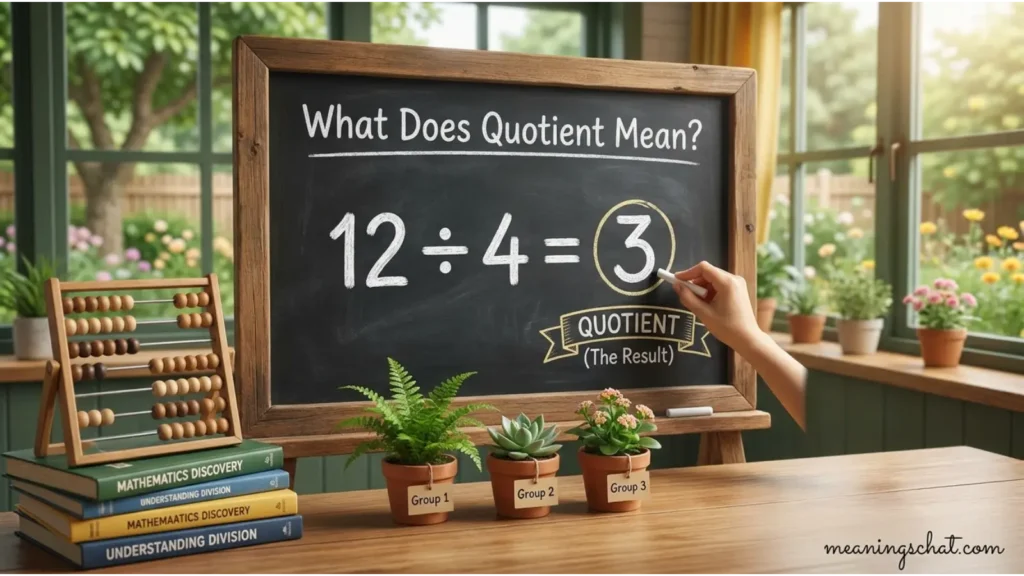
What Does Quotient Mean?
A quotient is the result of a division problem. In simple terms, it tells you how many times one number can be divided into another number.
Consider this example:
24 ÷ 6 = 4
Here:
- 24 is the dividend
- 6 is the divisor
- 4 is the quotient
So, the quotient meaning in mathematics is simply the answer to a division problem.
The word can appear in different types of math problems, including basic arithmetic, fractions, algebra, and higher mathematics.
Quotient Full Form and Definition
Unlike many abbreviations, quotient does not have a “full form” made from separate letters. It is a complete mathematical word.
The quotient full form is simply the result obtained by dividing one quantity by another.
For example:
36 ÷ 9 = 4
The quotient is 4.
A dictionary style definition would describe a quotient as the number obtained when one number is divided by another.
This makes the term easy to remember:
Division → Quotient
When you perform division, the answer is called the quotient.
What Does Quotient Stand For?
People sometimes search for “what does quotient stand for?” because they are familiar with abbreviations that have expanded forms. However, quotient is not an abbreviation.
It is a mathematical term that describes the result of division.
For example:
50 ÷ 10 = 5
The number 5 does not stand for a phrase. It is simply the quotient.
You can remember it with this simple formula:
Dividend ÷ Divisor = Quotient
This formula works for many basic division problems.
The Four Parts of a Division Problem
Understanding the four main parts of division makes the quotient much easier to identify.
1. Dividend
The dividend is the number being divided.
Example:
30 ÷ 5 = 6
Here, 30 is the dividend.
2. Divisor
The divisor is the number you divide by.
In:
30 ÷ 5 = 6
5 is the divisor.
3. Quotient
The quotient is the answer to the division.
In the same equation:
6 is the quotient.
4. Remainder
Sometimes a division problem does not divide evenly. The amount left over is called the remainder.
For example:
17 ÷ 5 = 3 remainder 2
Here:
- 17 = dividend
- 5 = divisor
- 3 = quotient
- 2 = remainder
This distinction is important because the quotient does not always represent the entire result when a remainder exists.
Quotient Meaning With Simple Examples
The easiest way to understand quotient meaning is through everyday examples.
Example 1: Sharing Candy
Suppose you have 12 candies and want to share them equally among 3 friends.
12 ÷ 3 = 4
Each friend receives 4 candies.
Therefore, 4 is the quotient.
Example 2: Dividing Money
Imagine you have $40 and split it equally between 8 people.
40 ÷ 8 = 5
Each person gets $5.
The quotient is 5.
Example 3: Classroom Groups
A teacher has 30 students and creates 5 equal groups.
30 ÷ 5 = 6
Each group contains 6 students.
The quotient is 6.
These examples show that quotient is not just a textbook word. It describes the answer to division in everyday situations.
Quotient Meaning With a Remainder
A quotient can also appear in a division problem that leaves something behind.
For example:
23 ÷ 4 = 5 remainder 3
Four can go into 23 five complete times. After using 20, three remain.
Therefore:
- Dividend = 23
- Divisor = 4
- Quotient = 5
- Remainder = 3
This is called division with a remainder.
In some mathematical contexts, the answer can also be written as a decimal:
23 ÷ 4 = 5.75
The exact way you express the quotient depends on the type of problem and the instructions you receive.
Quotient Meaning in Fractions
The word quotient is also closely connected to fractions.
A fraction represents division. For example:
8/2 = 4
This can also be written as:
8 ÷ 2 = 4
The result, 4, is the quotient.
In more advanced mathematics, you may hear that one expression is the quotient of two other expressions. The same basic idea still applies: something is being divided by something else.
For example:
a ÷ b
can be described as the quotient of a and b, provided that the division is defined.
Quotient Meaning in Algebra
Quotient is not limited to whole numbers.
In algebra, you may see expressions such as:
x ÷ 5
or
(x + 2) ÷ 3
These can be described as quotients.
For example:
(x + 6) / 2
is the quotient of x + 6 and 2.
This use may seem more advanced, but the central idea remains the same: a quotient is the result of division.
Is Quotient a Slang Term?
No. Quotient is not normally slang.
The phrase “quotient meaning slang” may appear in searches because people sometimes use search templates designed for words and abbreviations. However, quotient is primarily a formal mathematical term.
You would normally find it in:
- Math textbooks
- School assignments
- Educational websites
- Calculators
- Mathematical discussions
- Algebra lessons
- Science and engineering contexts
It does not have a common texting or social media meaning like modern slang terms do.
Where Is the Word Quotient Commonly Used?
The word quotient appears most often in educational and technical settings.
You may encounter it when:
- Learning basic division
- Studying fractions
- Solving algebra problems
- Working with ratios
- Reading math instructions
- Using a calculator
- Studying advanced mathematics
- Explaining numerical results
For example, a teacher might ask:
“What is the quotient of 48 and 6?”
The correct answer is:
8
because:
48 ÷ 6 = 8
Quotient vs. Dividend vs. Divisor
These three terms are easy to mix up.
| Math Term | Meaning | Example in 30 ÷ 5 = 6 |
|---|---|---|
| Dividend | Number being divided | 30 |
| Divisor | Number you divide by | 5 |
| Quotient | Answer to the division | 6 |
| Remainder | Amount left over | 0 |
A useful memory trick is:
Dividend ÷ Divisor = Quotient
Once you remember this pattern, identifying the quotient becomes much easier.
Quotient vs. Product
A quotient comes from division, while a product comes from multiplication.
For example:
20 ÷ 4 = 5
Here, 5 is the quotient.
But:
20 × 4 = 80
Here, 80 is the product.
So:
- Division gives you a quotient
- Multiplication gives you a product
- Addition gives you a sum
- Subtraction gives you a difference
Learning these terms can make math instructions much easier to understand.
Quotient vs. Difference
Students also sometimes confuse quotient with difference.
A difference is the answer to a subtraction problem.
For example:
15 − 7 = 8
Here, 8 is the difference.
A quotient is the answer to division:
15 ÷ 3 = 5
Here, 5 is the quotient.
The operation determines the name of the answer.
Real Life Examples of Quotient
The quotient appears in many everyday situations.
Sharing Food
You have 18 slices of pizza and divide them equally among 6 people.
18 ÷ 6 = 3
The quotient is 3.
Organizing Books
A library has 100 books and places them equally on 10 shelves.
100 ÷ 10 = 10
The quotient is 10 books per shelf.
Splitting a Bill
A $60 bill is divided equally among 4 friends.
60 ÷ 4 = 15
The quotient is 15.
Packing Items
A company has 72 products and packs 8 products in each box.
72 ÷ 8 = 9
The quotient is 9 boxes.
These examples demonstrate how division and quotients appear in ordinary situations.
How to Find the Quotient
Finding the quotient usually involves following a few simple steps.
Step 1: Identify the Dividend
Find the number being divided.
Example:
45 ÷ 9
The dividend is 45.
Step 2: Identify the Divisor
Find the number you are dividing by.
Here, the divisor is 9.
Step 3: Divide
Calculate:
45 ÷ 9 = 5
Step 4: Identify the Quotient
The answer, 5, is the quotient.
This process works for basic division and provides a foundation for more advanced mathematical calculations.
Common Mistakes About Quotient Meaning
Several mistakes can make the term confusing.
Mistake 1: Thinking Quotient Means the Dividend
The dividend is the number being divided. The quotient is the answer.
For:
40 ÷ 8 = 5
40 is not the quotient. 5 is the quotient.
Mistake 2: Confusing Quotient With Remainder
In:
19 ÷ 4 = 4 remainder 3
The quotient is 4, while 3 is the remainder.
Mistake 3: Treating Quotient as an Abbreviation
Quotient is not an acronym or shortened phrase. It is a complete mathematical term.
Mistake 4: Assuming Every Quotient Is a Whole Number
A quotient can be a whole number, decimal, fraction, or another mathematical expression, depending on the problem.
When Should You Use the Word Quotient?
Use quotient when discussing division in a mathematical or educational context.
For example:
“The quotient of 72 and 8 is 9.”
This sounds natural in a math lesson.
In everyday conversation, you may simply say:
“The answer is 9.”
Both communicate the result, but “quotient” provides the specific mathematical term.
Why Is the Quotient Important?
The quotient helps explain the result of division clearly and accurately.
It is useful because it allows teachers, students, and professionals to describe mathematical operations without ambiguity.
For example, instead of saying:
“Find the answer to 64 divided by 8.”
A math problem might say:
“Find the quotient of 64 and 8.”
Both mean that you need to calculate:
64 ÷ 8 = 8
Using the correct terminology also makes it easier to understand more advanced mathematical concepts.
Is Quotient Safe for Social Media?
Yes. The word quotient is completely safe and neutral for social media.
It is not offensive, inappropriate, or generally associated with harmful slang. You can use it in educational posts, math discussions, study content, or general explanations.
For example:
“Can you find the quotient of 81 and 9?”
is a perfectly normal educational social media post.
Comparison Table of Related Math Terms
| Term | Operation | Meaning | Example |
|---|---|---|---|
| Quotient | Division | Answer to division | 20 ÷ 4 = 5 |
| Product | Multiplication | Answer to multiplication | 5 × 4 = 20 |
| Sum | Addition | Answer to addition | 5 + 4 = 9 |
| Difference | Subtraction | Answer to subtraction | 9 − 4 = 5 |
| Remainder | Division | Amount left after division | 22 ÷ 5 = 4 R2 |
This table makes it easier to remember which term belongs to each mathematical operation.
FAQs:
What is the quotient meaning in simple words?
The quotient is the answer you get after dividing one number by another. In 24 ÷ 6 = 4, the quotient is 4.
What is the quotient full form?
Quotient does not have a letter-by-letter full form. It is a complete mathematical word meaning the result of division.
What does quotient stand for?
Quotient does not stand for an abbreviation. It refers to the result obtained when one quantity is divided by another.
Is quotient a slang word?
No. Quotient is a standard mathematical term, not common texting or social media slang.
What is the difference between a quotient and a remainder?
The quotient is the number of complete times the divisor goes into the dividend. The remainder is what is left afterward.
Can a quotient be a decimal?
Yes. A quotient can be a whole number, decimal, fraction, or another mathematical expression depending on the division problem.
Conclusion
The quotient meaning is simple once you connect it with division. A quotient is the result of dividing one number by another. In the equation 24 ÷ 6 = 4, 24 is the dividend, 6 is the divisor, and 4 is the quotient.
Remember the basic formula:
Dividend ÷ Divisor = Quotient
Quotient is a formal mathematical term rather than slang, so you will most often see it in classrooms, textbooks, worksheets, calculators, and other educational settings. Once you understand the difference between the dividend, divisor, quotient, and remainder, division problems become much easier to read and solve.