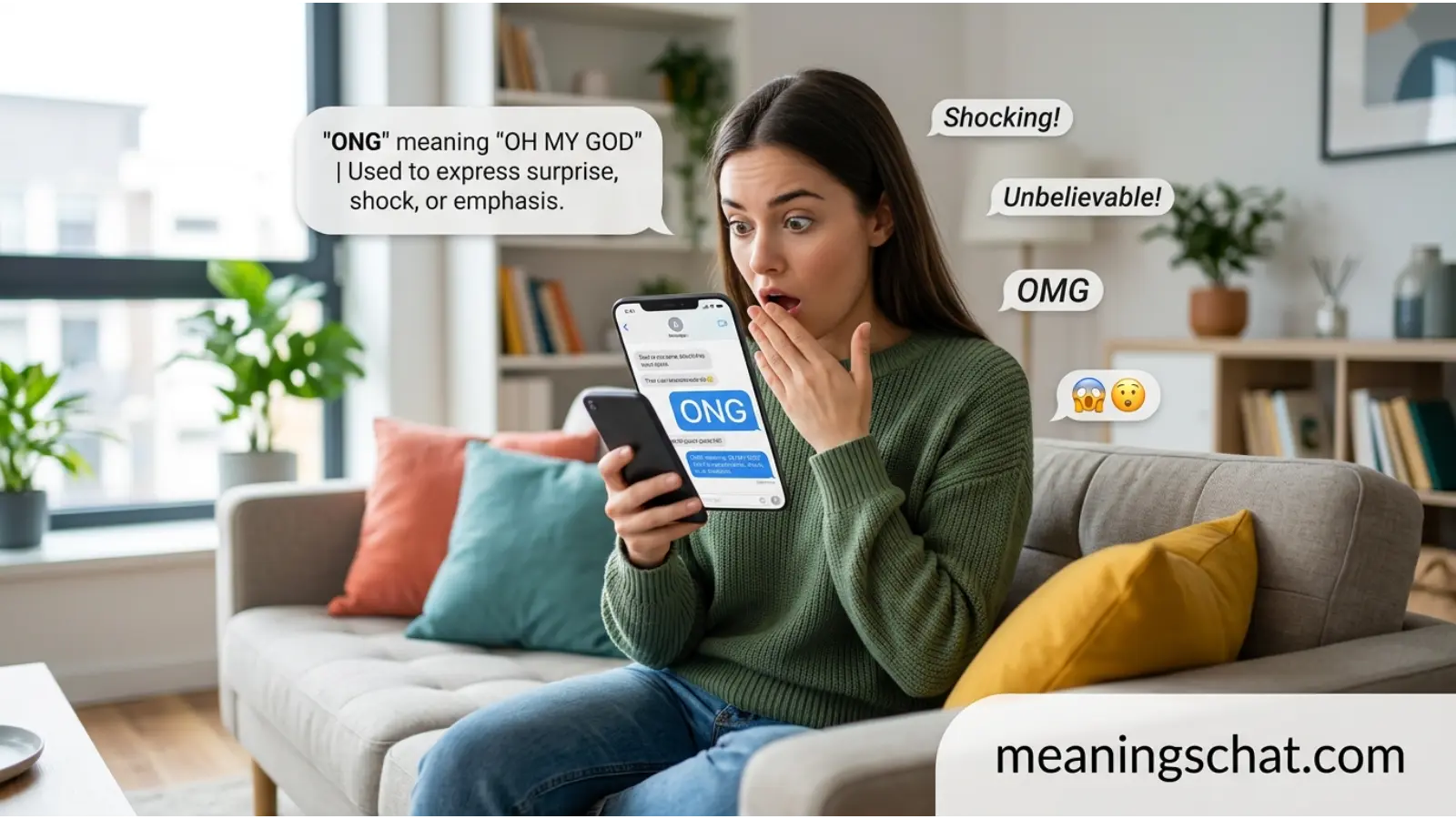
ONG meaning in text usually refers to the slang expression “On God.” People use ONG in texts, chats, comments, and social media when they want to strongly confirm that something is true or show that they are being completely honest. You may see it when someone makes a serious statement, reacts to surprising news, or wants to emphasize how strongly they feel.
For example, someone might text, “ONG, that was the best movie ever!” Here, ONG adds extra emphasis to the speaker’s opinion. The abbreviation has become common in casual online communication because it is quick, expressive, and easy to type.
Quick Answer
ONG means “On God” in text slang. People use it to emphasize honesty, seriousness, agreement, or the truth of a statement. It is mainly used in informal conversations and social media.
What Does ONG Mean in Text?
ONG stands for “On God.” In everyday texting, people use it as a strong way to say “I swear,” “I’m telling the truth,” or “I’m being completely serious.”
The expression does not always refer to religion. In many online conversations, it simply adds emphasis to a statement.
For example:
“ONG, I didn’t take your charger.”
The person is strongly insisting that they are telling the truth.
Another example is:
“ONG, that restaurant is amazing.”
In this sentence, ONG emphasizes how strongly the person feels about the restaurant.
The exact meaning can change slightly depending on the conversation, but the main idea remains honesty, emphasis, or strong agreement.
ONG Full Form
The most common ONG full form in texting and social media is:
ONG = On God
“On God” works as an emphatic expression. Someone may use it before or after a statement to show that they mean what they say.
For example:
- “ONG, I was there.”
- “That game was , ONG.”
- “ONG, you have to try this.”
- “I’m serious, ONG.”
In each case, the abbreviation strengthens the statement.
What Does ONG Stand For?
If you are wondering what does ONG stand for, the answer is “On God.”
The phrase is closely related to expressions such as “I swear,” “for real,” and “honestly.” However, ONG can sound stronger than a simple “for real” because it emphasizes the speaker’s sincerity.
For instance:
“For real, that happened.”
This sounds casual.
“ONG, that happened.”
This puts stronger emphasis on the speaker’s claim.
Is ONG Rude, Offensive, or Neutral?
ONG is generally casual and neutral, but its appropriateness depends on the audience and context.
In friendly texting, social media comments, gaming chats, and casual conversations, ONG usually causes no problem. However, the phrase “On God” has religious associations, so some people may prefer not to use it casually.
It can also sound disrespectful if someone uses it sarcastically or repeatedly in a serious conversation.
For example, saying:
“ONG, I’m telling the truth.”
can sound sincere.
But using ONG while mocking someone’s beliefs can make the message offensive.
When ONG Is Usually Fine
You can commonly see ONG in:
- Text messages
- Group chats
- TikTok comments
- Instagram comments
- Snapchat messages
- Gaming chats
- Casual conversations
- Memes
- Online discussions
For formal emails, academic writing, business communication, or professional documents, avoid using it.
Where Is ONG Commonly Used?
ONG is especially common in informal digital communication. Social media has helped abbreviations like this spread because users often want to communicate quickly.
You might encounter ONG meaning slang in places such as:
Text Messages
Friends may use ONG to emphasize a personal statement.
“ONG, I forgot we had homework.”
Social Media
People may comment ONG when they strongly agree with a post.
“ONG, this is so true.”
Gaming
Gamers may use ONG while reacting to an impressive play or unexpected event.
“ONG, that was the best clutch ever.”
Group Chats
Friends often use it to emphasize stories, jokes, or opinions.
“ONG, you should have seen his reaction.”
The casual environment makes the abbreviation easy to understand.
ONG Meaning in Social Media
On social media, ONG usually means “On God” and adds emphasis to a comment or post.
For example:
“ONG this song never gets old.”
The writer is strongly expressing their opinion.
You may also see:
“ONG 😭”
In this type of message, the abbreviation can express strong agreement, disbelief, amusement, or frustration. The surrounding text and emojis help determine the exact emotion.
Because social media slang changes quickly, users sometimes use ONG in slightly different ways. Still, “On God” remains the standard interpretation.
ONG Meaning in a Text From a Friend
If a friend sends you a message containing ONG, they are usually emphasizing what they just said.
For example:
Friend: “ONG, I saw him at the mall.”
They probably mean:
“I swear, I saw him at the mall.”
Another example:
Friend: “ONG, you need to watch this show.”
This means:
“I’m seriously telling you that you need to watch this show.”
The phrase generally adds confidence and intensity to the message.
Real-Life Examples of ONG
Here are examples showing how people might naturally use ONG in different situations.
Friendly Example
Alex: “ONG, your new haircut looks great!”
Here, ONG adds enthusiasm to the compliment.
Casual Example
Sam: “ONG, I forgot my headphones at home.”
The speaker uses ONG to emphasize that they really did forget them.
Strong Agreement
Mia: “That test was difficult.”
Jake: “ONG, I barely finished it.”
Here, ONG means something close to “I completely agree.”
Argumentative Example
Person A: “You took my charger.”
Person B: “ONG, I didn’t take it!”
Here, ONG strengthens the person’s denial.
Gaming Example
Player 1: “Did you see that move?”
Player 2: “ONG, that was !”
The abbreviation adds excitement and emphasis.
Social Media Example
Comment: “ONG, this is the funniest video I’ve seen all week.”
The commenter strongly emphasizes their reaction.
Origin and Background of ONG
The phrase “On God” existed as an expression before people began shortening it to ONG in online conversations. The phrase has religious roots because it invokes God as a way of emphasizing truth or sincerity.
Internet users later shortened the expression into ONG, making it easier and faster to type.
Like many slang abbreviations, its popularity grew through social media, messaging platforms, memes, gaming communities, and youth-oriented online conversations.
Today, ONG can function less as a literal religious statement and more as a casual intensifier. Its meaning therefore depends heavily on context and the person using it.
ONG vs. Similar Slang Terms
Several slang expressions can communicate a similar idea. However, they are not always interchangeable.
| Slang | Meaning | Common Use |
|---|---|---|
| ONG | On God | Strong emphasis or honesty |
| FR | For real | Agreement or sincerity |
| ISTG | I swear to God | Strong emphasis or frustration |
| NGL | Not gonna lie | Honest opinion |
| TBH | To be honest | Direct or honest opinion |
| No cap | I’m not lying | Emphasizes truth |
| I swear | Strong promise or claim | Casual conversations |
For example, “FR” often shows agreement, while “NGL” introduces an honest opinion. ONG more directly emphasizes that the speaker is serious or telling the truth.
ONG vs. “On God”
There is no major difference in meaning between ONG and On God.
The main difference is style.
On God is the complete phrase:
“On God, I’m telling the truth.”
ONG is the shortened texting version:
“ONG, I’m telling the truth.”
The abbreviation feels faster and more informal, while the full phrase can sound more direct or emphatic.
When Should You Avoid Using ONG?
Although ONG is common online, it does not fit every situation.
Avoid using it in:
- Formal business emails
- Job applications
- Academic assignments
- Professional reports
- Official letters
- Customer-service communication
- Formal presentations
- Serious professional discussions
For example, instead of writing:
“ONG, I finished the report.”
in a professional email, write:
“I have completed the report.”
Clear and professional wording works better in formal settings.
Polite Alternatives to ONG
If you want to express the same idea without slang, you can use:
- “Honestly”
- “I’m serious”
- “I truly mean it”
- “I’m telling the truth”
- “Absolutely”
- “I genuinely agree”
- “That’s definitely true”
- “I promise”
- “For real”
For example:
Slang: “ONG, that was amazing.”
Polite: “Honestly, that was amazing.”
Both communicate strong enthusiasm, but the second option works in more situations.
Why Do People Use ONG?
People use ONG because it makes messages feel short, expressive, and emotional.
There are several reasons the abbreviation has become popular.
It Saves Time
Typing “ONG” takes less time than writing “On God.”
It Adds Emphasis
The abbreviation makes a statement sound stronger.
It Shows Emotion
ONG can communicate excitement, frustration, surprise, or strong agreement.
It Fits Online Communication
Short abbreviations work naturally in texts, comments, and chats.
It Creates a Casual Tone
Using slang can make conversations between friends feel more relaxed and natural.
How Tone Changes the Meaning of ONG
Context plays an important role in understanding ONG.
Compare these examples:
“ONG, that was incredible!”
This sounds excited.
“ONG, I didn’t do it.”
This sounds defensive.
“ONG 😂”
This could express amusement or disbelief.
“ONG, stop.”
This may sound frustrated.
The same abbreviation can communicate different emotions depending on the surrounding words, punctuation, emojis, and conversation.
Is ONG Safe for Social Media?
Yes, ONG is generally safe to use on social media when you use it appropriately.
It is not normally considered a profanity or inherently offensive abbreviation. However, because it comes from “On God,” some people may interpret it differently depending on their religious or cultural views.
It is best to consider your audience. Casual use among friends is usually fine, while formal or sensitive conversations call for clearer language.
Also, remember that slang can be misunderstood by people who are unfamiliar with internet abbreviations. If clarity matters, writing the full phrase or using standard English may be better.
Common Mistakes When Using ONG
People sometimes misunderstand ONG or use it in the wrong context.
Mistake 1: Using It in Formal Writing
ONG belongs mainly to informal communication.
Mistake 2: Assuming Everyone Knows It
Older readers or people unfamiliar with online slang may not understand it.
Mistake 3: Using It in Every Sentence
Overusing slang can make your writing difficult to read and less natural.
Mistake 4: Ignoring Context
ONG can sound funny in one conversation and overly serious in another.
Use it when it naturally fits the tone.
FAQs:
What does ONG mean in texting?
ONG usually means “On God.” People use it to emphasize that they are telling the truth, being serious, or strongly agreeing with something.
What is the ONG full form?
The most common ONG full form is “On God.” It is an informal expression frequently used in texts and social media.
What does ONG mean on Instagram?
On Instagram, ONG generally means “On God.” Users may use it in comments or messages to show strong agreement, honesty, surprise, or emphasis.
Is ONG the same as “I swear”?
ONG can have a similar meaning to “I swear,” especially when someone wants to emphasize that they are telling the truth. However, the exact tone depends on the context.
Is ONG a bad word?
No. ONG is not generally considered a bad word. It is informal slang, so it may not be appropriate for professional or formal communication.
Can I use ONG in a professional email?
It is better to avoid ONG in professional emails. Use clear phrases such as “honestly,” “I can confirm,” or “I’m serious” instead.
Conclusion
The ONG meaning in text is most commonly “On God.” People use this slang abbreviation to emphasize honesty, seriousness, strong agreement, or an emotional reaction. You can commonly find it in text messages, social media comments, gaming chats, memes, and conversations between friends.
Understanding context is important because ONG can express different emotions depending on the message around it. While it works well in casual online communication, standard language is a better choice for professional and formal situations.
So, when someone texts “ONG, that was amazing,” they are basically saying, “I’m serious—that was amazing.” Knowing the tone behind the abbreviation can help you understand online conversations more naturally and respond appropriately.