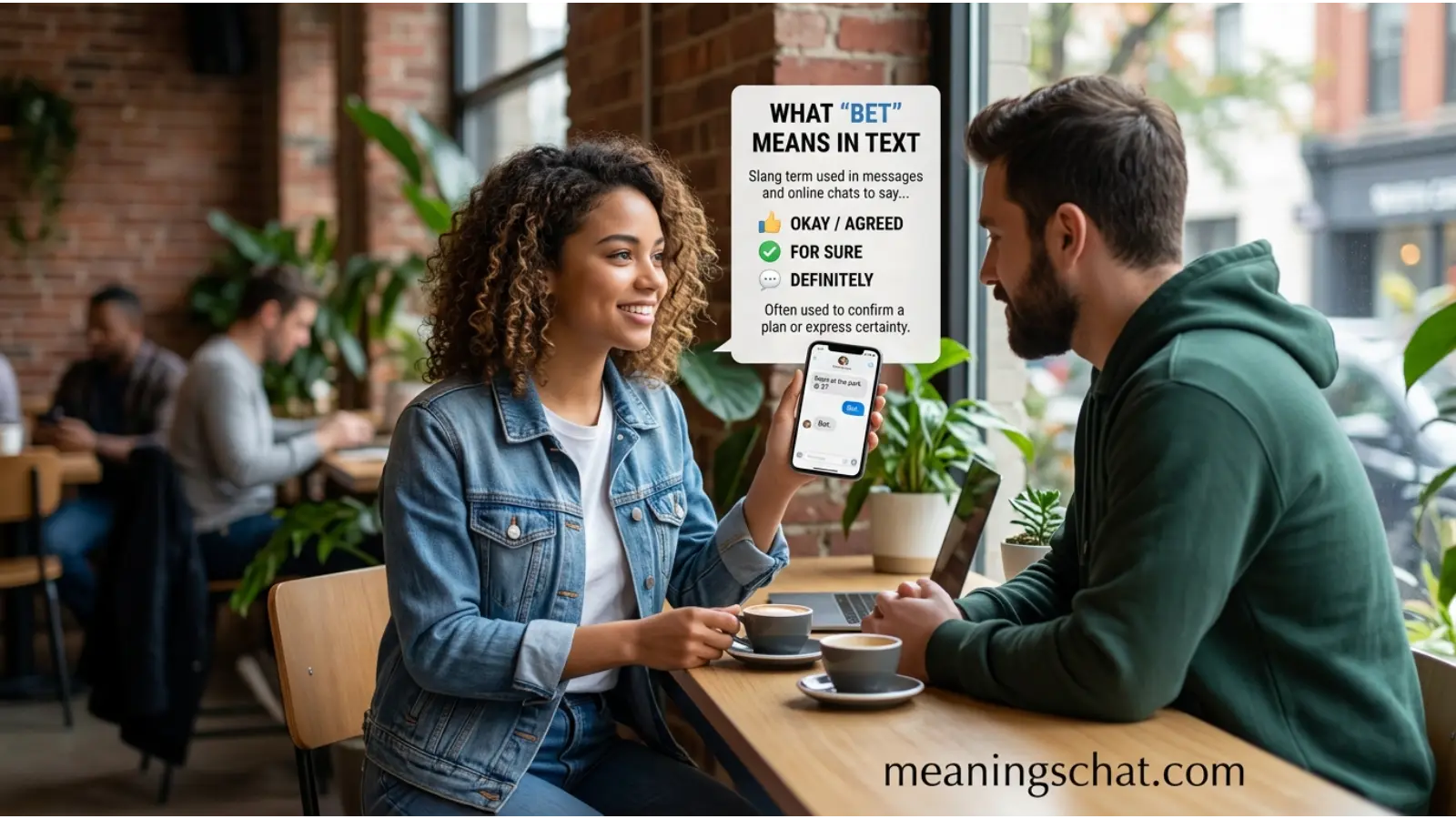
Bet meaning in text usually refers to a casual way of saying “okay,” “sure,” “agreed,” or “sounds good.” You may see someone reply with “Bet” after making plans, accepting a challenge, or agreeing with something you said. Because the word also has a traditional meaning related to gambling, its meaning can feel confusing when you first see it in a text.
People often search for the meaning of “bet” because its texting use does not always involve money or gambling. On Snapchat, Instagram, TikTok, gaming chats, and regular text messages, “bet” can show confidence, agreement, or readiness. The exact meaning depends on the conversation and the tone behind the message.
Quick Answer
In text messages, “bet” means “okay,” “sure,” “I agree,” or “you got it.” It is usually casual and friendly, although its tone can change depending on the situation.
What Does Bet Mean in Text?
When someone sends “bet” in a text, they are often showing agreement or acceptance. It can work much like “okay,” “sure,” or “sounds good.”
For example:
Person 1: “I’ll call you after work.”
Person 2: “Bet.”
Here, “bet” simply means “Okay, sounds good.”
The word can also express confidence. If someone challenges you or makes a bold statement, replying “bet” can mean “I accept the challenge” or “Let’s see.”
Friend: “I bet you can’t beat my score.”
You: “Bet.”
In this situation, the response shows confidence and willingness to prove yourself.
Bet Meaning Slang: What Does It Stand For?
The bet meaning slang use does not usually represent an acronym or abbreviation. It comes from the ordinary English word “bet,” but texting and internet culture gave it a broader conversational meaning.
In casual communication, “bet” can stand for ideas such as:
- Okay
- Sure
- Sounds good
- I agree
- Deal
- You got it
- I’m down
- Challenge accepted
- I understand
The intended meaning depends on the context.
For example, “Bet, I’ll be there at 8” means “Sure, I’ll be there at 8.”
On the other hand, “Bet you can’t do it” uses the word closer to its traditional meaning of making a wager or expressing confidence about an outcome.
Bet Full Form
There is no official full form of “bet” when people use it as slang in text messages.
Unlike abbreviations such as “LOL” or “BRB,” “bet” is a regular English word that developed an additional informal meaning through conversational and internet use.
So, if you are wondering “what does bet stand for?”, the simple answer is that it does not stand for a specific phrase. In texting, it commonly communicates agreement, confidence, or acceptance.
Is Bet Rude, Offensive, or Neutral?
“Bet” is generally neutral and casual. It is not normally considered rude or offensive.
However, tone matters.
A friendly “Bet!” can sound enthusiastic:
“Want to grab pizza tonight?”
“Bet!”
A short “bet” can sound less enthusiastic:
“Can you send me the notes?”
“Bet.”
In some situations, especially during an argument, “bet” can sound challenging or sarcastic.
“You won’t finish that project today.”
“Bet.”
Here, the person may mean, “Watch me prove you wrong.”
Therefore, “bet” itself is not offensive, but the surrounding conversation can change how people interpret it.
Where Is Bet Commonly Used?
People commonly use “bet” in informal digital conversations. You may encounter it on several platforms and in different types of chats.
Text Messages
Friends often use “bet” when confirming plans.
“Meet me at 7?”
“Bet.”
It provides a quick and natural response without typing “That sounds good.”
Snapchat and Instagram
People may use “bet” when responding to stories, direct messages, or casual conversations.
“I’m posting the pictures tonight.”
“Bet, I’ll check them out.”
TikTok and Social Media
The word appears frequently in comments and casual online conversations, especially when someone agrees with a statement or accepts a challenge.
Gaming Chats
Gamers can use “bet” when accepting a match, challenge, or plan.
“One more round?”
“Bet.”
Here, it can mean “Absolutely” or “Let’s do it.”
Group Chats
In group conversations, “bet” can quickly confirm that someone understands a plan.
“Everyone meet at Jake’s house at 6.”
“Bet.”
Real-Life Examples of Bet in Text
The meaning becomes much easier to understand when you see “bet” in different situations.
Friendly Example
Friend: “Want to get coffee tomorrow?”
You: “Bet! What time?”
Here, “bet” means “Sure, I’d like that.”
Casual Example
Friend: “I’ll send you the address.”
You: “Bet.”
The response means “Okay, sounds good.”
Agreement Example
Person 1: “We should finish this before Friday.”
Person 2: “Bet. Let’s start today.”
Here, “bet” shows agreement with the plan.
Challenge Example
Friend: “I can run faster than you.”
You: “Bet.”
Here, the word means “I accept your challenge.”
Argumentative Example
Person 1: “You’re not going to prove that.”
Person 2: “Bet.”
The reply may sound confident or challenging. It can mean “I will prove it.”
Gaming Example
Player 1: “Think you can beat me?”
Player 2: “Bet.”
Here, “bet” means “Challenge accepted.”
Social Media Example
Friend: “I’m going to post my new outfit later.”
You: “Bet, I’m waiting for it.”
The word expresses interest and agreement in a casual way.
Origin and Background of Bet
The traditional word “bet” has been used in English for a long time to describe a wager or agreement about the outcome of an event.
For example:
“I bet $10 that our team will win.”
Over time, informal speech expanded the word beyond gambling. In casual conversations, people began using “bet” to communicate confidence, agreement, or acceptance.
Modern internet culture helped spread this usage through social media, texting, music, gaming, and everyday conversations. Today, “bet” can function as a short conversational response even when nobody is actually making a wager.
The slang meaning is especially common in casual communication among younger speakers, although people of different ages may understand and use it.
Bet vs. Okay vs. Sure vs. Deal
Several words can communicate agreement, but they do not always carry exactly the same tone.
| Term | Common Meaning | Tone |
|---|---|---|
| Bet | Okay, agreed, challenge accepted | Casual and confident |
| Okay | I understand or agree | Neutral |
| Sure | Yes, I agree | Friendly and neutral |
| Deal | We have an agreement | Casual and direct |
| Sounds good | I agree with the plan | Friendly |
| Got it | I understand | Casual or neutral |
| Absolutely | Strong agreement | Positive and confident |
“Bet” often sounds more relaxed and confident than “okay.”
For example:
“Want to meet at 5?”
“Okay.”
This sounds neutral.
“Want to meet at 5?”
“Bet!”
This sounds more casual and energetic.
When Should You Avoid Using Bet?
Although “bet” is common in texting, it does not fit every situation.
Avoid using slang such as “bet” in formal communication when a clearer or more professional response would work better.
For example, you may want to avoid it in:
- Job applications
- Formal business emails
- Academic assignments
- Professional reports
- Official letters
- Serious workplace communication
- Conversations with someone who may not understand modern slang
Instead of replying:
“Bet.”
to a manager, you could say:
“Sounds good. I’ll take care of it.”
That response communicates the same basic idea while maintaining a professional tone.
Polite Alternatives to Bet
If you want a more professional or universally understood alternative, try one of these expressions:
- “Sounds good.”
- “Absolutely.”
- “Sure.”
- “That works for me.”
- “Understood.”
- “I agree.”
- “Consider it done.”
- “No problem.”
- “I’ll take care of it.”
- “That’s fine with me.”
For everyday conversations, “bet” is perfectly suitable when the other person understands the slang.
Why Do People Use Bet in Texts?
One major reason people use “bet” is convenience. It communicates agreement in just one word.
Instead of typing:
“Okay, that sounds good to me.”
someone can simply write:
“Bet.”
The word can also add personality to a conversation. Depending on the context, it can sound confident, relaxed, enthusiastic, or playful.
People also use slang because it feels natural within their social group. Words such as “bet,” “lowkey,” “fr,” and “no cap” can help create an informal conversational style.
How Tone Changes the Meaning of Bet
The meaning of “bet” can change based on punctuation, surrounding words, and the situation.
“Bet.”
This can simply mean “Okay.”
“Bet!”
The exclamation mark can make the response sound more enthusiastic.
“Bet 😂”
The emoji can make the message feel playful or humorous.
“Bet, say less.”
This usually communicates strong agreement, similar to “I understand; you don’t need to explain more.”
“Bet you won’t.”
This has a different structure. It can mean “I challenge you to prove me wrong.”
Therefore, do not interpret every use of “bet” in exactly the same way.
Is Bet Safe for Social Media?
Yes. “Bet” is generally safe for social media. It is a common informal word and does not normally contain offensive or harmful meaning.
However, context still matters. A harmless slang word can sound aggressive if someone uses it during a heated argument.
For example:
“You better not say that again.”
“Bet.”
Here, the response may sound confrontational rather than friendly.
When communicating online, consider the relationship between you and the other person before using slang.
Bet Meaning in Text From a Girl
If a girl sends you “bet”, the meaning usually depends on the conversation.
It can simply mean:
“Okay.”
“Sure.”
“Sounds good.”
“I agree.”
It does not automatically mean that she is flirting or interested romantically.
For example:
You: “Want to get coffee tomorrow?”
Her: “Bet.”
She may simply be agreeing to the plan.
If the conversation already has a playful or romantic tone, “bet” can sound more playful, but you should look at the complete conversation rather than assuming a hidden meaning.
Bet Meaning in Text From a Guy
If a guy texts “bet,” it usually has the same basic meaning: okay, sure, agreed, or challenge accepted.
For example:
You: “I’ll send you the game link tonight.”
Him: “Bet.”
He is most likely confirming that he understands and agrees.
Again, the exact interpretation depends on the surrounding messages.
Is Bet the Same as a Wager?
Not always.
The traditional meaning of “bet” involves a wager or prediction:
“I bet $20 on the game.”
The slang meaning does not necessarily involve money.
“I’ll meet you at 8.”
“Bet.”
In this example, nobody is gambling. The word simply means “Okay” or “Agreed.”
Understanding the surrounding sentence helps you distinguish between the traditional and slang meanings.
Common Misunderstandings About Bet
One common mistake is assuming that every use of “bet” involves gambling.
In modern texting, that is often not the case.
Another mistake is assuming that “bet” always sounds friendly. It can also communicate confidence or challenge.
For example:
“I bet you can’t win.”
Here, “bet” relates to confidence or a challenge.
“Bet, I’ll see you tomorrow.”
Here, it simply means agreement.
Context is the key to understanding the intended meaning.
How to Reply When Someone Says Bet
Your response depends on what the person means.
If they are confirming plans, you can say:
“Perfect!”
“Sounds good.”
“See you then.”
If they are accepting a challenge, you might respond:
“Let’s do it.”
“Game on.”
“We’ll see!”
If you are unsure what they mean, you can simply continue the conversation or ask for clarification.
FAQs:
What does bet mean in text messages?
In text messages, “bet” commonly means “okay,” “sure,” “agreed,” or “sounds good.” It can also express confidence or acceptance of a challenge.
What is the bet meaning slang?
The slang meaning of “bet” usually communicates agreement, confirmation, confidence, or willingness to do something. It is informal and common in casual conversations.
What does bet stand for in texting?
“Bet” does not have an official full form in texting. It is a regular English word that developed an additional slang meaning.
Is bet a rude word?
No. “Bet” is generally not rude or offensive. However, it can sound challenging or sarcastic depending on the situation and tone.
Can I use bet in professional messages?
It is better to avoid “bet” in formal professional communication. Use expressions such as “Sounds good,” “Absolutely,” or “Understood” instead.
Does bet mean challenge accepted?
Sometimes. When someone uses “bet” after making a challenge, it can mean “Challenge accepted” or “I’ll prove it.” Context determines the meaning.
Conclusion
The bet meaning in text is usually “okay,” “sure,” “agreed,” or “sounds good.” People also use it to show confidence or accept a challenge. Although “bet” traditionally refers to a wager, texting culture has given the word a much broader casual meaning.
The bet meaning slang is generally friendly and neutral, but its tone can change depending on the conversation. A simple “Bet!” can show enthusiasm, while “Bet.” during an argument may sound challenging.
Use “bet” freely in casual texts, gaming chats, social media conversations, and messages with friends. For formal situations, choose clearer phrases such as “Sounds good,” “I agree,” or “Understood.” As with most slang, context and tone matter most.