
Have you ever been reading a message, article, or social media post and come across the word simplify, then wondered what it actually means? You’re not alone. Many people see this common word in conversations, school assignments, work emails, or online tutorials without fully understanding how to use it correctly. The good news is that its meaning is easy to learn, and once you understand it, you’ll notice it everywhere.
In this guide, you’ll learn the simplify meaning, where people commonly use it, how it appears in conversations, and when it fits different situations. You’ll also find real examples, similar words, and answers to common questions so you can use the word naturally and confidently.
What Does Simplify Meaning in Text?
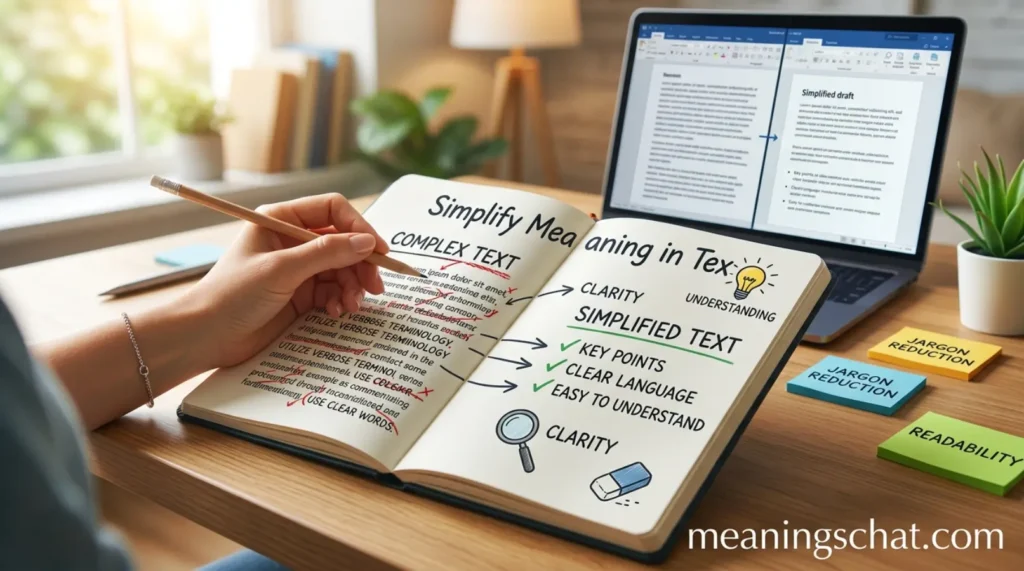
The word simplify means to make something easier to understand, do, explain, or solve. Instead of making something more complicated, you reduce the difficulty by breaking it into smaller or clearer parts.
In text messages or online conversations, people often use simplify when asking someone to explain something in plain language.
For example:
- “Can you simplify that for me?”
- “The teacher simplified the lesson.”
- “Please simplify the instructions.”
Unlike internet abbreviations such as LOL or BRB, simplify is a regular English verb, not a slang term or acronym.
Depending on the situation, simplify can mean:
- Make an explanation easier.
- Reduce unnecessary details.
- Make a task less complicated.
- Solve a math expression in its simplest form.
- Improve a process by removing extra steps.
Although the meaning stays mostly the same, the context changes how it is used.
Where Is Simplify Used?
The word simplify appears in many places both online and offline. Since it is part of everyday English, people of all ages use it.
Text Messages
Friends often ask each other to simplify confusing explanations.
Example:
“Can you simplify what you just said?”
Social Media
People use it in comments when they want an easier explanation of a topic.
Example:
“Can someone simplify this video?”
School
Teachers regularly ask students to simplify math expressions or explain ideas using simpler words.
Example:
“Simplify the equation before solving it.”
Work
Employees may ask coworkers to simplify reports, presentations, or instructions.
Example:
“Can you simplify this process for the team?”
Online Learning
Educational websites and video creators often promise to simplify difficult topics like science, technology, or finance.
Overall, simplify is common among students, teachers, professionals, content creators, and everyday internet users.
Examples of Simplify in Conversation
Here are some natural conversations showing how people use simplify.
Example 1
Alex: I don’t understand this chapter.
Sam: I’ll simplify it for you.
Example 2
Emma: That explanation was confusing.
Jake: Let me simplify it.
Example 3
Teacher: Please simplify the fraction before answering.
Student: Okay, I’ll do that.
Example 4
Sarah: Can you simplify the directions?
Mike: Sure. Just turn left after the traffic light.
Example 5
Anna: This article is hard to read.
Chris: I’ll explain it in simpler words.
Example 6
Manager: We should simplify the onboarding process.
Employee: That will save everyone time.
Example 7
Friend: Can you simplify what happened yesterday?
Friend: Basically, we missed the train because we arrived late.
When to Use and When Not to Use Simplify
Knowing when to use the word makes your communication clearer.
Use Simplify When
- You want an easier explanation.
- You are teaching someone.
- You want to remove unnecessary complexity.
- You are discussing math or science.
- You want instructions to become easier.
Examples:
- “Please simplify your answer.”
- “Let’s simplify this project.”
- “Can you simplify these instructions?”
Avoid Using Simplify When
Although the word is appropriate in many situations, it may not fit every conversation.
Avoid it when:
- You already have a very simple explanation.
- Someone may feel their work is being criticized.
- A detailed explanation is necessary.
For example, saying “Simplify your research paper” may not be appropriate if detailed information is required.
Is Simplify Friendly, Casual, Professional, or Flirty?
Friendly
Yes. Friends commonly use simplify when helping each other.
Example:
“Can you simplify this for me?”
Casual
Absolutely. It’s very common in everyday conversations.
Example:
“Please simplify that.”
Professional
Yes. It is widely accepted in business communication.
Example:
“Let’s simplify the workflow.”
Flirty
Not usually.
However, it may appear playfully.
Example:
“You explain things so well. Can you simplify my life too?”
Even then, the word itself is not considered romantic or flirtatious.
Different Meanings of Simplify
Although the core meaning stays the same, simplify has several common uses.
In Everyday English
Make something easier to understand.
Example:
“She simplified the instructions.”
In Mathematics
Reduce an equation or fraction to its simplest form.
Example:
“Simplify 12/18.”
In Writing
Replace difficult words with easier ones.
Example:
“Please simplify this paragraph.”
In Business
Improve efficiency by removing unnecessary steps.
Example:
“The company simplified its hiring process.”
In Technology
Make software or systems easier to use.
Example:
“The latest update simplifies navigation.”
Why People Use the Word Simplify
People choose this word because it clearly communicates the idea of reducing confusion.
Some common reasons include:
- Explaining difficult ideas.
- Teaching beginners.
- Saving time.
- Improving communication.
- Making instructions easier.
- Creating better user experiences.
- Solving math problems.
- Writing in plain English.
Its versatility makes it one of the most useful everyday English words.
Similar Words or Alternatives
Here are several words with meanings similar to simplify.
Explain
Make something easier to understand through details.
Example:
“Can you explain this?”
Clarify
Remove confusion and make something clearer.
Example:
“Could you clarify your point?”
Shorten
Reduce the length of something.
Example:
“Please shorten the report.”
Streamline
Make a process more efficient.
Example:
“We streamlined the application process.”
Break Down
Explain something step by step.
Example:
“Can you break it down for me?”
Common Mistakes People Make
Many learners confuse simplify with similar words.
Simplify vs Explain
Simplify means making something easier.
Explain means providing more information.
Example:
Explain:
“The teacher explained the lesson.”
Simplify:
“The teacher simplified the lesson.”
Simplify vs Clarify
Clarify removes confusion.
Simplify reduces complexity.
Sometimes both happen together, but they are not exactly the same.
Simplify vs Shorten
Shortening reduces length.
Simplifying makes something easier to understand.
A shorter explanation is not always simpler.
Tips for Using Simplify Correctly
Using simplify naturally is easy if you remember a few tips.
- Use it when helping someone understand.
- Don’t replace necessary details with overly short explanations.
- Match your explanation to your audience.
- Use simple examples whenever possible.
- In professional settings, use simplify respectfully.
For example:
Instead of saying:
“This document is confusing.”
Say:
“Could we simplify this document so everyone can understand it more easily?”
That sounds much more helpful and polite.
FAQs
What does simplify mean from a girl?
It has the same meaning regardless of who says it. She is simply asking someone to make something easier to understand or explain.
Is simplify slang?
No. Simplify is a standard English word, not internet slang or a text abbreviation.
Can I use simplify in professional chats?
Yes. It is commonly used in workplaces, meetings, emails, and business discussions.
Does simplify have any flirty meaning?
No. The word itself has no romantic meaning. Any flirtatious tone depends on the overall conversation.
Is simplify still popular in 2025?
Yes. It remains one of the most commonly used English verbs in education, work, online communication, and everyday conversations because people constantly look for easier ways to understand information.
Conclusion
The simplify meaning is straightforward. It means making something easier to understand, explain, solve, or complete. Unlike internet slang, simplify is a standard English word that works in casual conversations, classrooms, workplaces, and online discussions. Knowing how and when to use it helps you communicate more clearly and makes your explanations easier for others to follow. Whenever you want to reduce confusion or make an idea easier to understand, simplify is the perfect word to use.

William Jones is a dedicated writer at Meaningschat who specializes in explaining text slang, abbreviations, and online language trends. He enjoys creating simple, engaging, and reader-friendly content that helps people understand modern digital communication with ease. His writing style is clear, conversational, and informative, making complex internet terms easy for everyone to follow. In his free time, William loves exploring social media trends, reading about digital culture, and discovering how online language continues to evolve.