Explicit meaning in text can be confusing because the word “explicit” can describe clear language, detailed instructions, adult content, or information that leaves little room for interpretation. People often search for the term after seeing it in a text message, social media post, video description, warning, or online conversation.
In simple communication, “explicit” usually means something is clearly stated, directly expressed, or described in detail. However, the meaning can change based on the context. For example, “explicit instructions” means detailed and clear instructions, while “explicit content” usually refers to material containing strong sexual, violent, or otherwise adult themes.
Understanding the context helps you interpret the word correctly and respond appropriately.
Quick Answer:
Explicit means something is stated clearly and directly, without being vague or hidden. In online contexts, “explicit” can also describe content that contains adult, sexual, violent, or otherwise sensitive material.
What Does Explicit Mean in Text?
The word explicit generally means clear, direct, specific, and fully expressed.
When someone uses “explicit” in a text message, they usually want to communicate that something is not implied or left for the reader to guess.
For example:
“She gave me explicit instructions.”
This means she gave clear and detailed instructions.
Another example is:
“The warning contains explicit details.”
Here, “explicit” means the details are stated openly and clearly.
The meaning depends heavily on the words around it. In everyday communication, explicit can be completely neutral. It does not automatically mean something sexual or inappropriate.
Explicit Meaning Slang and Everyday Texting
Unlike many internet abbreviations, explicit is not usually slang. It is a standard English word that people use in texts, emails, social media posts, workplace conversations, and everyday speech.
Someone might write:
- “Be explicit about what you want.”
- “He gave me explicit directions.”
- “The movie has explicit scenes.”
- “I need explicit permission before I continue.”
- “That message was pretty explicit.”
Each sentence gives the word a slightly different shade of meaning.
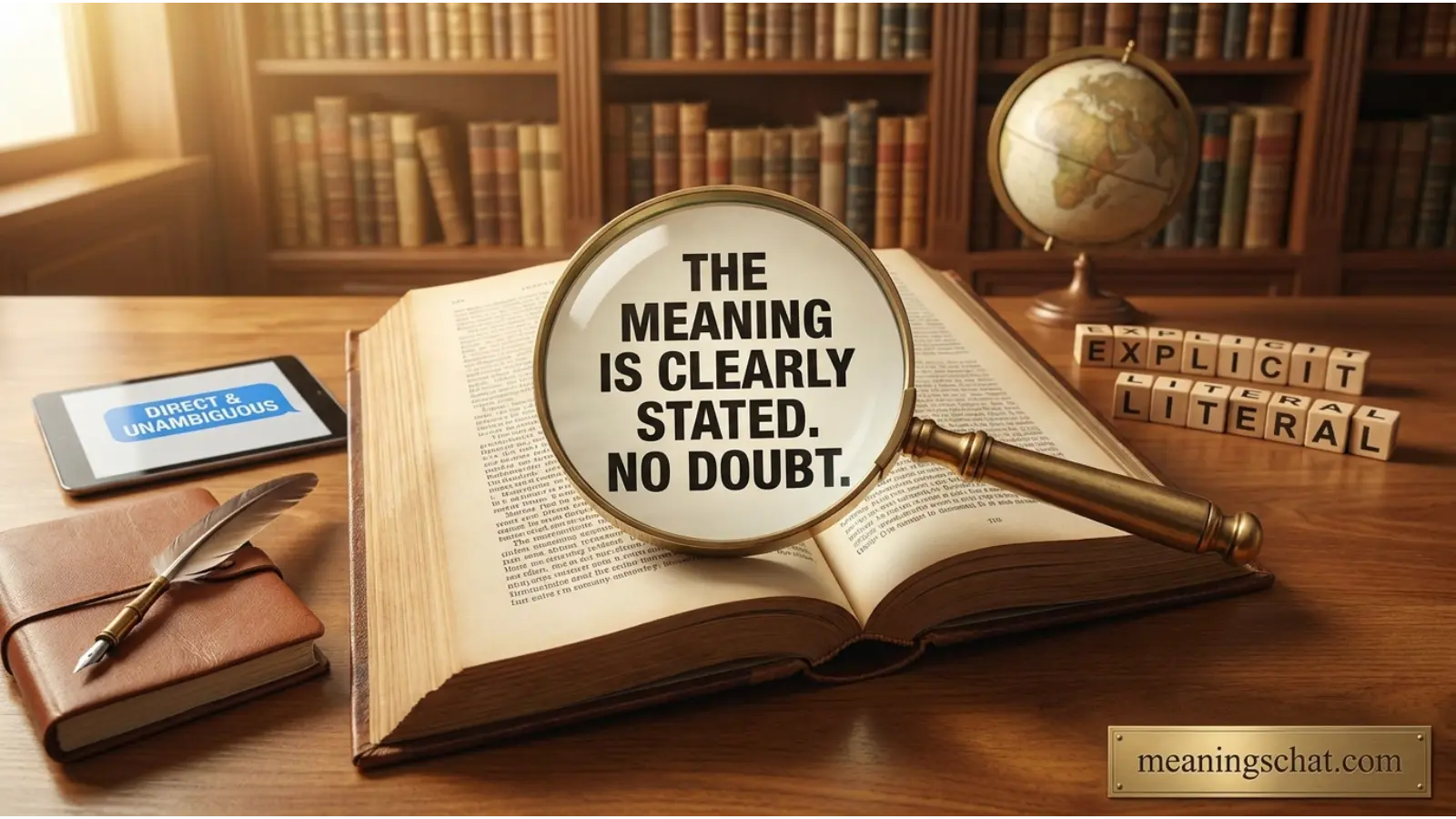
Explicit Full Form and Definition
There is no special explicit full form because “explicit” is a normal English word, not an acronym.
Its basic definition is:
Explicit: Something expressed clearly, directly, and in enough detail that its meaning is easy to understand.
Depending on the context, dictionaries and everyday usage associate the word with ideas such as:
- Clearly stated
- Directly expressed
- Specific
- Detailed
- Unambiguous
- Openly shown
- Not hidden or implied
The opposite of explicit is generally implicit, which means something is suggested rather than directly stated.
What Does Explicit Stand For?
If you are wondering what does explicit stand for, the answer is simple: it does not stand for a phrase or group of words.
“Explicit” is a complete English adjective.
So, you should not search for an acronym expansion like you would with “LOL,” “BRB,” or “IDK.”
Is Explicit Rude, Offensive, or Neutral?
The word explicit itself is usually neutral.
It becomes sensitive when it describes the subject matter of a conversation.
For example:
“Please give me explicit instructions.”
This is completely normal and professional.
But:
“The video contains explicit sexual content.”
Here, the word refers to adult material.
The word itself is not an insult or offensive expression. However, using explicit language in an inappropriate setting can create discomfort.
When Explicit Can Become Sensitive
The term can refer to:
- Sexual content
- Graphic violence
- Strong profanity
- Disturbing descriptions
- Adult themes
- Detailed descriptions of sensitive subjects
Context determines the tone.
Where Is Explicit Commonly Used?
You can encounter “explicit” in many different places.
Text Messages
People use it when asking someone to communicate clearly.
Example:
“Can you be explicit about what you mean?”
Social Media
Platforms often use “explicit content” labels to warn users about mature material.
Example:
“This post may contain explicit content.”
Music
Songs can receive an explicit label when they contain strong profanity, sexual references, or other mature themes.
Example:
“The album has both clean and explicit versions.”
Movies and Television
Streaming platforms may identify programs with explicit language, sexual material, violence, or mature themes.
Workplaces
In professional communication, explicit often means clear and specific.
Example:
“The manager gave explicit instructions for the project.”
Education
Teachers and textbooks may use the word when describing information that is directly stated.
Example:
“The author makes the main idea explicit.”
Real Life Examples of Explicit in Text
Here are several examples showing how people may use the word naturally.
Friendly Example
Person A: “What did she ask you to do?”
Person B: “She was explicit. She wants us there at 7 PM.”
Here, explicit means clear and direct.
Casual Example
Friend A: “Did he actually tell you he likes her?”
Friend B: “Yeah, he was pretty explicit about it.”
In this sentence, the person openly expressed his feelings.
Professional Example
Manager: “Please follow the explicit instructions in the project document.”
The word means clear and specific.
Argumentative Example
Person A: “You never told me the deadline.”
Person B: “I was explicit about it yesterday.”
Here, explicit emphasizes that the information was supposedly communicated clearly.
Social Media Example
“This account posts explicit content.”
Here, explicit warns users that the content may contain mature or sensitive material.
Gaming Example
“The quest gives explicit instructions about where to go.”
Here, explicit simply means detailed and clear.
Explicit vs Implicit
The easiest way to understand explicit is to compare it with implicit.
| Term | Meaning | Example |
|---|---|---|
| Explicit | Clearly and directly stated | “She explicitly said no.” |
| Implicit | Suggested without being directly stated | “His silence implied disagreement.” |
| Direct | Straightforward communication | “He directly asked for help.” |
| Specific | Focused and detailed | “Give me specific instructions.” |
| Obvious | Easy to understand or notice | “The answer was obvious.” |
The key difference is that explicit information is directly communicated, while implicit information requires the reader or listener to interpret the meaning.
For example:
Explicit: “I do not want to go.”
Implicit: “I have other plans tonight.”
The first statement gives the answer directly. The second may suggest that the person does not want to go, but it does not say so directly.
Explicit vs Graphic
These words can overlap, but they are not identical.
Explicit means something is clearly or openly expressed. It does not always mean graphic.
Graphic usually means something is described or shown with vivid detail, especially something violent, sexual, or disturbing.
For example:
“The teacher gave explicit instructions.”
This is clear and neutral.
“The documentary contains graphic images.”
This suggests disturbing or visually detailed material.
When Should You Avoid Using Explicit?
You do not normally need to avoid the word itself. The main concern is the content it describes.
Be careful when discussing explicit material in:
- Professional emails
- School assignments
- Public posts
- Family-friendly communities
- Workplace chats
- Customer support conversations
- Formal presentations
If sensitive content is involved, use a warning when appropriate.
For example:
“Content warning: This discussion includes explicit descriptions.”
This gives readers a chance to decide if they want to continue.
Polite Alternatives to Explicit
If you want a softer or more audience-friendly expression, you can use alternatives based on your intended meaning.
For “clear and direct,” try:
- Clear
- Direct
- Specific
- Detailed
- Precise
- Straightforward
- Clearly stated
For sensitive content, you can use:
- Mature content
- Adult content
- Sensitive content
- Graphic content
- Strong language
- Mature themes
The best alternative depends on the context.
Why Do People Use the Word Explicit?
People use “explicit” because it communicates an important distinction: the information is clearly stated rather than merely suggested.
It can help prevent misunderstandings.
For example:
“Please give me explicit directions.”
This request tells someone that vague guidance is not enough.
Similarly:
“The contract contains explicit rules.”
This tells the reader that the rules are directly written down.
The word can also act as a warning.
For example:
“Explicit content.”
This quickly tells users that material may not be suitable for everyone.
Impact of Using Explicit in Communication
Using explicit language can improve communication when you need clarity.
It helps people:
- Understand instructions
- Avoid confusion
- Identify expectations
- Recognize boundaries
- Follow rules correctly
- Understand sensitive-content warnings
However, being explicit does not mean being rude.
You can communicate directly while remaining respectful.
For example, instead of:
“You are doing everything wrong.”
You could say:
“The instructions explicitly require these three steps, so please follow them.”
The second statement is direct but more constructive.
Is Explicit Safe for Social Media?
The word “explicit” itself is safe and commonly used on social media.
However, explicit content can be subject to platform rules, age restrictions, moderation policies, or community guidelines.
If you see a warning such as:
“Explicit content”
it usually means the platform considers the material potentially mature, graphic, sexual, violent, or otherwise sensitive.
If you are posting content publicly, consider your audience and the rules of the platform.
Using a content warning can also help readers understand what they are about to view.
Explicit Meaning in Different Contexts
The same word can communicate different ideas depending on the situation.
Explicit Instructions
Means instructions are clear and detailed.
Explicit Permission
Means someone clearly gave permission.
Explicit Agreement
Means someone directly expressed agreement.
Explicit Language
Usually means language that openly contains strong, offensive, sexual, or otherwise mature expressions.
Explicit Content
Usually refers to material containing adult, graphic, sexual, violent, or sensitive themes.
Explicit Details
Means information is described clearly and specifically.
Context is the key to understanding the intended meaning.
Common Misunderstandings About Explicit
One common mistake is assuming that “explicit” always means sexual.
That is not correct.
For example:
“The teacher gave explicit instructions.”
There is nothing sexual about this sentence.
Another misunderstanding is treating explicit as slang. It is not normally a texting abbreviation.
People may use it casually in messages, but the word itself remains standard English.
A third misunderstanding is assuming explicit and offensive mean the same thing. They do not.
Something can be explicit and completely harmless.
For example:
“The recipe provides explicit instructions.”
The information is simply detailed.
FAQs:
What is the explicit meaning in text?
Explicit means something is communicated clearly, directly, or in detail. In some contexts, it can also refer to mature, sexual, violent, or sensitive content.
What does explicit stand for?
Explicit does not stand for anything because it is a normal English word rather than an acronym or abbreviation.
Is explicit a slang word?
No. Explicit is a standard English adjective. People commonly use it in texts, social media, education, workplaces, entertainment, and everyday conversations.
Does explicit always mean sexual?
No. Explicit can simply mean clear and detailed. Its association with sexual or mature material depends on the context.
What is the opposite of explicit?
The most common opposite is implicit. Explicit information is directly stated, while implicit information is suggested or understood without being directly stated.
Is explicit rude?
The word itself is not rude. It is generally neutral. However, the content described as explicit may be sensitive or inappropriate for certain audiences.
Conclusion
The explicit meaning in text is generally something that is clear, direct, specific, or fully expressed. The word can describe instructions, permission, agreements, details, language, or content.
It is important to remember that “explicit” does not automatically mean sexual or offensive. In many everyday and professional situations, it simply means that something has been communicated clearly.
Context determines the meaning. If someone asks for explicit instructions, they want clear details. If a website labels something as explicit content, the label usually warns about mature or sensitive material.
Understanding this difference helps you interpret messages accurately and choose the right tone when communicating. When in doubt, look at the words surrounding “explicit” to determine what the speaker actually means.