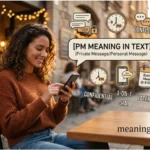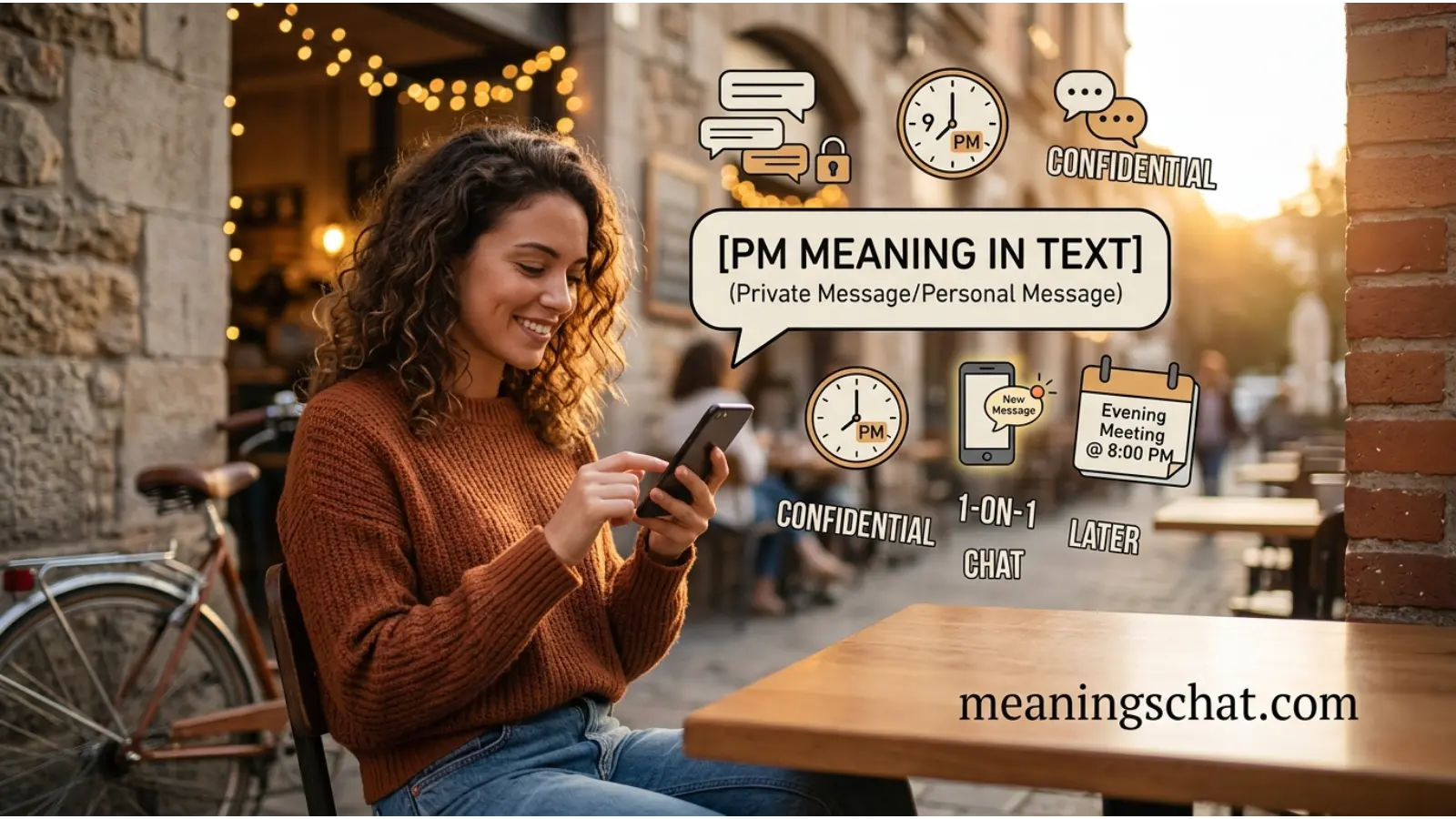
Have you ever received a message saying “PM me” and wondered what those two letters meant? If you have seen PM in a text, Instagram comment, Facebook post, or online chat, the meaning can depend on the context. Most commonly, PM means “Private Message” when people are talking about social media or online communication.
However, PM can also mean “personal message,” “afternoon” when used with a time, or other phrases in specific situations. Understanding the sentence around PM makes the meaning much easier to identify.
Quick Answer
PM usually means “Private Message” or “Personal Message” in online conversations. For example, “PM me the details” means “Send me the details privately.” When PM appears after a time, such as 7 PM, it means Post Meridiem, referring to a time from noon until midnight.
What Does PM Mean in Text?
The most common PM meaning in text depends on how the abbreviation is used.
1. PM Means Private Message
On social media and messaging platforms, PM commonly means Private Message. Someone may use it when they want you to contact them privately rather than discussing something publicly.
For example:
Friend: I have the information you need.
You: Where should you send it?
Friend: PM me.
Here, “PM me” means send me a private message.
You may also see:
- PM me for details
- Please PM me
- I’ll PM you later
- PM me your number
- Check your PMs
In these examples, PM refers to a private conversation.
2. PM Means Personal Message
PM can also be understood as personal message. The meaning is very similar to private message.
For example:
PM me when you’re free.
This means:
Send me a personal or private message when you’re free.
The exact expansion can vary by platform and speaker, but the practical meaning is usually the same.
3. PM Means Post Meridiem
When PM appears after a clock time, it has a completely different meaning.
PM = Post Meridiem
It is used for times from 12:00 noon through 11:59 at night.
Examples include:
- 1 PM
- 3:30 PM
- 7 PM
- 10:45 PM
So, if someone says:
Let’s talk at 8 PM.
They mean 8 o’clock in the evening, not a private message.
Where Is PM Used?
PM appears in several types of digital communication. Its meaning depends heavily on the context.
Social Media
On platforms such as Facebook, Instagram, and other social networks, PM can mean private message.
For example:
PM me for the price.
The person is asking you to contact them privately.
Online Communities
PM is also common in forums, gaming communities, discussion groups, and online marketplaces.
You might see:
I sent you a PM.
This means:
I sent you a private message.
Text Messaging
People can use PM casually in regular texting too, especially when referring to sending a private message through a social platform.
Time and Scheduling
PM is extremely common when discussing time.
For example:
The movie starts at 9 PM.
Here, PM clearly refers to the time of day.
Because PM has multiple meanings, the words around it are important.
Examples of PM in Conversation
Here are some realistic examples showing how PM can appear in different situations.
Example 1: Private Message
Alex: Can you send me the address?
Sam: Sure, PM me and I’ll send it.
Here, PM means private message.
Example 2: Social Media
Mia: How much is this dress?
Seller: PM me for the price.
The seller wants to discuss the price privately.
Example 3: Personal Conversation
Jake: I have something to tell you.
Ryan: Okay, PM me when you’re ready.
PM means sending a private message.
Example 4: Evening Time
Emma: What time should we meet?
Lily: Around 7 PM.
Here, PM means post meridiem, or the time after noon.
Example 5: Flirty Context
Noah: PM me when you’re alone 😉
Ava: Okay lol.
In this example, PM still means private message. The flirty feeling comes from the surrounding conversation, not from PM itself.
Example 6: Online Community
Chris: Did you send me the information?
Dan: Yes, check your PM.
Here, PM means a private message.
Example 7: Planning
Tom: Are you free at 8 PM?
Ben: Yes, that works.
In this sentence, PM clearly refers to time.
When to Use and When Not to Use PM
PM is useful when the context is clear, but it is important to choose the right wording for your audience.
When PM Works Well
You can use PM when:
- Talking casually with friends
- Messaging someone on social media
- Using online forums
- Talking in gaming communities
- Selling items online
- Asking someone to contact you privately
- Discussing an evening appointment or event
For example:
PM me the details when you get a chance.
This is perfectly natural in an informal online conversation.
When to Avoid PM
If you are communicating professionally, it is often clearer to write private message or direct message, especially if the other person may not understand the abbreviation.
For example, instead of:
PM me the documents.
A professional message could say:
Please send me the documents by direct message.
Also, if PM refers to time, make sure your audience understands the 12-hour clock.
Is PM Friendly or Casual?
When PM means private message, it is generally neutral and casual.
It is not inherently rude, offensive, or romantic.
For example:
PM me when you get home.
sounds completely normal.
However, the tone can change based on the surrounding words.
PM me ASAP.
may sound urgent.
PM me 😉
could feel playful or flirty depending on the relationship.
Again, PM itself does not determine the emotional tone.
Does PM Have a Flirty Meaning?
PM does not have a specific flirty meaning.
If someone says:
PM me later ❤️
the message may be romantic because of the heart emoji and the relationship between the people.
But PM simply means private message.
Likewise:
PM me the details.
is normally just a practical request.
Always look at the complete message instead of assuming that PM is romantic.
Similar Slang Words or Alternatives
If you see PM in online conversations, you may also encounter these related terms.
DM — Direct Message
DM is one of the most common alternatives to PM.
DM me the details.
means essentially the same thing as PM me the details.
Msg — Message
MSG is a shortened form of “message.”
Send me a msg later.
Inbox
Someone may say:
Check your inbox.
This usually means they have sent a private message.
Chat
Chat can refer to a private online conversation.
Let’s chat later.
Text
Text usually means sending a message through a phone’s messaging service.
Text me when you arrive.
These terms can overlap, although their exact meaning depends on the platform.
FAQs
What does PM mean from a girl?
If a girl says “PM me,” she usually means “send me a private message.” It does not automatically indicate romantic or flirty interest. The surrounding conversation provides the context.
Is PM slang rude?
No. PM is generally neutral and harmless when it means private message. The tone depends on the complete sentence and situation.
Can I use PM in professional chats?
You can, but clarity is often better in professional communication. Depending on the platform, DM, direct message, or private message may be easier for everyone to understand.
Does PM have any flirty meaning?
Not by itself. PM simply refers to a private message when used in online communication. A flirty meaning comes from the surrounding words, emojis, or relationship.
Is PM still popular in 2025?
PM remains a recognizable abbreviation in online communication, although DM is also very widely used on modern social platforms. PM is still commonly understood when referring to private messages or evening times.
Conclusion
The PM meaning in text depends on context. In social media and online chats, PM most commonly means “Private Message” or “Personal Message.” When someone says “PM me,” they are asking you to contact them privately.
However, PM can also mean Post Meridiem when it appears with a time, such as 6 PM or 9 PM. The easiest way to understand PM is to look at the sentence around it. If it involves contacting someone, it probably means private message. If it follows a number on a clock, it refers to the time after noon.
Once you understand the context, PM is a simple abbreviation to recognize and use.