Perimeter meaning is one of the most common concepts in basic mathematics and geometry. If you have ever wondered how to find the total distance around a shape, you are already thinking about perimeter. Students often search for the meaning of perimeter because the word appears in math problems, diagrams, real life measurements, and everyday descriptions of boundaries.
Understanding perimeter becomes much easier when you connect it to something familiar. Imagine walking around the outside edge of a garden, measuring the border of a picture frame, or putting a fence around a yard. The total distance you travel around that outside edge represents the perimeter.
In this guide, you will learn the perimeter meaning, formulas, examples, related terms, and practical uses in simple English.
Quick Answer:
Perimeter means the total distance around the outside boundary of a two-dimensional shape. You usually find it by adding the lengths of all its sides.
What Does Perimeter Mean?
The perimeter is the total length of the boundary surrounding a two-dimensional shape.
In simple words, perimeter tells you how far it is around a shape.
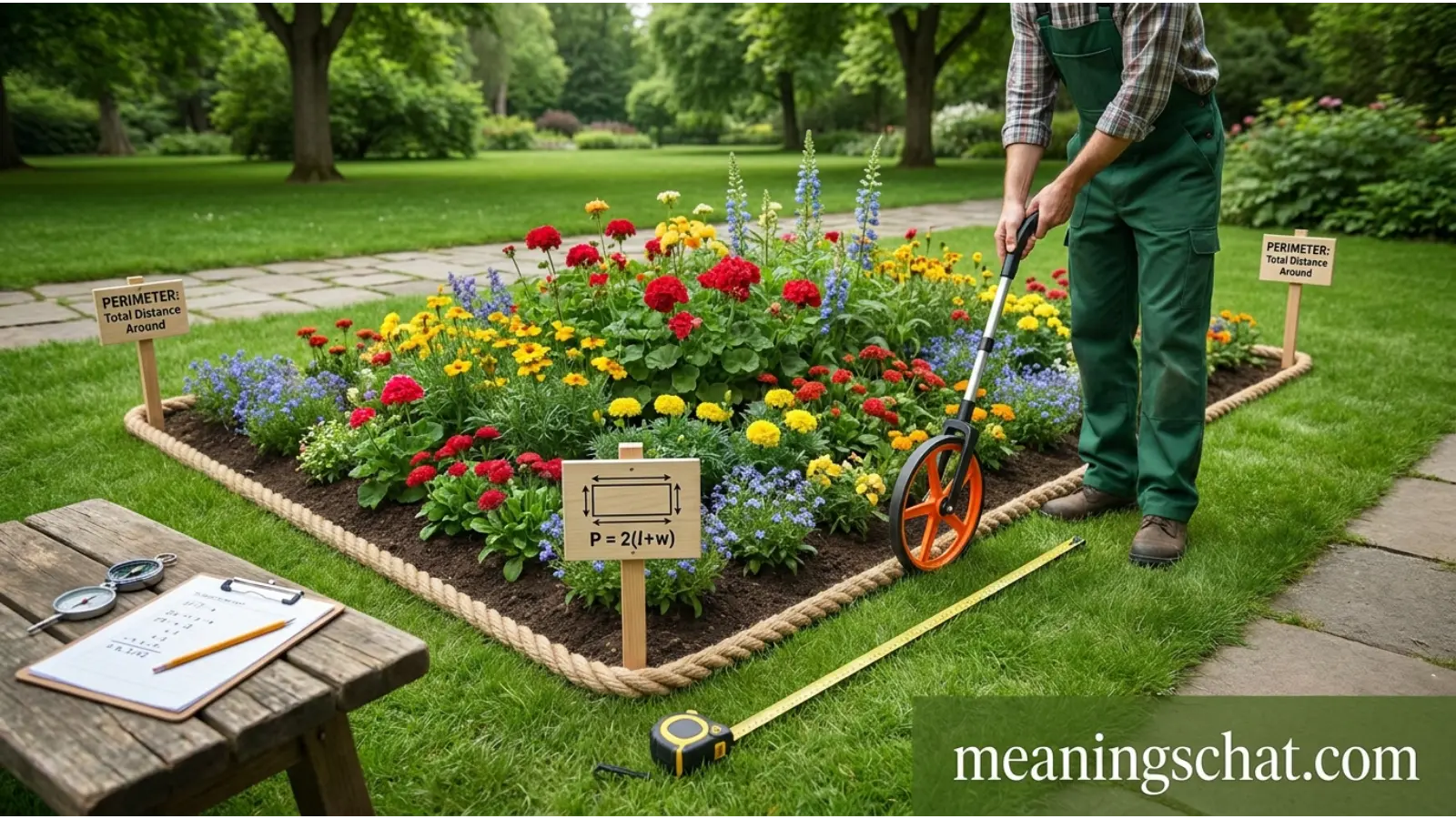
For example, imagine a rectangular garden. If you walk from one corner around all four sides and return to your starting point, the distance you walked is the garden’s perimeter.
The word can apply to many shapes, including:
- Squares
- Rectangles
- Triangles
- Circles
- Parallelograms
- Trapezoids
- Polygons
- Irregular shapes
The basic idea remains the same: add the lengths around the outside of the shape.
For example, if a rectangle has sides measuring 8 feet, 5 feet, 8 feet, and 5 feet:
Perimeter = 8 + 5 + 8 + 5 = 26 feet
So, the perimeter is 26 feet.
Perimeter Meaning in Simple English
If you want the easiest possible definition, think of perimeter as the distance around something.
Imagine a playground surrounded by a fence. The amount of fencing needed to completely surround the playground depends on its perimeter.
Another easy example is a picture frame. The outside edge of the frame has a certain total length. That total length represents its perimeter.
A useful way to remember it is:
Perimeter = distance around
This is different from area, which tells you how much space is inside a shape.
Perimeter Definition in Mathematics
In mathematics, perimeter is the measurement of the complete boundary of a two-dimensional figure.
For a polygon, you calculate the perimeter by adding the lengths of every side.
The general idea can be written as:
Perimeter = sum of all side lengths
For example, suppose a five-sided shape has sides of 4 cm, 6 cm, 3 cm, 5 cm, and 7 cm.
You add them together:
4 + 6 + 3 + 5 + 7 = 25 cm
Therefore, the perimeter is 25 centimeters.
The unit of perimeter is always a unit of length, such as:
- Inches
- Feet
- Yards
- Miles
- Centimeters
- Meters
- Kilometers
What Is the Perimeter Formula?
There is no single formula that works for every shape. The formula depends on the shape you are measuring.
Here are some of the most common perimeter formulas.
Rectangle Perimeter Formula
For a rectangle:
P = 2(l + w)
Here:
- P = perimeter
- l = length
- w = width
Square Perimeter Formula
A square has four equal sides, so its perimeter is:
P = 4s
Here, s represents the length of one side.
If one side measures 9 inches:
P = 4 × 9
P = 36 inches
Triangle Perimeter Formula
For a triangle:
P = a + b + c
You simply add the lengths of the three sides.
If a triangle has sides of 6 cm, 8 cm, and 10 cm:
P = 6 + 8 + 10
P = 24 cm
Parallelogram Perimeter Formula
For a parallelogram:
P = 2(a + b)
If its two different side lengths are 10 feet and 6 feet:
P = 2(10 + 6)
P = 32 feet
Trapezoid Perimeter Formula
A trapezoid has four sides, so:
P = a + b + c + d
If its sides measure 5 cm, 8 cm, 6 cm, and 7 cm:
P = 5 + 8 + 6 + 7
P = 26 cm
Circle Perimeter Formula
The perimeter of a circle is usually called its circumference.
The formula is:
C = 2πr
You can also use:
C = πd
Here:
- C = circumference
- r = radius
- d = diameter
- π is approximately 3.14
If a circle has a radius of 5 cm:
C = 2 × π × 5
C ≈ 31.4 cm
So, the circumference is approximately 31.4 centimeters.
Area measures the amount of space inside a shape.
Think about a rectangular backyard.
If you want to install a fence around the backyard, you need the perimeter.
If you want to know how much grass seed you need to cover the backyard, you need the area.
Here is a simple comparison:
| Feature | Perimeter | Area |
|---|---|---|
| Measures | Distance around a shape | Space inside a shape |
| Common units | cm, m, ft, yd | cm², m², ft² |
| Main idea | Boundary | Surface |
| Example use | Building a fence | Covering a floor |
| Formula for rectangle | 2(l + w) | l × w |
Remembering around versus inside can help you avoid confusing the two.
How to Find the Perimeter Step by Step
Finding a perimeter is usually simple when you follow a few steps.
Step 1: Identify the Shape
First, determine what kind of shape you have.
Is it a square, rectangle, triangle, circle, or irregular polygon?
Step 2: Find the Side Lengths
Look at the measurements shown on the diagram.
Make sure you identify every outside side.
Step 3: Choose the Correct Formula
Use the formula that matches the shape.
For a rectangle, use:
P = 2(l + w)
For a square, use:
P = 4s
For a triangle, add all three sides.
Step 4: Add the Measurements
Calculate the total distance around the boundary.
Step 5: Include the Correct Unit
Perimeter is a length, so use units such as meters, feet, inches, or centimeters.
Do not use square units for perimeter.
Perimeter Examples in Real Life
Perimeter is not just a classroom concept. People use it in many practical situations.
Fencing a Yard
Suppose a rectangular yard is 30 feet long and 20 feet wide.
P = 2(30 + 20)
P = 100 feet
You would need at least 100 feet of fencing to surround the yard, assuming there are no openings.
Framing a Picture
Imagine a rectangular picture that measures 18 inches by 12 inches.
P = 2(18 + 12)
P = 60 inches
The outside boundary measures 60 inches.
Walking Around a Park
A square park has sides measuring 100 meters.
P = 4 × 100
P = 400 meters
A person walking around the outside edge would travel 400 meters.
Decorating a Table
A rectangular table measures 6 feet by 3 feet.
P = 2(6 + 3)
P = 18 feet
If you wanted to place decorative trim around the edge, you would need approximately 18 feet of material.
Perimeter Meaning for Irregular Shapes
Not every shape has equal or easily recognizable sides.
An irregular shape can have several different side lengths. You can still find its perimeter by adding every outside side.
For example:
- Side 1 = 4 m
- Side 2 = 6 m
- Side 3 = 3 m
- Side 4 = 8 m
- Side 5 = 5 m
Then:
P = 4 + 6 + 3 + 8 + 5
P = 26 m
The key is to include every side that forms the outer boundary.
Common Mistakes When Finding Perimeter
Students often make a few simple mistakes when working with perimeter.
Confusing Perimeter With Area
This is probably the most common mistake.
Perimeter measures around the outside, while area measures the inside space.
Forgetting a Side
When working with an irregular shape, it is easy to overlook one side.
A helpful trick is to trace the entire outside edge with your finger.
Using Square Units
Perimeter should use regular length units.
For example:
25 meters is correct.
25 square meters describes area, not perimeter.
Using the Wrong Formula
Make sure the formula matches the shape.
A square and rectangle have different formulas, even though both have four sides.
Mixing Different Units
If one side is measured in centimeters and another in meters, convert them to the same unit before adding them.
Perimeter and Circumference: What Is the Difference?
The terms perimeter and circumference can sometimes cause confusion.
Perimeter generally describes the boundary length of a polygon or other two-dimensional figure.
Circumference specifically describes the distance around a circle.
For example:
- A square has a perimeter.
- A rectangle has a perimeter.
- A triangle has a perimeter.
- A circle has a circumference.
You can think of circumference as the circle’s version of perimeter.
Perimeter Meaning Compared With Boundary
The word boundary refers to the edge or limit that separates one area from another.
Perimeter measures the total length of that boundary.
For example, a garden may have a boundary formed by its outer edges. The total length of those edges is its perimeter.
So, boundary describes the edge, while perimeter gives you the measurement of that edge.
Why Is Perimeter Important?
Perimeter helps solve practical problems involving borders, edges, and boundaries.
People use it to calculate how much material they need for:
- Fences
- Borders
- Frames
- Garden edging
- Decorative trim
- Track boundaries
- Property boundaries
- Construction projects
It also builds an important foundation for geometry and more advanced mathematics.
Understanding perimeter can make many measurement problems easier because it teaches you to focus on the outside boundary of an object.
Perimeter in Everyday Language
Although perimeter is strongly associated with mathematics, people also use the word in general conversation.
For example:
“Security guards checked the perimeter of the building.”
Here, perimeter refers to the outer boundary or surrounding area.
Another example is:
“The workers placed a fence around the perimeter of the property.”
In this sentence, perimeter means the entire outside boundary of the property.
This broader meaning is useful because it shows that perimeter does not always involve a mathematical calculation.
Is Perimeter Used Outside Mathematics?
Yes. The word appears in several real-life contexts.
Security
Security teams may monitor the perimeter of a building or restricted area.
Construction
Builders use perimeter measurements when planning fences, walls, borders, and other structures.
Landscaping
Gardeners may calculate the perimeter of a garden to determine how much edging or fencing they need.
Sports
Some sports facilities have clearly defined boundaries or perimeter areas.
Property Planning
Property owners may use perimeter measurements when planning boundaries and fencing.
Perimeter Meaning in Different Contexts
The meaning stays connected to the idea of an outside boundary, but its use can vary.
| Context | Meaning |
|---|---|
| Mathematics | Total distance around a shape |
| Construction | Outer measurement of a structure or area |
| Security | Outer boundary of a protected location |
| Landscaping | Edge around a garden or yard |
| Property | Outer boundary of land or premises |
| Everyday speech | Surrounding edge or boundary |
Perimeter vs. Similar Terms
Several words are related to perimeter, but they do not always mean exactly the same thing.
| Term | Meaning |
|---|---|
| Perimeter | Total distance around a shape |
| Boundary | Edge or limit of an area |
| Circumference | Distance around a circle |
| Area | Space inside a two-dimensional shape |
| Length | Measurement of distance from one point to another |
| Border | Edge separating one area from another |
Knowing these differences can help you understand math questions and everyday conversations more accurately.
What Does Perimeter Stand For?
A common question is, “What does perimeter stand for?”
Perimeter is not an acronym, so it does not have a traditional “full form” like a texting abbreviation.
The word refers to the complete distance around the boundary of a shape.
If someone searches for perimeter full form, the simplest answer is that perimeter is a mathematical term rather than an abbreviation.
Perimeter Meaning Slang
Unlike internet slang or texting abbreviations, perimeter is not normally slang.
People generally use it as a standard English word, especially in mathematics, construction, security, geography, and everyday descriptions of boundaries.
So, if you searched for perimeter meaning slang, the important point is that its usual meaning remains related to an outer boundary or surrounding edge.
When Should You Avoid Using the Word Perimeter?
There is no major social concern associated with the word perimeter. It is a neutral and widely accepted term.
However, you should choose a simpler word when your audience may not understand mathematical vocabulary.
For example, instead of saying:
“Measure the perimeter of the garden.”
You could say:
“Measure the distance around the garden.”
Both communicate the same basic idea, but the second version may be easier for young learners.
Why Do People Use the Word Perimeter?
People use the word because it communicates a specific idea efficiently.
Instead of saying “the total distance around the outside edge,” you can simply say “perimeter.”
That makes communication clearer in mathematics, engineering, construction, design, and planning.
The word also helps people distinguish an outside measurement from an inside measurement.
Impact of Understanding Perimeter
Learning perimeter develops more than the ability to solve one type of math problem.
It helps you understand:
- Measurement
- Geometry
- Spatial relationships
- Mathematical formulas
- Practical planning
- Problem solving
For students, perimeter often becomes an early introduction to geometry. Once the concept makes sense, more complicated measurement problems become easier to understand.
Is Perimeter Safe to Use on Social Media?
Yes. Perimeter is a neutral and safe word for social media, school assignments, websites, and everyday communication.
You might see posts discussing:
- Math homework
- DIY projects
- Home improvement
- Gardening
- Property boundaries
- Security
- Construction
- Geometry lessons
There is no offensive or inappropriate meaning associated with the standard use of the word.
Real-Life Examples of Perimeter Usage
Friendly Example
“I measured the perimeter of my garden so I know how much fencing to buy.”
This uses perimeter in a practical and friendly way.
Casual Example
“Do you know the perimeter of this table?”
This is a normal question about measurement.
Educational Example
“To find the perimeter of the rectangle, add all four sides together.”
This example fits a classroom setting.
Construction Example
“The contractor calculated the perimeter before ordering the border material.”
Here, perimeter helps determine the required amount of material.
Security Example
“The guards checked the perimeter before the event began.”
Here, perimeter means the outer boundary of an area.
Social Media Example
“Math tip: perimeter means the distance around a shape. Area means the space inside it.”
This is a simple educational social media post.
Gaming Context
“Stay near the perimeter of the map and watch for opponents approaching from outside.”
In gaming, perimeter can refer to the outer boundary or edge of a game area.
How to Remember Perimeter Easily
Use this simple memory trick:
Perimeter = Around
Area = Inside
Imagine a box.
If you are putting a ribbon around the outside, you need the perimeter.
If you are filling the inside with wrapping paper, you are thinking about area.
Another way to remember it is to imagine walking around the edge of a shape. The distance you walk represents the perimeter.
FAQs:
What is the simple meaning of perimeter?
Perimeter means the total distance around the outside boundary of a two-dimensional shape.
What is the perimeter formula?
The formula depends on the shape. For a rectangle, the formula is P = 2(l + w). For a square, it is P = 4s.
Is perimeter the same as area?
No. Perimeter measures the distance around a shape, while area measures the amount of space inside it.
What is the perimeter of a square?
Multiply the length of one side by four. For example, a square with a side of 6 meters has a perimeter of 24 meters.
Is perimeter a slang word?
No. Perimeter is a standard English and mathematical term. It does not normally function as texting or internet slang.
What does perimeter stand for?
Perimeter is not an abbreviation, so it does not have a traditional full form. It refers to the total distance around a shape or the outer boundary of an area.
Conclusion
Perimeter meaning is simple once you connect it with the idea of going around something. In mathematics, perimeter is the total distance around the outside boundary of a two-dimensional shape. You can calculate it by adding all the side lengths or by using a formula designed for a particular shape.
The concept also appears in everyday situations such as fencing a yard, framing a picture, measuring a garden, planning construction work, and describing the outer boundary of a protected area.
Remember the easiest rule: perimeter measures around, while area measures inside. With that distinction in mind, perimeter problems become much easier to understand and solve.