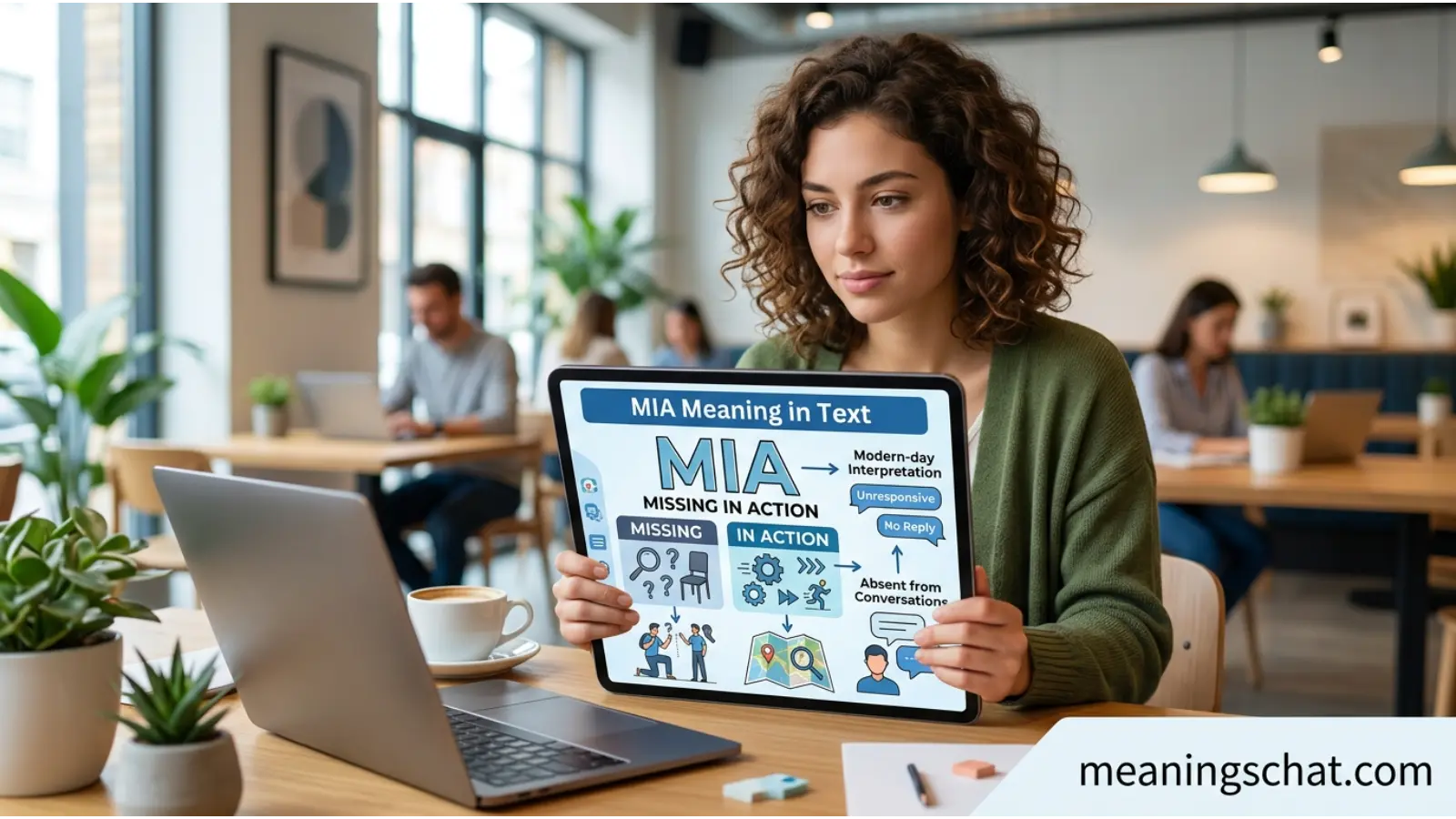
Mia meaning in text can confuse you when someone suddenly writes “MIA” in a chat, caption, or social media post. You may wonder if it is an abbreviation, slang term, or simply someone’s name. In most texting and online conversations, MIA means “Missing in Action.” People use it when someone has disappeared, stopped replying, or has not been around for a while.
You may see it in messages such as “Where have you been? You’ve been MIA!” or “Sorry, I was MIA all weekend.” The meaning usually depends on the situation and tone.
Quick Answer:
In text messages, MIA usually means “Missing in Action.” It describes someone who is absent, unavailable, quiet, or not responding for some time.
What Does MIA Mean in Text?
The most common MIA meaning in text is “Missing in Action.”
People use MIA to describe someone who has suddenly become unavailable or stopped appearing in a conversation, group, event, or social setting.
For example:
“You’ve been MIA lately. Everything okay?”
Here, the person is saying that you have not been around or responding as usual.
MIA can describe a temporary absence. It does not always suggest something serious happened. Friends often use it casually when someone takes a break from texting or social media.
MIA Full Form
The MIA full form is “Missing in Action.”
The expression originally comes from military language. It describes a service member who cannot be located after military action and whose status remains unknown.
Over time, people adopted MIA in everyday English. Today, you can see it in texts, social media posts, group chats, emails, and casual conversations.
What Does MIA Stand For?
So, what does MIA stand for?
MIA = Missing in Action
In everyday texting, however, people usually use it in a much lighter way. Someone might say they were “MIA” simply because they were busy, traveling, studying, sleeping, or taking a break from their phone.
MIA Meaning as Slang
The MIA meaning slang version usually refers to someone being absent or hard to reach.
For example:
“Why are you MIA?”
This means:
“Why have you disappeared?” or “Why haven’t you been around or replying?”
Another example is:
“I’ve been MIA from Instagram.”
This means the person has not been active on Instagram for some time.
The slang can describe both physical and digital absence.
You might be MIA from:
- A group chat
- Social media
- School
- Work
- Gaming
- Parties
- Friend groups
- Text conversations
- Online communities
Is MIA Rude, Offensive, or Neutral?
MIA is generally neutral and casual.
The abbreviation itself is not a swear word or offensive expression. However, the tone can change depending on how someone uses it.
For example:
Friendly:
“Hey! You’ve been MIA 😂 Where have you been?”
This sounds playful.
Concerned:
“You’ve been MIA for a few days. Is everything okay?”
This sounds caring.
Annoyed:
“You went MIA again when we needed you.”
This can sound critical.
Therefore, MIA is not inherently rude. The surrounding words and relationship between the speakers determine the tone.
Where Is MIA Commonly Used?
MIA appears frequently in informal digital communication.
You can encounter it on platforms such as:
- TikTok
- Snapchat
- Discord
- X
- Gaming chats
- Group messages
People also use MIA in captions.
For example:
“Been MIA lately, but I’m back!”
Here, the person tells followers that they have not posted or interacted recently.
MIA also works well in casual conversations between friends.
Real-Life Examples of MIA in Text
Understanding examples makes the slang easier to recognize.
Friendly Example
Friend 1: “You disappeared after graduation!”
Friend 2: “Haha, I’ve been MIA because I started my new job.”
The speaker uses MIA to explain their absence.
Casual Example
“Sorry for being MIA yesterday. I had a lot going on.”
This simply means:
“Sorry I was unavailable yesterday.”
Social Media Example
“I’ve been MIA from social media lately.”
This means the person has not been active online.
Group Chat Example
“Where’s Jake? He’s been MIA all morning.”
The speaker means Jake has not appeared or responded.
Gaming Example
“Bro went MIA halfway through the match.”
This means the player disappeared or stopped participating.
Argumentative Example
“You went MIA when I needed your help.”
Here, MIA carries a more frustrated tone.
MIA in Different Contexts
The meaning of MIA can stay the same while the emotional tone changes.
MIA Between Friends
Friends often use MIA playfully.
“You’ve been MIA! We miss you.”
This usually expresses affection rather than anger.
MIA in Relationships
A partner might say:
“Why have you been MIA all day?”
Depending on the relationship, this could sound concerned, playful, or annoyed.
MIA at Work
Someone might casually say:
“I was MIA this morning because I had a doctor’s appointment.”
However, in formal workplace communication, “unavailable” or “away” may sound more professional.
MIA in Gaming
Gamers can use MIA when a player stops responding or disappears.
“Our support player is MIA.”
The phrase can also describe an absent teammate.
MIA on Social Media
A creator might write:
“Sorry I’ve been MIA lately!”
This tells followers that the creator has not posted or interacted recently.
Origin and Background of MIA
The expression “Missing in Action” has military roots.
In military contexts, MIA describes personnel who cannot be located after an operation or battle and whose status has not been confirmed.
The abbreviation eventually entered general English.
People began using MIA metaphorically to describe ordinary situations involving absence. Someone who does not answer messages for several days might jokingly be described as “MIA.”
This modern use does not necessarily carry the serious meaning associated with its military origin.
That distinction matters. In everyday texting, MIA usually functions as a casual metaphor for disappearing or becoming unavailable.
MIA vs. AFK vs. Ghosting
MIA can look similar to other expressions that describe absence. However, these terms do not always mean exactly the same thing.
| Term | Meaning | Common Context | Typical Tone |
|---|---|---|---|
| MIA | Missing in Action; absent or unavailable | Texting, social media, everyday conversation | Casual |
| AFK | Away From Keyboard | Gaming and online chats | Casual |
| Ghosting | Suddenly cutting off communication | Dating, friendships, social situations | Usually negative |
| Offline | Not currently connected or active | Apps and online platforms | Neutral |
| BRB | Be Right Back | Texting and chats | Casual |
MIA vs. AFK
AFK means “Away From Keyboard.”
Gamers commonly use it when they temporarily leave their computer or game.
MIA is broader. You can use it for social media, texting, work, school, or everyday life.
MIA vs. Ghosting
Ghosting usually means someone deliberately stops communicating without explanation.
MIA does not necessarily imply intentional avoidance.
Someone can be MIA because they are:
- Busy
- Traveling
- Sleeping
- Working
- Taking a break
- Dealing with personal responsibilities
So, calling someone MIA does not automatically mean they are ghosting you.
When Should You Avoid Using MIA?
Although MIA is common and harmless in casual communication, you should consider your audience.
Avoid using MIA when the reader may not understand abbreviations.
For example, instead of writing:
“I was MIA yesterday.”
in a formal business email, write:
“I was unavailable yesterday.”
You should also avoid casual slang when discussing sensitive situations where the phrase could sound dismissive.
For example, calling someone MIA during a serious emergency may sound inappropriate.
In professional or sensitive communication, choose direct and respectful language.
Polite Alternatives to MIA
You can replace MIA with several expressions depending on the situation.
Casual Alternatives
- I disappeared for a bit.
- I wasn’t around.
- I’ve been away.
- I’ve been quiet lately.
- I haven’t been online.
- I’ve been off the grid.
Professional Alternatives
- I was unavailable.
- I was away from my desk.
- I was out of the office.
- I was unable to respond.
- I wasn’t available earlier.
The best alternative depends on your audience and the level of formality you need.
Why Do People Use MIA in Texting?
People use MIA because it communicates absence quickly.
Instead of writing:
“I haven’t been active online or responding to messages for the last few days,”
someone can simply write:
“I’ve been MIA.”
The abbreviation also feels informal and conversational.
People may use it to:
Save time: Short abbreviations make messages quicker.
Sound casual: MIA fits naturally into friendly conversations.
Explain an absence: It gives a simple reason for limited activity.
Add humor: Someone may jokingly call themselves MIA after disappearing from a group chat.
Connect with online culture: Abbreviations make digital conversations feel natural.
The Impact of MIA on Communication
Slang can make conversations feel relaxed and personal. MIA works especially well when both people understand the expression.
For example:
“Sorry I’ve been MIA!”
sounds more casual than:
“I apologize for my recent absence.”
However, slang can sometimes create confusion. Not everyone knows every abbreviation, especially across different age groups, cultures, or professional environments.
Clear communication should always come first.
If you think someone may not understand MIA, simply use “absent,” “away,” or “unavailable.”
Is MIA Safe for Social Media?
Yes. MIA is generally safe for social media.
It is a common abbreviation without inherently offensive or inappropriate content.
You can use it in captions such as:
“MIA for a few weeks, but I’m back!”
or:
“Sorry I’ve been MIA. Life got busy.”
Still, context matters. Avoid using the phrase carelessly when discussing serious missing-person situations because the casual slang meaning can sound insensitive.
MIA Examples by Tone
Here are several examples that show how the same abbreviation can communicate different feelings.
Friendly
“You’ve been MIA! We need to catch up soon.”
The speaker sounds warm and friendly.
Casual
“I’ve been MIA because I’ve been studying for exams.”
The speaker casually explains their absence.
Playful
“My phone and I have been MIA from the world 😂.”
The speaker uses MIA humorously.
Concerned
“You’ve been MIA since yesterday. Are you okay?”
The phrase expresses concern.
Argumentative
“You went MIA when I needed you most.”
Here, MIA expresses frustration.
Gaming
“Our teammate went MIA during the final round.”
The abbreviation describes an absent player.
Social Media
“Been MIA from TikTok lately. I’ll post again soon!”
The speaker explains their lack of online activity.
Common Misunderstandings About MIA
One common misunderstanding involves assuming that MIA always means someone is deliberately ignoring another person.
That is not necessarily true.
Someone can be MIA because they are busy or unavailable. The phrase alone does not prove that a person is intentionally avoiding communication.
Another misunderstanding comes from the different meanings of Mia and MIA.
Mia can be a person’s name.
MIA usually means “Missing in Action” when used as an abbreviation.
Capitalization and context can help you determine which meaning applies.
For example:
“Mia sent me a message.”
Here, Mia is probably someone’s name.
But:
“Tom has been MIA all week.”
Here, MIA clearly means “Missing in Action.”
How to Respond When Someone Says “You’re MIA”
Your response can match the tone of the original message.
If a friend says:
“You’ve been MIA!”
you could respond:
“Haha, I know! Work has been Wild.”
Or:
“Sorry! I’ve been super busy lately.”
If someone sounds concerned, provide a little more context:
“I’m okay! I just needed some time offline.”
You do not need a complicated response. A short explanation usually clears things up.
FAQs:
What does MIA mean in text?
MIA usually means “Missing in Action.” In texting, people use it to describe someone who has been absent, unavailable, or unusually quiet.
What is the MIA full form?
The MIA full form is “Missing in Action.” The expression originated in military terminology and later became common in everyday communication.
What does MIA stand for in slang?
In slang and casual texting, MIA stands for “Missing in Action.” It usually means someone has disappeared from chats, social media, or normal activities.
Is MIA rude?
MIA is generally not rude or offensive. However, it can sound annoyed or critical depending on the surrounding message and context.
What does “You’ve been MIA” mean?
“You’ve been MIA” means “You have been absent, unavailable, or not around lately.” Friends often use it when someone stops responding or disappears from social activities.
Is MIA the same as ghosting?
No. MIA simply means someone is absent or unavailable. Ghosting usually involves deliberately ending communication without explanation, so ghosting carries a more negative meaning.
Conclusion
Understanding mia meaning in text becomes easy once you know the context. In most chats and social media conversations, MIA means “Missing in Action.” People use it to describe someone who has disappeared, become unavailable, or stopped being active for a while.
The MIA meaning slang can sound friendly, humorous, concerned, or frustrated depending on the situation. You might say, “I’ve been MIA” when explaining your own absence or tell a friend, “You’ve been MIA!” when they suddenly stop responding.
MIA works best in casual conversations, social media, gaming, and friendly chats. For professional or sensitive situations, clearer terms such as “unavailable” or “away” may work better. Always consider the audience, context, and tone before using slang.