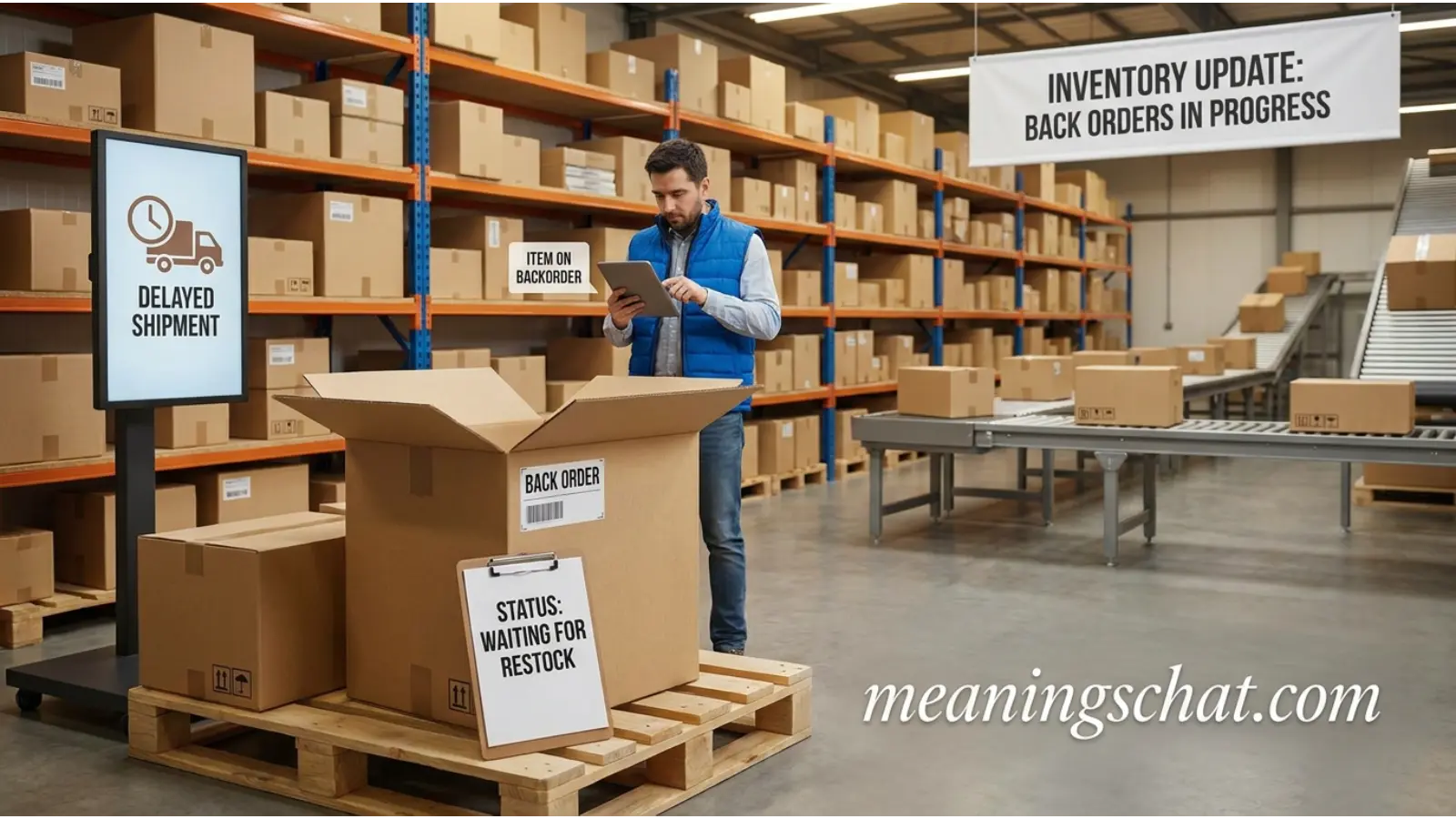
Back order meaning usually refers to an item that customers can order even though the seller does not currently have it in stock. Instead of canceling the purchase, the company accepts the order and ships the product once new inventory arrives.
You may see “back order” while shopping online, checking an order status, or talking with a seller about a delayed product. The phrase can be confusing because it sounds like an ordinary order, but it actually tells you that the product is temporarily unavailable.
Understanding the back order meaning in text helps you know what a seller means when they say your item is on back order. It also helps you avoid confusion about shipping dates, availability, and delivery expectations.
Quick Answer:
A back order means an item is currently out of stock but can still be ordered. The seller will fulfill the order after the product becomes available again.
What Does Back Order Mean in Text?
The back order meaning is simple: a product has been ordered by a customer, but the seller does not have enough stock to ship it immediately.
For example, imagine you want to buy a popular pair of headphones. The website says:
“This item is currently on back order.”
That means the headphones are temporarily unavailable. However, the seller expects to receive more units and plans to send your order when the new stock arrives.
A back order can happen when:
- Demand is higher than expected
- A product sells out quickly
- A supplier has delayed a shipment
- Manufacturing takes longer than expected
- The seller has limited inventory
- A popular product experiences a sudden increase in demand
The key point is that back order does not always mean the product is discontinued. It generally means the seller expects to receive or produce more stock.
Back Order Full Form and Definition
Unlike texting abbreviations, back order is not an acronym. Therefore, there is no special back order full form made from individual letters.
The phrase itself consists of two words:
- Back: Refers to something that is delayed or waiting.
- Order: A request from a customer to purchase something.
Together, back order describes an order that cannot be fulfilled immediately because the product is temporarily unavailable.
You may also see the term written as backordered or back-ordered, depending on the company and style guide.
What Does Back Order Stand For?
If you are wondering what does back order stand for, it does not stand for a longer phrase like many text abbreviations do.
Instead, it is a standard business and retail term. Companies use it to describe customer orders that remain pending until inventory becomes available.
For instance:
“Your laptop is on back order.”
This means the company has your order but cannot ship the laptop right now because it needs additional stock.
Is Back Order Rude, Offensive, or Neutral?
The back order meaning slang is not actually slang in the traditional sense. It is a neutral commercial phrase.
It is not:
- Rude
- Offensive
- Profane
- Insulting
- Informal in a problematic way
You can use “back order” in professional emails, customer service conversations, online shopping, business communication, and everyday discussions.
For example:
Professional: “The replacement parts are currently on back order.”
Casual: “My shoes are on back order, so I have to wait a little longer.”
Both uses are completely normal.
Where Is Back Order Commonly Used?
You will most often encounter the term in situations involving products, inventory, and purchasing.
Online Shopping
E-commerce websites frequently use “back order” when products sell faster than expected.
Example:
“This phone case is available for back order and will ship next month.”
Customer Service
A customer service representative may explain a shipping delay by saying:
“Your order is currently on back order.”
Business Purchasing
Businesses often use the term when ordering equipment, supplies, or replacement parts.
Example:
“The office printers are on back order because the supplier is waiting for a new shipment.”
Manufacturing
Manufacturers may also use back order information to track customer demand and pending orders.
Text Messages
Friends or coworkers might use the phrase casually:
“The keyboard I wanted is on back order 😭.”
Real Life Examples of Back Order
Here are several examples that show how the phrase works naturally.
Friendly Example
Friend: “Did your new headphones arrive?”
You: “Not yet. They’re on back order, so I’m waiting for the next shipment.”
Casual Example
“I finally ordered that jacket, but it’s on back order.”
This simply explains why the item has not shipped yet.
Customer Service Example
Customer: “Why hasn’t my order shipped?”
Representative: “The item is currently on back order. We expect more inventory soon.”
Business Example
“The replacement parts are on back order from the manufacturer.”
Social Media Example
“Everyone bought this phone case because it’s already on back order 😂.”
Here, the phrase highlights how popular the product has become.
Gaming Example
“The new gaming headset is on back order, so I’ll have to wait before upgrading my setup.”
Back Order vs Out of Stock
These terms sound similar, but they can communicate different things.
Out of stock generally means the seller does not currently have the product available.
Back order means customers may still be able to place an order even though the seller does not currently have enough inventory to ship it.
For example:
| Term | Meaning |
|---|---|
| Back order | You can order the item, but shipment will happen later |
| Out of stock | The item is currently unavailable |
| In stock | The seller currently has the item available |
| Preorder | You order before the product is officially released |
| Discontinued | The seller or manufacturer no longer plans to provide the product |
A back ordered item can eventually return to normal availability after new inventory arrives.
Back Order vs Preorder
A preorder and a back order are not the same.
A preorder usually involves a product that has not been released yet. Customers place orders before the official launch.
A back order usually involves an existing product that has already been released but is temporarily unavailable.
For example:
Preorder: “The new game releases next month, so I placed a preorder.”
Back order: “The game is already available, but the store sold out and placed my order on back order.”
When Should You Avoid Using Back Order?
There are very few situations where you need to avoid the phrase.
The main concern is accuracy. Do not call something a back order if the product has actually been discontinued or if the seller has canceled the order.
For example, these statements have different meanings:
“The item is on back order.”
The seller expects to fulfill it later.
“The item has been discontinued.”
The seller no longer plans to sell or produce it.
“The order was canceled.”
The seller will not fulfill that particular order.
Using the correct term prevents misunderstandings.
Polite Alternatives to Back Order
If you want to explain the situation in simpler language, you can use phrases such as:
- “The item is temporarily unavailable.”
- “The product is currently out of stock.”
- “Your order is waiting for new inventory.”
- “The item will ship when it becomes available.”
- “We are waiting for the next shipment.”
- “The product is temporarily delayed.”
For customer service communication, “temporarily unavailable” can sound especially clear and customer friendly.
Why Do People Use the Term Back Order?
Businesses use “back order” because it communicates an important inventory situation in just two words.
Instead of saying:
“We received your order, but we do not currently have enough products to ship it, and we expect more inventory later.”
A company can simply say:
“Your item is on back order.”
The phrase saves time while giving customers a basic explanation for a delayed shipment.
It also helps businesses organize pending orders and manage inventory.
Impact of Back Orders on Communication
A back order can affect customer expectations.
If a seller clearly communicates that an item is on back order, the customer can decide whether to wait or choose another product.
Poor communication, however, can create frustration.
For example, simply saying:
“Your order is delayed.”
does not explain much.
Saying:
“Your order is on back order because the item is temporarily unavailable. We expect new stock next week.”
provides much more useful information.
Clear communication builds trust and gives customers a better understanding of what is happening.
Is Back Order Safe for Social Media?
Yes. The phrase back order is completely safe for social media.
You can use it in posts, comments, captions, messages, and discussions about shopping or products.
Examples include:
“My favorite sneakers are on back order again.”
“This gaming chair is so popular that it’s already on back order.”
“Just ordered it! Now I have to survive the back order wait 😂.”
There is no offensive or inappropriate meaning associated with the standard term.
Different Tones of Back Order in Text
The phrase can work across different communication styles.
Friendly
“Hey! My order is on back order, but hopefully it arrives soon.”
Casual
“The shoes I wanted are on back order 😭.”
Professional
“The requested equipment is currently on back order. We will provide an update once inventory becomes available.”
Frustrated
“Seriously? My order is on back order again. I’ve been waiting forever!”
Gaming or Social Media
“The new controller is already on back order. Gamers really rushed to buy it 😂.”
The meaning stays the same, but the tone changes depending on the situation.
Back Order in Customer Service Conversations
Customer service teams frequently use this term when explaining delayed purchases.
A typical conversation might look like this:
Customer: “Can you tell me why my order hasn’t shipped?”
Agent: “Sure. The product is currently on back order.”
Customer: “When will it ship?”
Agent: “We expect new inventory soon and will ship your order once the product arrives.”
This conversation shows an important detail: being on back order does not automatically guarantee a specific delivery date.
If timing matters, customers should ask the seller for an estimated restock and shipping date.
Common Misunderstandings About Back Orders
Some people assume a back order means their purchase has failed. That is not necessarily true.
A back ordered item can mean:
- The seller accepted your order.
- The product is temporarily unavailable.
- The seller expects more inventory.
- Shipment will happen later.
- The delivery date may change.
However, policies vary between retailers. Some companies may charge customers immediately, while others may wait until the product ships.
For important purchases, check the seller’s stated back order and cancellation policy.
FAQs About Back Order Meaning
What is the simple meaning of back order?
A back order means a customer can order an item even though the seller does not currently have enough stock to ship it.
Is back order slang?
No. Back order is a standard retail, business, and inventory term rather than traditional slang.
What does back order stand for?
It does not stand for an acronym. It is simply a phrase describing an order waiting for available inventory.
Is a back ordered item canceled?
Usually, no. A back order generally means the order remains pending until the product becomes available.
Is back order the same as out of stock?
Not exactly. An out of stock item is currently unavailable, while a back ordered item may still be ordered and fulfilled after new inventory arrives.
How long does a back order take?
The waiting period depends on the seller, supplier, product, and availability. Some back orders take days, while others can take weeks or longer.
Conclusion
The back order meaning is straightforward: a product has been ordered but is temporarily unavailable for immediate shipment. The seller usually expects to receive or produce more inventory and fulfill the order later.
Unlike internet slang, back order is a neutral business and shopping term. You can safely use it in customer service conversations, professional communication, online shopping discussions, texts, and social media posts.
Remember the key difference between a back order and similar terms. Out of stock describes current unavailability, while back order usually means an order can remain active until new stock arrives. A preorder, meanwhile, normally happens before a product’s release.