a la carte meaning can be confusing when you see it in a message, menu, social media post, or casual conversation. Unlike common internet slang, “a la carte” is a French phrase that has become a familiar part of everyday English. People often search for its meaning because they encounter it outside restaurants, where its use can feel less obvious.
The phrase generally describes choosing individual items separately instead of taking a complete package or set. For example, someone might say, “I want the a la carte options,” meaning they prefer to select specific things rather than accept everything included in a bundle.
Its meaning can shift slightly depending on context, so understanding how people use it can help you avoid confusion.
Quick Answer:
“A la carte” means choosing individual items or services separately rather than receiving a fixed combination or package. It is usually neutral and can describe food, services, features, or other choices.
What Does a La Carte Mean in Text?
In text messages, a la carte usually means selecting something individually rather than as part of a complete package.
For example:
“Can I get the side dishes a la carte?”
This means the person wants to order the side dishes separately instead of buying a meal that already includes them.
The phrase can also appear in broader conversations:
“I prefer buying features a la carte.”
Here, the speaker means they want to purchase individual features instead of paying for a larger package.
So, the basic idea behind the a la carte meaning slang is individual choice or separate selection.
It is important to understand that “a la carte” is not really slang. It is a French expression commonly used in English.
A La Carte Full Form and Definition
There is no traditional “full form” for a la carte because it is not an abbreviation.
The phrase comes from French and literally relates to choosing from a menu or list. In modern English, a la carte generally means:
Individual items selected separately rather than as part of a fixed set.
You might see it used for:
- Restaurant dishes
- Hotel services
- Entertainment packages
- Software features
- Subscription options
- Travel services
- Business services
- Product bundles
- Personalized choices
For example, a streaming service might offer several features in a package but also allow customers to purchase certain features separately. Those individual choices could be described as a la carte options.
What Does A La Carte Stand For?
If you’re wondering what does a la carte stand for, the answer is simple: it does not stand for a group of words like “LOL” or “BRB.”
It is a French phrase.
In English usage, it refers to selecting individual items from a list or menu instead of choosing a predetermined combination.
That distinction matters because some people mistakenly treat “a la carte” like an acronym or texting abbreviation.
Is A La Carte Rude, Offensive, or Neutral?
A la carte is neutral.
It is not normally rude, offensive, insulting, or inappropriate.
You can comfortably use it in many everyday situations, especially when discussing choices, pricing, menus, or services.
For example:
“I don’t want the full package. I’ll choose the services a la carte.”
There is nothing offensive about this sentence.
However, tone can still affect how any phrase sounds. Saying something like “I want everything a la carte because your package is useless” could sound rude because of the criticism, not because of the phrase “a la carte.”
Where Is A La Carte Commonly Used?
The phrase appears in several areas of everyday communication.
Restaurants
This is the most traditional use.
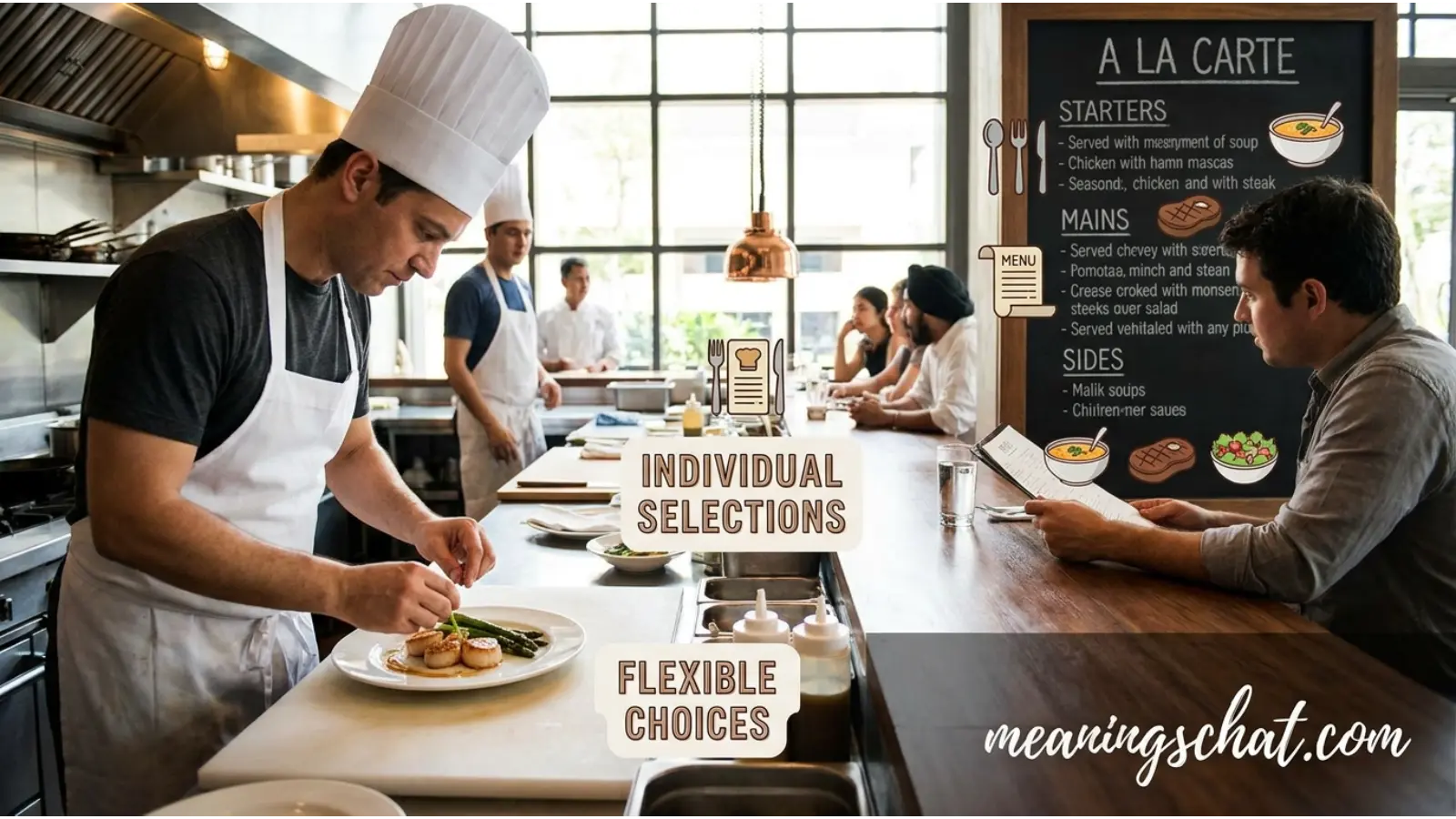
An a la carte menu lets customers order individual dishes separately rather than choosing a fixed meal.
Example:
“The restaurant lets you order the appetizers a la carte.”
Business Services
Companies may offer individual services separately.
Example:
“You can buy consulting services a la carte.”
Technology
Software companies sometimes describe separately purchased features as a la carte options.
Example:
“The premium tools are available a la carte.”
Travel
Hotels, airlines, and travel companies can use the phrase when customers select additional services individually.
Example:
“Breakfast and airport transfers are available a la carte.”
Everyday Conversation
People also use it metaphorically.
Example:
“I want my weekend activities a la carte.”
This means the person wants to choose each activity separately instead of following a complete schedule.
Real Life Examples of A La Carte in Text
Here are several examples showing how the phrase can appear naturally in messages.
Friendly Example
Friend: “Are you getting the dinner combo?”
You: “No, I’m ordering a la carte tonight.”
This simply means you want to choose individual dishes.
Casual Example
Friend: “Did you buy the whole membership?”
You: “Nope, I picked the features a la carte.”
The tone is relaxed and conversational.
Argumentative Example
Person A: “Why didn’t you choose the complete package?”
Person B: “Because I don’t need everything. I’d rather pick what I actually use a la carte.”
Here, the phrase describes a preference for individual choices.
Gaming Example
Player 1: “Did you buy the complete bundle?”
Player 2: “Nah, I got the upgrades a la carte.”
The player purchased individual upgrades instead of the entire bundle.
Social Media Example
“My travel plans are totally a la carte this year. I’m choosing each experience separately.”
Here, the phrase is being used creatively rather than literally.
Origin and Background of A La Carte
“A la carte” comes from French.
The expression became widely used in English, particularly in restaurant settings. Traditionally, an à la carte menu lists individual dishes with separate prices. Customers choose exactly what they want rather than ordering a fixed meal.
The phrase eventually expanded beyond food.
Today, English speakers use “a la carte” to describe almost any situation where people select separate components instead of accepting a complete package.
That is why you might encounter it in business, technology, travel, entertainment, and everyday conversation.
A La Carte vs. Similar Terms
Several English expressions have meanings close to “a la carte,” but they are not always interchangeable.
| Term | Meaning | Common Use |
|---|---|---|
| A la carte | Individual items chosen separately | Food, services, features |
| Individual | One item considered separately | General situations |
| Standalone | Something that works or exists independently | Products, software, services |
| Custom | Designed according to personal preferences | Products, plans, services |
| Bundle | Multiple items sold together | Products and services |
| Package | A predetermined combination | Travel, subscriptions, services |
The key difference is that a la carte emphasizes choosing separate items, while “bundle” and “package” emphasize receiving multiple items together.
When Should You Avoid Using A La Carte?
Although the phrase is neutral, you should avoid using it when your audience may not understand French-derived expressions.
For very simple communication, “separately” or “individually” may be clearer.
For example:
Instead of:
“The services are available a la carte.”
You could say:
“You can choose the services individually.”
The second sentence is more straightforward for readers who may not know the phrase.
You should also avoid using “a la carte” simply to sound sophisticated. Use it when the idea of individual selection actually matters.
Polite Alternatives to A La Carte
Since a la carte is already neutral, you do not need a softer version.
Still, several alternatives may work depending on the situation:
- Separately
- Individually
- One at a time
- Custom selected
- Pick and choose
- Standalone
- By item
- Individually priced
- Customized options
- Choose what you need
For casual texting, “pick and choose” can sound more natural.
Example:
“I just want to pick and choose what I need.”
For professional communication, “individual options” may be clearer.
Why Do People Use A La Carte?
People use the phrase because it communicates a specific idea quickly.
Instead of saying:
“I want to select each item separately instead of purchasing the entire package.”
Someone can simply say:
“I want the a la carte option.”
The phrase is especially useful when discussing:
- Personal choice
- Flexible pricing
- Customization
- Individual products
- Separate services
- Restaurant ordering
- Optional features
It also has a familiar business and restaurant meaning, making it useful in professional conversations.
Impact of Using A La Carte in Communication
Using “a la carte” can make communication concise and precise when your audience understands the expression.
In professional settings, it can clearly communicate that someone wants flexibility instead of a predetermined package.
However, context matters.
If your audience is unfamiliar with the phrase, they might wonder what you mean. In those situations, adding a simple explanation can help.
For example:
“The services are available a la carte, so you can choose them individually.”
This makes the meaning immediately clear.
Is A La Carte Safe for Social Media?
Yes. A la carte is generally completely safe for social media.
It does not contain profanity, offensive language, sexual content, or an insulting meaning.
People may use it in:
- Instagram captions
- Facebook posts
- TikTok captions
- X posts
- Reddit discussions
- Group chats
- Business posts
- Food reviews
For example:
“Tonight’s dinner is a la carte because I couldn’t decide on one meal.”
This is a normal and harmless use.
Different Tones and How A La Carte Works
The phrase itself remains neutral, but the surrounding words can create different tones.
Friendly
“Let’s order a la carte and share everything!”
This sounds warm and social.
Casual
“I’m just getting the burger a la carte.”
This is relaxed and natural.
Professional
“Clients can purchase these services a la carte.”
This sounds formal and businesslike.
Playful
“I’m choosing my vacation activities a la carte. No schedule, just vibes.”
This uses the phrase humorously.
Argumentative
“I don’t want the entire package. I’ll choose what I need a la carte.”
The phrase remains neutral even though the conversation is tense.
Common Mistakes With A La Carte
People sometimes misunderstand or misuse the phrase.
Mistake 1: Calling It an Acronym
“A la carte” does not have a texting full form.
It is a French phrase.
Mistake 2: Assuming It Always Refers to Food
Although restaurants are strongly associated with the phrase, its use has expanded to services, products, technology, and other areas.
Mistake 3: Thinking It Means Free Choice Without Cost
A la carte often means items are available separately, but that does not mean they are free.
In fact, individual items can sometimes cost more than a bundled package.
Mistake 4: Using It Without Context
If someone has never heard the phrase, they may not understand what you mean.
Adding “individually” can remove confusion.
A La Carte Meaning in Different Situations
The exact interpretation depends on context.
At a restaurant: Choose individual dishes instead of a set meal.
For software: Purchase specific features separately.
For travel: Select individual services instead of buying a complete package.
For entertainment: Choose individual options rather than a complete subscription or bundle.
In casual conversation: Pick individual things according to personal preference.
The central idea remains the same: separate selection instead of a fixed combination.
FAQs:
What is the a la carte meaning?
A la carte means selecting individual items separately rather than choosing a fixed package or combination.
Is a la carte slang?
No. A la carte is not technically slang. It is a French expression that has become common in English.
What is the a la carte full form?
It does not have a full form because it is not an abbreviation. It is a French phrase used in English.
Is a la carte rude?
No. A la carte is neutral and generally has no rude or offensive meaning.
Can I use a la carte in texting?
Yes. You can use it in casual texts when discussing individual choices, meals, services, features, or options.
Is a la carte only used for food?
No. While restaurants are its most familiar setting, people also use it for services, technology, travel, subscriptions, and other customizable options.
Conclusion
The a la carte meaning is simple: it refers to choosing individual items separately instead of selecting a fixed package or combination. Although the phrase comes from French and is strongly associated with restaurant menus, modern English uses it in many other contexts.
It is not offensive or traditional texting slang, and there is no special full form for it. You can use “a la carte” when talking about food, services, features, travel options, or anything else that allows separate selection.
When your audience knows the phrase, it offers a short and precise way to express individual choice. If you think someone may not understand it, simply say “separately” or “individually” to make your meaning crystal clear.